General
GraphQL Explained: When to Use It (and When REST Is Still Better)
TL;DR This is the most common misconception. SQL queries your database. GraphQL queries your API layer. A GraphQL resolver for a "user" field might call a Postgres database, a microservice, or a third-party API — GraphQL doesn't care. It orchestrates the shape of data returned to clients; it has nothing to say about how you store or retrieve that data internally.
Read this article as text (accessible version)
GraphQL vs REST — API Design Deep Dive
·
3,800 words · 4 interactive labs · April 2026
GraphQL Explained:
GraphQL Explained:
When to Use It
(and When REST Is Still Better)
Every mobile team that's hit the N+1 problem knows the pain. Every backend engineer who's fought over-fetching knows the frustration. GraphQL promises to fix both — but it comes with caching headaches, tooling costs, and a whole new class of security risks. Here's the honest, complete story.
Read the Deep Dive ↓ Open the API Lab 🔌 ✦ GraphQL: one endpoint, client-driven queries ✦ REST: resource URLs, server-driven shape Table of Contents- What Is GraphQL? The Origin Story
- Schema, Queries, Mutations, Subscriptions
- GraphQL vs REST: A Genuine Comparison
- The N+1 Problem GraphQL Actually Solves
- The Real Drawbacks You're Probably Underestimating
- The Caching Problem in Depth
- Query Complexity & Security Risks
- When to Actually Choose GraphQL
01What Is GraphQL? The Origin Story from Meta's War Rooms
In 2012, the Facebook mobile team was in trouble. The News Feed on iOS was a sprawling mess of over-fetching — the API returned enormous payloads stuffed with fields the mobile app never needed. Bandwidth was expensive, connections were unreliable, and loading times were embarrassing. The RESTful API designed for the web just didn't fit the mobile constraint: you needed some fields from User, some from Posts, some from Comments, all stitched together on the client with multiple sequential requests. Lee Byron, Nick Schrock, and Dan Schafer started building something different. By 2015, that internal project was open-sourced as GraphQL.
GraphQL is a query language for APIs and a runtime for executing those queries. It sits as a layer between your clients (mobile apps, web frontends, third-party consumers) and your backend services. Instead of exposing many URL-based resource endpoints, GraphQL exposes a single endpoint and lets clients describe exactly what data they want in a structured query document. The server validates that query against a schema — a typed description of all available data and operations — and returns precisely the requested shape.
"Query language for APIs" is slightly misleading — it suggests something like SQL for databases. Better mental model: GraphQL is a specification for how clients and servers communicate about data. The client writes a declarative description of the shape it needs. The server resolves that into data from wherever it lives — relational databases, microservices, legacy REST APIs, Redis caches, or any combination thereof. GraphQL is the translation layer, not a database and not a replacement for your persistence layer.
💡 GraphQL Is Not a Database Query LanguageThis is the most common misconception. SQL queries your database. GraphQL queries your API layer. A GraphQL resolver for a "user" field might call a Postgres database, a microservice, or a third-party API — GraphQL doesn't care. It orchestrates the shape of data returned to clients; it has nothing to say about how you store or retrieve that data internally. You absolutely can (and usually should) have GraphQL resolvers that execute SQL queries behind the scenes.
02Schema, Queries, Mutations, and Subscriptions: The Three Operations
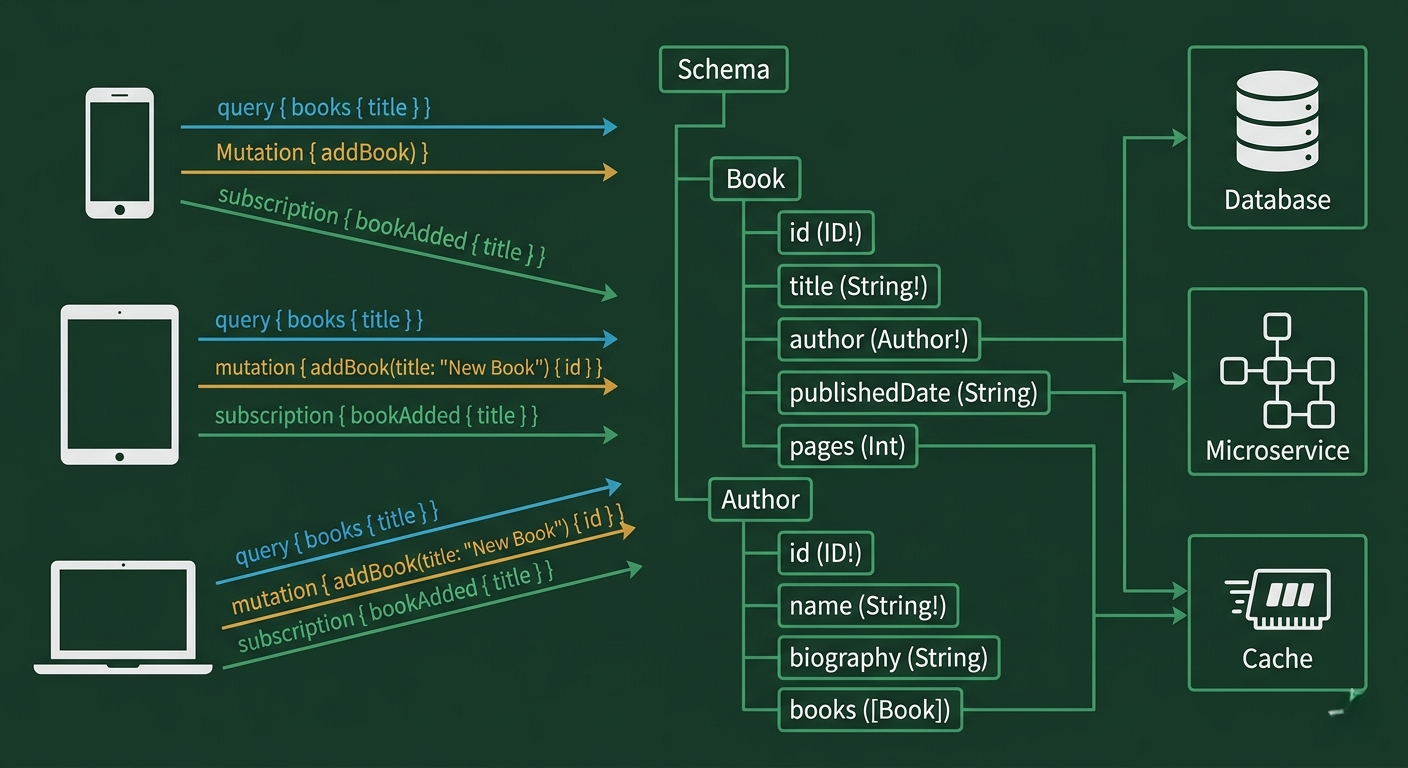
Everything in GraphQL starts with the schema. The schema is a contract written in GraphQL's Schema Definition Language (SDL) that defines all the types in your API, all their fields, and the three root operations: Query (reads), Mutation (writes), and Subscription (real-time). The schema is simultaneously documentation, validation spec, and type contract — and it's introspectable, meaning clients can programmatically discover everything your API offers without reading a separate doc page.
Queries fetch data. A GraphQL query document specifies exactly which fields of which types you want, and the server returns exactly that — no more, no less. Imagine ordering at a restaurant where the menu lists every ingredient and you specify exactly which ingredients you want in your dish. The kitchen (resolver) uses what it needs to make it, but your plate only contains what you asked for. Mutations modify data — they're GraphQL's equivalent of POST/PUT/PATCH/DELETE in REST. Mutations can also return data, which is extremely useful: create a user and get back the populated user object in a single round trip.
Subscriptions are GraphQL's real-time primitive. Instead of polling every 5 seconds or building a custom WebSocket protocol, subscriptions let clients declare "tell me whenever this data changes." The server pushes updates when the relevant data is modified. This is powerful for chat applications, live dashboards, collaborative editors, and any use case where polling is wasteful. Subscriptions require WebSocket or SSE infrastructure and are more complex to implement than simple queries, but the client experience is significantly better than polling.
⚠️ Subscriptions Are Not FreeAdding subscriptions to your GraphQL server means maintaining persistent connections with every subscribed client. At scale, this creates significant infrastructure overhead: you need pub/sub systems (Redis, NATS), careful connection lifecycle management, and load balancers that support WebSocket upgrades. Don't add subscriptions because "they're available." Add them when polling is genuinely creating unacceptable latency or bandwidth costs for a specific use case.
bookstore.graphql — Schema + Operations# Schema Definition Language (SDL) — the contract
type Book {
id: ID!
title: String!
authors: [Author!]!
pages: Int
rating: Float
}
type Author {
id: ID!
name: String!
books: [Book!]!
}
type Query {
book(id: ID!): Book
books(limit: Int): [Book!]!
}
type Mutation {
createBook(title: String!, authorId: ID!): Book!
}
type Subscription {
bookAdded: Book! # pushed when new book is created
}
# A client query — notice client controls the exact shape
query GetBookWithAuthors {
book(id: "123") {
title
rating
authors {
name
books { title } # nested — would be N+1 in REST!
}
}
}
03GraphQL vs REST: An Honest, Non-Hype Comparison
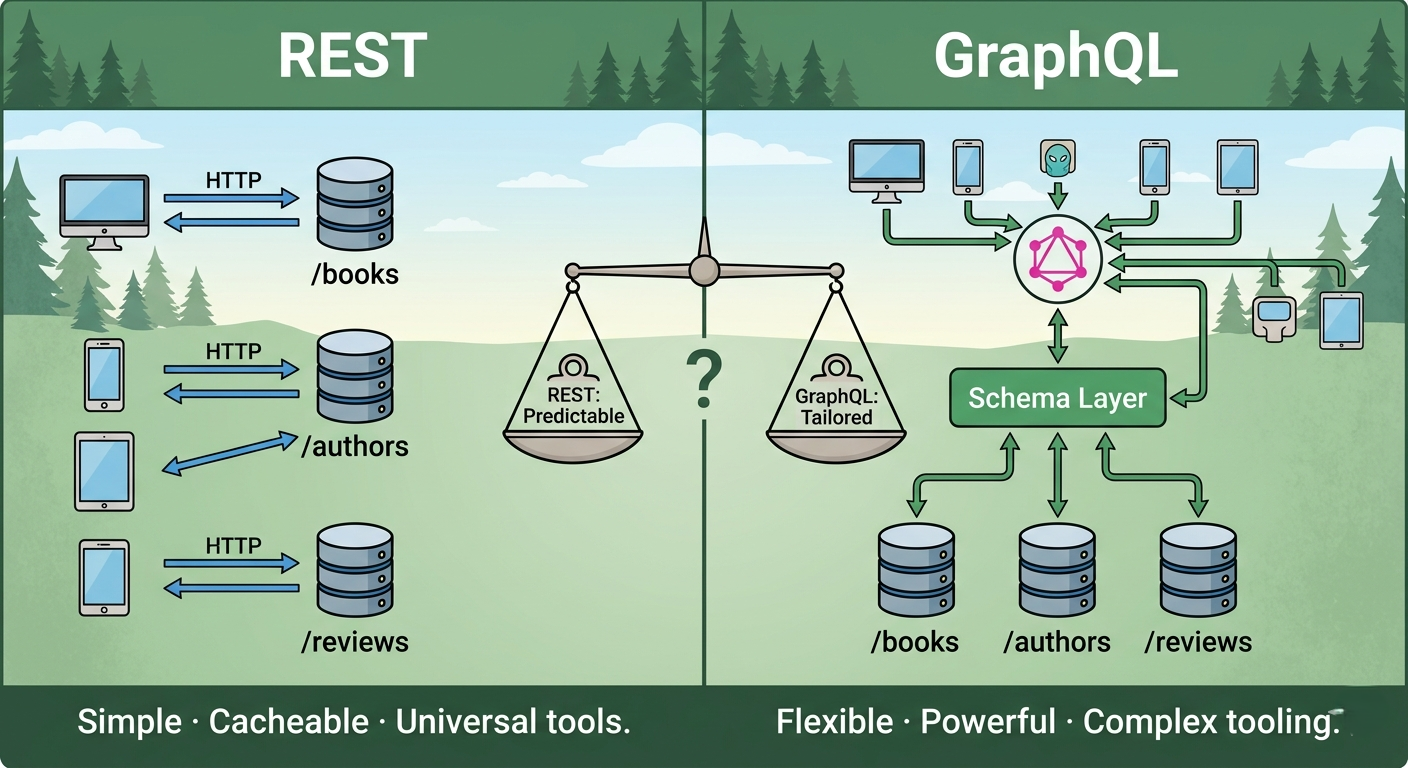
At the infrastructure level, GraphQL and REST are more alike than their advocates admit. Both use HTTP. Both send requests and receive responses. Both can return JSON. A GraphQL request is an HTTP POST to a single endpoint; a REST request is an HTTP GET (or POST/PUT/DELETE) to a resource URL. The difference is in who controls the shape of the response.
In REST, the server decides what data to include. The bookstore API's GET /books/123 endpoint returns whatever the backend engineer decided to include — maybe the full author object, maybe just an author ID, maybe a paginated list of reviews. The client adapts to what the server provides. This makes REST easy to reason about, easy to document, and extremely cacheable (GET /books/123 can be cached by URL). The downside: clients often receive too much data (over-fetching) or need multiple requests to get related data (under-fetching).
In GraphQL, the client decides. The client query specifies exactly which fields of Book and Author it wants. The server resolves exactly that and returns no more. A mobile client that only needs title and rating gets exactly title and rating — not the full author biography, not the review history, not the alternate editions. This is the primary developer experience advantage of GraphQL, and it's genuinely significant for teams building multiple clients (web, mobile, TV) against the same data.
🔮 Myth: GraphQL Is Always Better Than RESTThis is the shibboleth of a certain vintage of frontend developer, and it's simply wrong. REST is better for public APIs consumed by many unknown clients — HTTP caching works perfectly, standard tools (curl, browsers, OpenAPI spec) work out of the box, and the predictable request/response pattern makes it trivially auditable. REST is better for simple CRUD services where the overhead of a schema, resolver infrastructure, and specialized client tooling isn't justified. REST is better when your data is naturally resource-oriented and your clients don't have wildly divergent data needs. Choose the tool for the job.
04The N+1 Problem: The Real Pain That GraphQL Solves
Here's the problem that motivated GraphQL's creation at Meta. You want to display a list of 20 books, each with their authors. In REST, you might call GET /books to get 20 books (1 request), then for each book call GET /books/123/authors (20 more requests) — 21 requests total for what feels like one page of data. This is the N+1 problem: one request to get the list, plus N requests to get the related data. With 20 books it's annoying. With 200 books across a slow mobile network, it's a product-killing performance disaster.
REST developers work around this in several ways: embed related resources in the response (but then you're always over-fetching for clients that don't need authors), add custom batch endpoints (GET /books/batch?ids=1,2,3), or move the joins to the client. All of these approaches are workarounds that add complexity. GraphQL solves this cleanly at the schema level: because the query declares the nested author relationship, the server knows upfront exactly what data is needed and can execute a single batched database query (using patterns like DataLoader) to fetch all authors for all books in one round trip.
Picture this: you're a waiter taking orders from 20 tables simultaneously. In REST, you'd run to the kitchen once per table. In GraphQL, you'd collect all 20 orders first, then bring everything from the kitchen in one trip. DataLoader is the GraphQL pattern that implements this: it collects all individual "fetch author by ID" calls within one execution tick, deduplicates them, fires a single batched query, and distributes results back to all the waiting resolvers. This turns an O(N) request problem into an O(1) problem.
✅ The DataLoader PatternDataLoader is a batching and caching library, originally from Meta, that solves the N+1 problem in GraphQL resolvers. Instead of each resolver independently fetching its data, DataLoader batches all requests made within a single event loop tick into a single batched call. If 20 book resolvers each ask for their author's data, DataLoader fires one SELECT * FROM authors WHERE id IN (1,2,...,20) instead of 20 individual queries. Without DataLoader (or an equivalent), GraphQL can actually make your database performance worse than REST.
const DataLoader = require('dataloader')

Without DataLoader: N+1 problem
For each book, this fires a separate SQL query
const badResolvers = {
 Book: {
 authors: (book) => db.query('SELECT * FROM authors WHERE book_id = ?', book.id)
 20 books = 20 separate DB queries 😱
 }
}

With DataLoader: single batched query
const authorLoader = new DataLoader(async (bookIds) => {
 Called ONCE with ALL book IDs collected in this tick
 const authors = await db.query(
 'SELECT * FROM authors WHERE book_id IN (?)', [bookIds]
 )
 Return in same order as input IDs (DataLoader requirement)
 return bookIds.map(id => authors.filter(a => a.book_id === id))
})

const goodResolvers = {
 Book: {
 authors: (book) => authorLoader.load(book.id)
 20 books = 1 DB query, results distributed back 🎉
 }
}
05The Real Drawbacks You're Probably Underestimating
The GraphQL hype cycle made it sound like a free upgrade from REST with no downsides. That's not accurate. There are genuine, significant costs that teams often discover only after shipping to production. The first is the tooling investment. In REST, you can consume an API with curl, a browser, any HTTP library in any language. In GraphQL, every client needs a GraphQL client library (Apollo Client, urql, Relay) that understands queries, fragments, caching, and subscription protocol. Every server needs a GraphQL execution engine (Apollo Server, graphql-yoga, Hot Chocolate) with resolver infrastructure. This is a non-trivial upfront investment for the entire team.
Here's the thing most tutorials miss: the tooling cost isn't just about initial setup. It's about ongoing maintenance, debugging, and operational complexity. When your GraphQL server is slow, diagnosing whether the bottleneck is the resolver for a specific field, a DataLoader batch, or an underlying database query requires significantly more sophisticated monitoring than "which endpoint is slow." You need GraphQL-aware observability — tools like Apollo Studio, GraphQL Inspector, or custom instrumentation — that most teams don't have when they start.
A second underestimated cost is the learning curve for the entire organization. Frontend developers need to understand the schema, how to write queries and mutations, how fragments work, and how to manage the GraphQL client's normalized cache. Backend developers need to understand resolver patterns, DataLoader, authorization at the field level, and schema evolution. Product managers and designers need to understand what's possible to ask for vs what requires schema changes. REST's uniformity — you have endpoints, you hit them — is a feature, not a limitation, for teams where cognitive overhead is a real constraint.
🚨 Don't Use GraphQL For Simple CRUD APIsIf you're building an internal admin tool with straightforward CRUD operations, a microservice consumed by exactly one other service, or a public API used by external developers unfamiliar with GraphQL — stop. The tooling cost is not justified. REST with OpenAPI documentation is vastly simpler to implement, consume, and maintain for these cases. GraphQL's benefits only materialize when you have multiple heterogeneous clients with genuinely different data needs, or significant N+1 issues that REST workarounds can't cleanly solve.
06The Caching Problem: Why GraphQL Fights HTTP
HTTP caching is one of the internet's great engineering gifts. A GET request to /books/123 can be cached by your browser, by a CDN, by a reverse proxy, by any intermediate server. The cache key is the URL. The semantics are standardized: GET is safe and idempotent, Cache-Control headers control TTL, ETags handle validation. A well-configured REST API can serve most of its traffic entirely from cache without ever touching your origin servers.
GraphQL's default configuration — a single endpoint at /graphql using HTTP POST — is fundamentally incompatible with HTTP caching. POST is not cacheable by default. Every query, no matter how identical to previous ones, goes to the origin. For a high-traffic public API, this means your GraphQL server and all its downstream services receive the full load of every request, all the time. This is a significant operational and cost difference from a well-optimized REST API that might serve 95% of traffic from CDN cache.
There are workarounds: persisted queries (pre-register known queries and reference them by hash, allowing GET requests and CDN caching), HTTP GET for queries (send query as a query string parameter), and client-side normalized caching (Apollo Client's cache reduces repeat network requests). These solutions work, but they add operational complexity. Persisted queries require coordination between client and server deploys. HTTP GET for queries works but breaks for very long queries. Client-side caching helps latency but doesn't reduce origin server load. The bottom line: matching REST's caching story with GraphQL requires deliberate, non-trivial engineering work.
📦 Apollo Client's Normalized CacheApollo Client maintains a normalized in-memory cache where every fetched object is stored by its unique identifier (type + ID). When you query book(id: "123") and then later query books { id title }, if book "123" is in that list, Apollo uses the cached version and doesn't re-fetch. This is powerful for reducing redundant network requests on the client, but it requires careful cache configuration and can cause subtle stale-data bugs if cache invalidation isn't handled correctly — a famously hard problem in distributed systems.
07Query Complexity & Security: The Danger of Letting Clients Drive
GraphQL's core promise — clients request exactly what they need — is also its core security challenge. A client can write a query that traverses deeply nested relationships, requesting enormous amounts of data in a single request. Consider a social network's GraphQL schema: a User has Friends (Users), each Friend has their Friends, and so on. A malicious (or just careless) client can write a query that's 10 levels deep and requests data for exponentially many users. This kind of query can bring down a database in seconds.
The Meta incident is instructive: when they shipped a new mobile feature that unexpectedly caused a full table scan of a critical database, the damage was done the moment the app went live, because the query was perfectly valid GraphQL. In REST, you'd never expose "give me an unbounded list of all users joined to all their posts joined to all comments" as a single endpoint. In GraphQL, the schema theoretically allows exactly that unless you've explicitly defended against it.
Defense mechanisms exist: query depth limiting rejects queries beyond a specified nesting level; query complexity analysis assigns a cost to each field and rejects queries that exceed a total complexity budget; operation allow-listing (persisted queries) only permits pre-approved queries. Each adds implementation complexity. In REST, these attack surfaces simply don't exist in the same way — you control exactly what each endpoint returns. In GraphQL, you're continuously playing defense against the full power of your own schema.
🚨 Always Implement Query Complexity LimitsIf you ship a public GraphQL API without query complexity limits, you've shipped a denial-of-service vulnerability. Any client — or attacker — can craft a deeply nested query that joins your entire data graph and exhausts your database connection pool. This is not theoretical. At minimum, implement a depth limit (max 10–15 levels for most APIs) and a complexity budget. Libraries like graphql-depth-limit and graphql-query-complexity handle this with a few lines of configuration. Treat this as a mandatory security control, not an optional optimization.
security.js — Depth + Complexity Limitingconst { ApolloServer } = require('@apollo/server')
const depthLimit = require('graphql-depth-limit')
const { createComplexityRule } = require('graphql-query-complexity')
const server = new ApolloServer({
typeDefs, resolvers,
validationRules: [
depthLimit(10), max query depth of 10 levels
createComplexityRule({
maximumComplexity: 1000,
estimators: [
fieldExtensionsEstimator(), per-field cost in schema
simpleEstimator({ defaultComplexity: 1 })
],
onComplete: (complexity) => {
console.log(`Query complexity: ${complexity}`)
}
})
]
})
Dangerous query this now blocks (depth 11 + huge complexity):
query { users { friends { friends { friends { ... } } } } }
08When to Actually Choose GraphQL: A Decision Framework
GraphQL is the right choice when you have multiple clients with genuinely different data needs. If you're building a product with a web dashboard, a mobile app, and maybe a public API, and each needs different subsets of the same underlying data, GraphQL pays off: one API contract, client-driven queries, no more "we need a new endpoint for the mobile experience." The more heterogeneous your clients, the more GraphQL's flexibility compounds into real productivity gains.
GraphQL is right when you're suffering documented N+1 or over-fetching problems that REST workarounds can't cleanly solve. If your mobile app is making 8 sequential API calls to build one screen, or if your REST responses are 10KB when the mobile view only needs 1KB, GraphQL's selective fetching is genuinely worth the infrastructure investment. If neither problem exists, you don't need GraphQL.
GraphQL is not right for simple internal services, public APIs consumed by developers using standard tools, systems where HTTP caching is architecturally critical, or teams without the bandwidth to invest in the operational complexity. The pattern I've seen most often: teams adopt GraphQL prematurely because it's interesting, spend months fighting caching and tooling complexity, and either abandon it or work around its limitations in ways that largely eliminate its benefits. Adopt GraphQL to solve specific, documented problems — not because it sounds modern.
🌊 The Decision ChecklistBefore adopting GraphQL, ask: Do you have multiple clients (≥2) with meaningfully different data requirements? Are you experiencing N+1 queries or over-fetching that's causing measurable user impact? Do you have the team bandwidth to invest in schema design, resolver infrastructure, DataLoader, and observability? Is HTTP caching not a critical architectural requirement? Are your security practices mature enough to implement query complexity limits? If the answers are yes, GraphQL is probably worth the investment. If even one is no, seriously consider whether REST with thoughtful endpoint design solves your actual problems more simply.
synthesisHow It All Connects
GraphQL's design philosophy is client-first: every architectural decision — the schema, the type system, the query language, the single endpoint — stems from the conviction that clients should get exactly the data they need with minimum round trips. This philosophy directly solves the N+1 problem and eliminates over-fetching. It makes multi-client APIs manageable. The schema becomes a living contract that makes API evolution safer.
But the same client-empowerment that makes GraphQL powerful creates the caching problem (clients can send any query, not cacheable by URL), the security challenge (clients can craft expensive queries), and the tooling cost (both sides need GraphQL-aware infrastructure). None of these are bugs — they're direct consequences of the design. Understanding the trade-offs means understanding that the benefits and costs are two sides of the same coin.
FAQFrequently Asked Questions
Is GraphQL better than REST? + Neither is categorically better — they solve different problems. GraphQL excels when you have multiple heterogeneous clients, complex nested data relationships, or documented N+1/over-fetching problems. REST excels for public APIs, simple CRUD services, cases requiring robust HTTP caching, and teams without the bandwidth for GraphQL's tooling overhead. The most common mistake is choosing GraphQL because it seems modern rather than because it solves a specific, documented pain point. What is the N+1 problem in GraphQL? + The N+1 problem occurs when fetching a list of N items requires N additional database queries to fetch related data for each item. For example, fetching 20 books and then needing 20 separate queries to fetch each book's authors = 21 total queries. In REST, you work around this with custom batch endpoints or over-fetching. In GraphQL, you solve it with DataLoader: a batching library that collects all individual "fetch by ID" requests within one event loop tick and fires a single batch query, turning the O(N) query problem into O(1). Without DataLoader, GraphQL can actually make N+1 problems worse, not better. Why is caching harder with GraphQL than REST? + REST uses HTTP GET for fetching data, and GET requests have well-defined, standardized caching semantics that browsers, CDNs, and proxies understand natively. The cache key is the URL, making it trivially cacheable. GraphQL typically uses HTTP POST to a single endpoint, and POST is not cacheable by default. Every query — even identical ones — hits the origin server. Workarounds include persisted queries (register queries by hash and use GET), and Apollo Client's client-side normalized cache. But achieving REST's caching efficiency with GraphQL requires deliberate, non-trivial engineering work that must be planned from the start. What are GraphQL mutations and how do they differ from REST POST/PUT/DELETE? + GraphQL mutations are the equivalent of REST's state-modifying operations (POST, PUT, PATCH, DELETE). Both modify server data. The key differences: (1) In REST, the HTTP method (POST/PUT/DELETE) communicates the operation type; in GraphQL, all mutations use POST and the operation type is expressed in the query body. (2) GraphQL mutations can return data in the same request — you create a user and immediately receive the populated user object with its generated ID and server-computed fields, eliminating a common REST round-trip pattern of create → get. (3) GraphQL mutations are explicitly named in the schema and listed in the Mutation type, making them self-documenting via introspection. What is GraphQL schema introspection and why does it matter? + GraphQL schema introspection is a built-in feature that lets any client query the API's schema itself — discovering all available types, fields, queries, and mutations programmatically. This powers GraphQL's developer tooling ecosystem: IDEs provide auto-completion and type-checking, tools like GraphiQL and Apollo Studio render interactive documentation automatically, and clients can validate queries against the schema before sending them. The entire documentation story is built into the protocol. This is a genuine advantage over REST, where documentation is always a separate artifact (OpenAPI spec, Swagger, README) that can drift out of sync with the actual API behavior. In GraphQL, if it's not in the schema, it doesn't exist. What is Apollo Client and do I need it for GraphQL? + Apollo Client is a popular full-featured GraphQL client for JavaScript/React that provides normalized caching, query management, mutation state handling, and subscription support. You don't strictly need it — you can make GraphQL requests with any HTTP client (fetch, axios) by sending a POST request with a JSON body containing your query string. But without a GraphQL client, you're managing cache invalidation, loading/error states, and subscription connections manually. For production applications, using Apollo Client (or an alternative like urql or Relay) is practically necessary to get the full benefit of GraphQL's client-side efficiency. The tooling overhead is real, but so is the productivity benefit once set up. How does GraphQL handle versioning? + GraphQL avoids the traditional REST versioning problem (v1, v2, v3 endpoints) by using schema evolution. You add new fields to existing types and mark old fields as deprecated (with a reason), rather than creating entirely new versions. Because clients query only the fields they declare, adding new fields is backward-compatible — existing clients don't see new fields unless they ask for them. Removing fields requires a deprecation period: mark deprecated, communicate to clients, monitor usage, then remove. This "deprecate, don't version" approach keeps the API surface stable over time. The main limitation: breaking changes (changing a field type, removing required arguments) still require careful coordination, and the GraphQL spec doesn't provide built-in versioning primitives for these scenarios. Can GraphQL and REST coexist in the same architecture? + Absolutely, and this is often the most pragmatic approach. A common pattern: GraphQL as the BFF (Backend for Frontend) layer for client-facing applications, backed by REST microservices or databases internally. The GraphQL server's resolvers call internal REST endpoints to fetch data, combining and reshaping responses according to client needs. This gives the frontend GraphQL's developer experience benefits while preserving REST's simplicity for internal service-to-service communication. Another approach: use GraphQL for complex, relationship-heavy data (user feeds, social graphs) and REST for simple CRUD operations (file uploads, webhooks, public API endpoints). The two aren't mutually exclusive.🔌 API Lab
Four interactive experiments comparing GraphQL and REST side by side.
🌐 REST Requests What data do you need? Requests Made Response (full payload) 0 HTTP Requests 0 Response Bytes ✦ GraphQL Query Query (auto-generated) Same checkboxes apply →GraphQL uses the same selections above to build one single query to /graphql.
Response (exact shape) 1 HTTP Requests 0 Response BytesTimeline of HTTP requests: REST (orange, sequential) vs GraphQL+DataLoader (green, batched)
N+1 Problem Simulator Items in list 20 DB query time (ms) 50ms Network latency (ms) 30ms — REST total time — GraphQL total time — REST DB queries — GQL DB queriesWatch: As N increases, REST time grows linearly (1 + N DB calls). GraphQL with DataLoader stays flat (1 + 1 batched call) regardless of N.
Server load comparison: REST with HTTP caching vs GraphQL (POST) under repeated identical requests
HTTP Caching Simulator Number of clients 100 Cache hit rate (REST) 85% GQL caching strategy — REST origin requests — GQL origin requests — REST cache hits — DifferenceQuery complexity vs depth — green = safe, yellow = warning, red = blocked
Query Complexity Analyzer Query depth 3 List multiplier 10 Max depth limit 8 Max complexity 1000 — Query depth — Complexity score — Est. DB rows — VerdictKeep reading
Related articles
 General
How Microchips Are Made: The Complete CPU Fabrication Process Step by Step | Zetsapp
Here's the thing most chip articles miss: the "nm" number in modern process node names (TSMC 3nm, Intel 4nm, Samsung 3nm) does not correspond to any physical dimension on the chip. This was true when Intel's 45nm node launched in 2007 and became increasingly disconnected from reality thereafter. TSMC's "3nm" node has a gate pitch (the distance between gates) of approximately 48nm — not 3nm.
 General
How Hard Disk Drives Work: Inside the Spinning Metal That Still Stores Most of the Internet | Zetsapp
Here's the thing most explainers skip: that internal air isn't just "kept clean," it's engineered. Traditional HDDs are filled with filtered, dry air at roughly atmospheric pressure because the read/write head relies on aerodynamic lift from that specific air density to fly at the correct height — too thin an atmosphere and the head flies too low or crashes; too thick and it flies too high to read reliably.
 General
How GPUs Actually Work: The Nvidia GA102 Architecture Decoded Inside the RTX 3090
GPU acceleration is limited by the fraction of your workload that's actually parallel. Amdahl's Law states: if 90% of a program can be parallelized, the maximum speedup from infinite parallel processors is 10× — not infinite. The 10% sequential bottleneck always limits total speedup. In GPU-accelerated ML training, the actual workload split is typically: 85-95% embarrassingly parallel tensor operations