General
How Hard Disk Drives Work: Inside the Spinning Metal That Still Stores Most of the Internet
TL;DR Here's the thing most explainers skip: that internal air isn't just "kept clean," it's engineered. Traditional HDDs are filled with filtered, dry air at roughly atmospheric pressure because the read/write head relies on aerodynamic lift from that specific air density to fly at the correct height — too thin an atmosphere and the head flies too low or crashes; too thick and it flies too high to read reliably.
Read this article as text (accessible version)
// Storage Engineering · HDD Mechanics · 2026
·
3,900 words · 4 interactive labs · Updated July 2026
How Hard Disk Drives Work:
How Hard Disk Drives Work:
Inside the Spinning
Metal That Still Stores
Most of the Internet
Every photo you took this year could sit inside the area of a single ballpoint-pen dot — and that's roughly how densely a hard drive packs your data. Crack one open and you'll find a spinning platter, a read/write head flying 15 nanometers above it, and a mechanism precise enough to place a bit of data with nanometer accuracy while spinning at 7,200 revolutions per minute. This is the complete, engineer-level breakdown of how it actually works — and why, in 2026, HDDs are racing toward 100 terabytes instead of dying out.
Read the Deep Dive ↓ Open Platter Lab 🔬 Platter → Tracks → Sectors → Bits Magnetic Domains · GMR Read Heads CMR vs SMR vs HAMR · Areal Density // Table of Contents- Inside a Hard Drive: The Physical Components
- How Writing to an HDD Actually Works
- How Reading Data Works: GMR and Bit Transitions
- Fitting More Bits: CMR, SMR, and HAMR
- How It All Connects: One Write, One Read
- Getting Started: Inspect Your Own Drive
- Frequently Asked Questions
Picture this: somewhere inside the laptop or server sitting near you, a metal disk is spinning fast enough that its edge is moving at highway speed, while a mechanical arm hovers less than 100 atoms above its surface, reading and writing data in chunks smaller than a virus. It sounds like something that should require a clean room and a physics PhD to operate reliably — and in a sense, it does. Yet this same mechanism, refined over six decades, now ships inside a $40 drive that outperforms, in raw capacity per dollar, anything else humans have ever built for storing information.
Most people who use hard drives daily have a rough mental model — "the spinny disk that remembers things." That's not wrong, but it skips the actual engineering, and the engineering is where the good stuff is. In this guide we'll open one up, walk through every component, follow a single bit of data from the moment it's written to the moment it's read back, and then look at where the technology is headed in 2026 — because contrary to popular belief, HDDs aren't fading away. They're scaling faster than they have in a decade.
// 01Inside a Hard Drive: The Physical Components
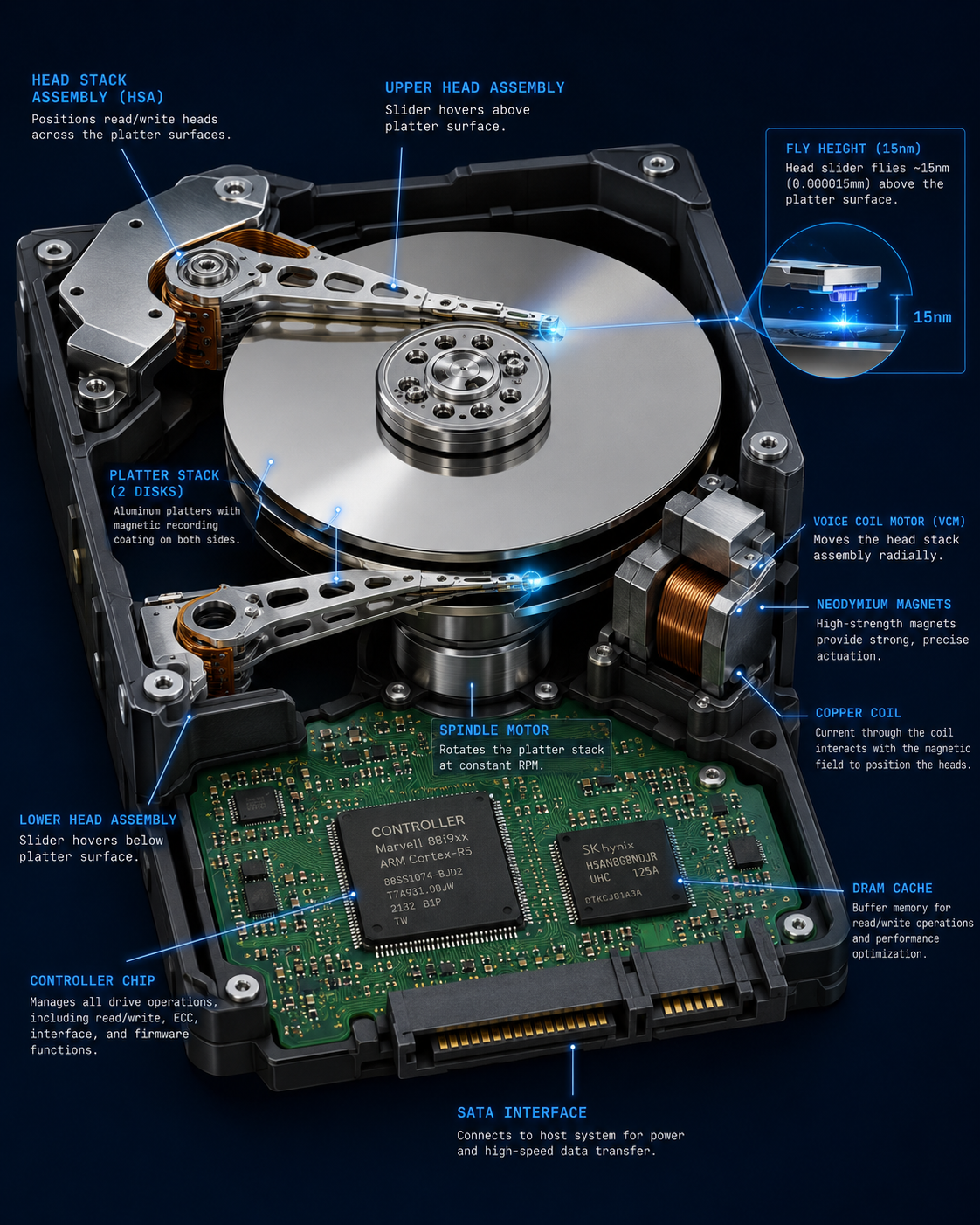
Pop the lid off any hard drive and the first thing you'll see is the platter — the disk that actually stores your data. Depending on the drive's capacity, there might be just one platter or a stack of a dozen. The platter itself is built from an aluminum-magnesium alloy chassis coated in several protective layers, but the layer that matters is a mere 120 nanometers thick: a cobalt-chromium-tantalum alloy whose structure is broken into billions of microscopic magnetic domains, each of which can be polarized in one direction or another by an external magnetic field. That thin film is the entire storage medium — everything else in the drive exists to spin it, position a sensor over it, and shuttle signals in and out.
The platter sits on a spindle, spun by a brushless DC motor at speeds typically around 7,200 RPM (some enterprise drives run at 10,000 or 15,000 RPM for faster access). Above and below each platter surface is an arm from the head stack assembly, and at the tip of every arm is a slider carrying the read/write head. The slider's underside is shaped — almost like a tiny airfoil — to catch the air dragged along by the spinning platter and use that airflow to "fly" the head just 15 nanometers above the surface. For scale, that's about 100 atoms of clearance, thinner than a sheet of aluminum foil by a factor of thousands. Because that lift only exists once the platter is at full speed, the arm assembly parks itself off the disk on a plastic ramp whenever the drive spins down.
Moving that arm precisely is the job of the voice coil motor — a coil of wire sandwiched between two powerful neodymium magnets. Push current one direction through the coil and the resulting electromagnetic force swings the arm one way; reverse the current and it swings back. This is the same basic principle as a stereo speaker, just engineered for nanometer positioning instead of sound. It's precise enough to park the head within about 30 nanometers of a target track and fast enough to seek across the entire platter up to 20 times a second. A flexible ribbon cable routes the head's signals off the moving arm to a connector, which feeds the drive's printed circuit board — home to the main controller, a DRAM buffer chip, a motor-control chip, and the SATA and power connectors that link the drive to everything else. Two more unglamorous but critical parts round things out: a sealed gasket and a pair of filters that catch stray dust, because a single 10,000-nanometer dust particle colliding with a head flying 15 nanometers above a 7,200-RPM platter is how drives die.
💡 Why HDDs Are Sealed, Not Just "Closed"Here's the thing most explainers skip: that internal air isn't just "kept clean," it's engineered. Traditional HDDs are filled with filtered, dry air at roughly atmospheric pressure because the read/write head relies on aerodynamic lift from that specific air density to fly at the correct height — too thin an atmosphere and the head flies too low or crashes; too thick and it flies too high to read reliably. That's also why some modern high-capacity enterprise drives are helium-filled instead: helium is roughly one-seventh the density of air, which cuts aerodynamic drag and turbulence enough that manufacturers can pack in more, thinner platters (up to 10-12 in a single 3.5" enclosure) without the extra platters fighting each other for airflow.
hdd_geometry.py — estimate platter geometry and head clearanceimport math
# Rough physical constants for a modern 3.5" consumer HDD
platter_diameter_mm = 95 # usable magnetic surface diameter
spindle_rpm = 7200
fly_height_nm = 15 # read/write head clearance above platter
magnetic_layer_nm = 120 # CoCrTa alloy thickness
domain_dims_nm = (90, 100, 125) # single magnetic domain, W x L x H (nm)
# Outer-edge linear velocity of the platter
radius_m = (platter_diameter_mm / 1000) / 2
rps = spindle_rpm / 60
edge_speed_kmh = (2 * math.pi * radius_m * rps) * 3.6
print(ff"Platter edge speed: {edge_speed_kmh:.1f} km/h")
print(ff"Head clearance: {fly_height_nm}nm (~100 atoms)")
print(ff"Magnetic domain volume: {domain_dims_nm[0]*domain_dims_nm[1]*domain_dims_nm[2]:,} nm³")
# Output:
# Platter edge speed: 129.0 km/h
# Head clearance: 15nm (~100 atoms)
# Magnetic domain volume: 1,125,000 nm³
// 02How Writing to an HDD Actually Works
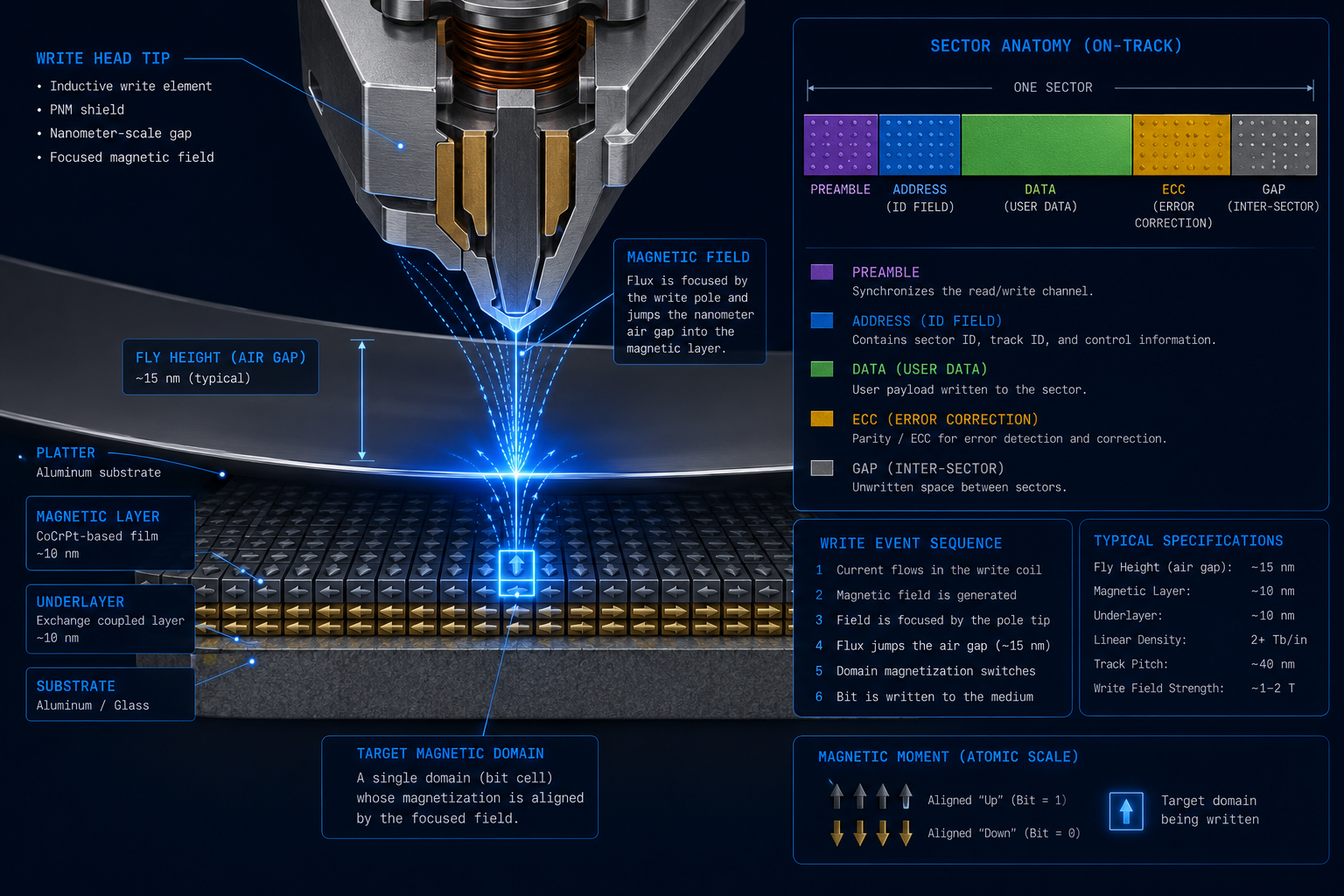
Before any data goes anywhere, the platter needs a map. Its surface is divided into concentric rings called tracks — modern drives pack more than 500,000 of them onto a single surface — and each track is subdivided into sectors. Every sector follows a fixed anatomy: a preamble (or synchronization zone) that tells the head exactly how fast the disk is spinning and how long each bit should be, an address field that tells the head which track and sector it's currently over, the actual data payload (typically 4KB), an error-correcting code (ECC) region used to verify the data was written and can be read back correctly, and finally a small gap that gives the head some tolerance when the next write begins.
Writing itself comes down to manipulating the magnetic orientation of a single domain in that cobalt-chromium-tantalum layer — forcing a region roughly 90 by 100 by 125 nanometers to point "up" or "down." A current sent through a coil of wire at the back of the write head generates a strong magnetic field, which is funneled through the head's core and focused down to a sharp point at the tip. That focused field jumps the 15-nanometer air gap and, when it reaches the platter, forces every atom inside that one domain to align its own tiny magnetic moment with the applied field — turning the domain into a miniature permanent magnet. Pull the head away and the domain holds that orientation for years, radiating a faint but permanent magnetic field that a read head can sense every time you access that sector, right up until the drive writes a new bit there and either flips the direction or reinforces it.
What's counterintuitive here is that "writing a bit" isn't really about pointing individual domains up for 1 and down for 0 — that's the simplified mental model, and it's wrong in a way that matters for understanding how reading works (more on that in the next section). What's actually happening at the write stage is more mechanical: the write head is committing a physical, persistent magnetic pattern to a spinning disk, sector by sector, track by track, with the timing of every pulse locked to the preamble's synchronization signal so the resulting domains land at consistent, addressable positions.
⚠️ Pro Tips / Common MistakesMistake: Assuming "formatting" a drive erases the magnetic domains. A quick format only rewrites the file table — the old domains (and old data) physically remain until something writes over them, which is why "quick-formatted" drives are recoverable and why secure erasure tools perform multiple full-surface overwrite passes instead.
Pro tip: The preamble/sync-zone tolerance is exactly why HDDs are so sensitive to vibration and shock while writing — if the platter's rotational timing drifts mid-write, the write head can misplace a domain relative to its track, corrupting the sector's ECC check on the next read.
// 03How Reading Data Works: GMR and Bit Transitions
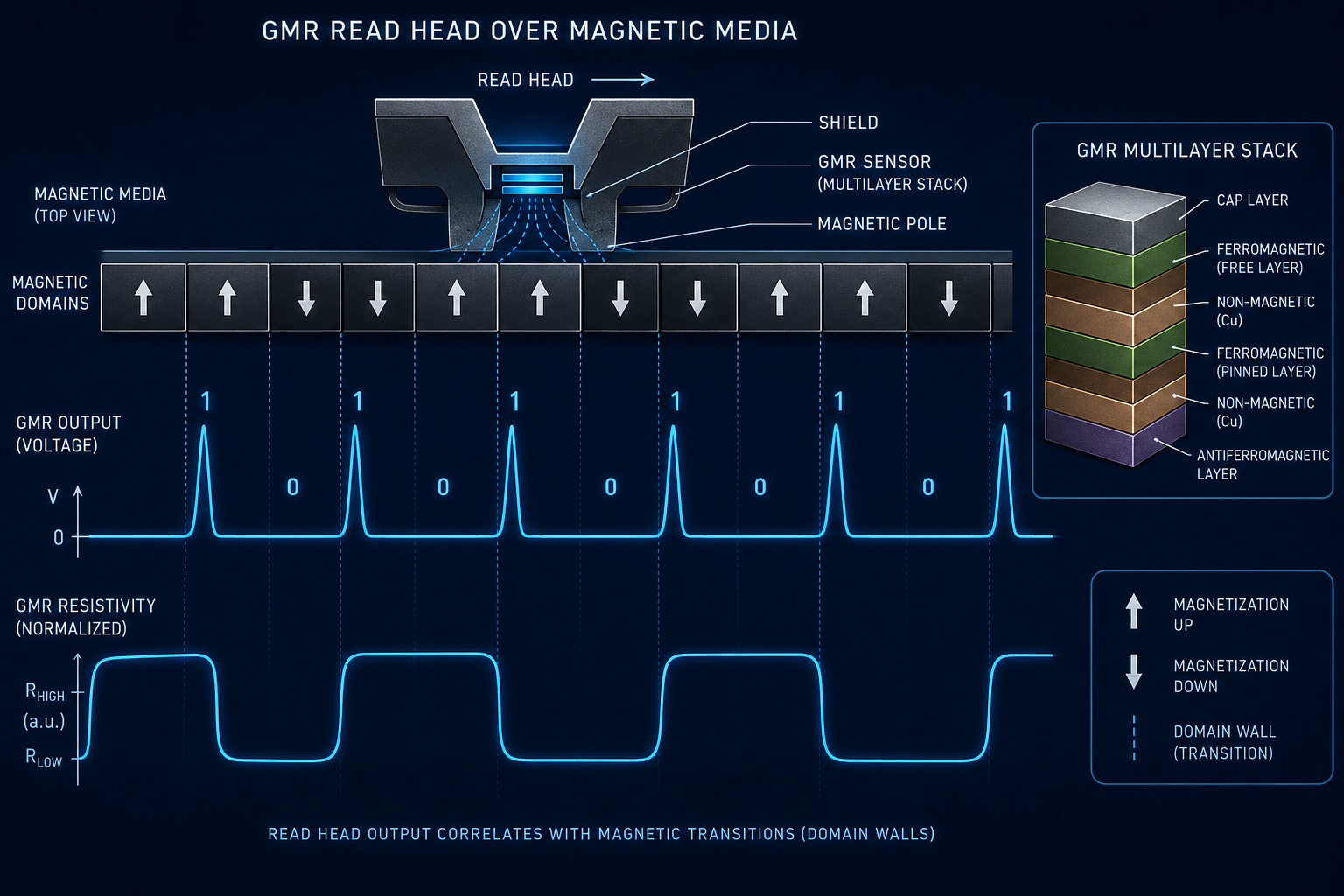
Here's the thing most tutorials get wrong when they simplify hard drives: they'll tell you a domain pointing one way is a "1" and pointing the other way is a "0." It's a clean mental model, but it's not how the read head actually decodes data. In reality, the read head is built to detect changes in orientation — the transition from one domain to an adjacent domain pointing the opposite direction — because the magnetic field emitted at a transition boundary is far stronger and easier to detect than the field from a single domain sitting in one orientation. So the encoding scheme is transition-based: a flip from one domain's orientation to the next is read as a 1, and no flip between adjacent domains is read as a 0. A run of magnetic transitions might read out as 0011 0010, where every 1 marks a place the orientation flipped and every 0 marks a place it didn't.
The sensor that makes this possible is built from a multilayer stack of alternating ferromagnetic and non-magnetic materials, exploiting a quantum-mechanical property called giant magnetoresistance (GMR) — discovered in 1988 and Nobel-Prize-worthy enough to earn its discoverers the 2007 Nobel Prize in Physics. A GMR sensor's electrical resistance changes measurably depending on the strength of the magnetic field passing through it. So reading a bit becomes a matter of measuring resistivity in real time as the platter spins beneath the head: low resistance means a strong field from a nearby transition (a 1), high resistance with no change means no transition (a 0).
That transition-based scheme creates an obvious problem: how do you tell the difference between "five zeros in a row" and "six zeros in a row" when nothing is changing to count against? This is exactly what the sector's preamble and ECC fields solve — the preamble establishes a precise timing reference (a known pattern of alternating domains) so the drive's circuitry knows exactly how long each bit-cell lasts, and the ECC field at the end of the sector catches and corrects any bits that were miscounted or corrupted along the way. It's a beautifully pragmatic solution: rather than engineering away ambiguity at the physics layer, HDD designers solved it with clever data encoding and error correction, which turned out to be far more tractable than trying to eliminate the ambiguity in the magnetic medium itself.
decode_transitions.py — decode a magnetic transition stream into bits# domains: sequence of 'U' (up) / 'D' (down) magnetic orientations
# read off the platter in order along one track
domains = ['U','U','D','D','U','D','D','U']
bits = []
for i in range(1, len(domains)):
transitioned = domains[i] != domains[i-1]
bits.append('1' if transitioned else '0')
print("Domain sequence: ", ' '.join(domains))
print("Decoded bits: ", ' '.join(bits))
# Output:
# Domain sequence: U U D D U D D U
# Decoded bits: 0 1 0 1 1 0 1
✅ Pro Tips / Common Mistakes
Mistake: Thinking a "bad sector" means the platter is physically damaged. Most reallocated sectors are cases where the ECC repeatedly fails to reconstruct clean data — often from a weakening domain or a head slightly out of alignment — not a scratch. The drive's firmware quietly remaps the logical sector to a spare physical one.
Pro tip: GMR read sensitivity is why HDDs are more sensitive to strong external magnets than most people expect — a sufficiently powerful external field near the enclosure can bias the sensor's readings even without touching the platter directly.
🖼️
// 04Fitting More Bits: CMR, SMR, and HAMR
Areal density — the number of bits that can be packed into a given area of platter — has grown by more than 50 million times over the last six decades, and the cost to store a trillion bits has fallen by more than 100 million times in the same span. Time-travel a modern hard drive back to the 1960s and it would have been worth billions of dollars; today the same capacity costs less than a fast-food meal. Getting there required several distinct engineering leaps, not just steady miniaturization.
The first big leap, around 2010, was switching domains from longitudinal orientation (lying flat, in-plane with the disk) to perpendicular orientation (standing up vertically). As domains shrink in volume, they become increasingly vulnerable to thermal instability — random heat energy can flip a bit on its own, a phenomenon called the superparamagnetic limit. Standing the domains up let engineers use the depth of the magnetic layer instead of just its surface area, buying more thermal stability at a given footprint and pushing perpendicular magnetic recording (PMR) to roughly 3TB per platter before it, too, hit its own limit.
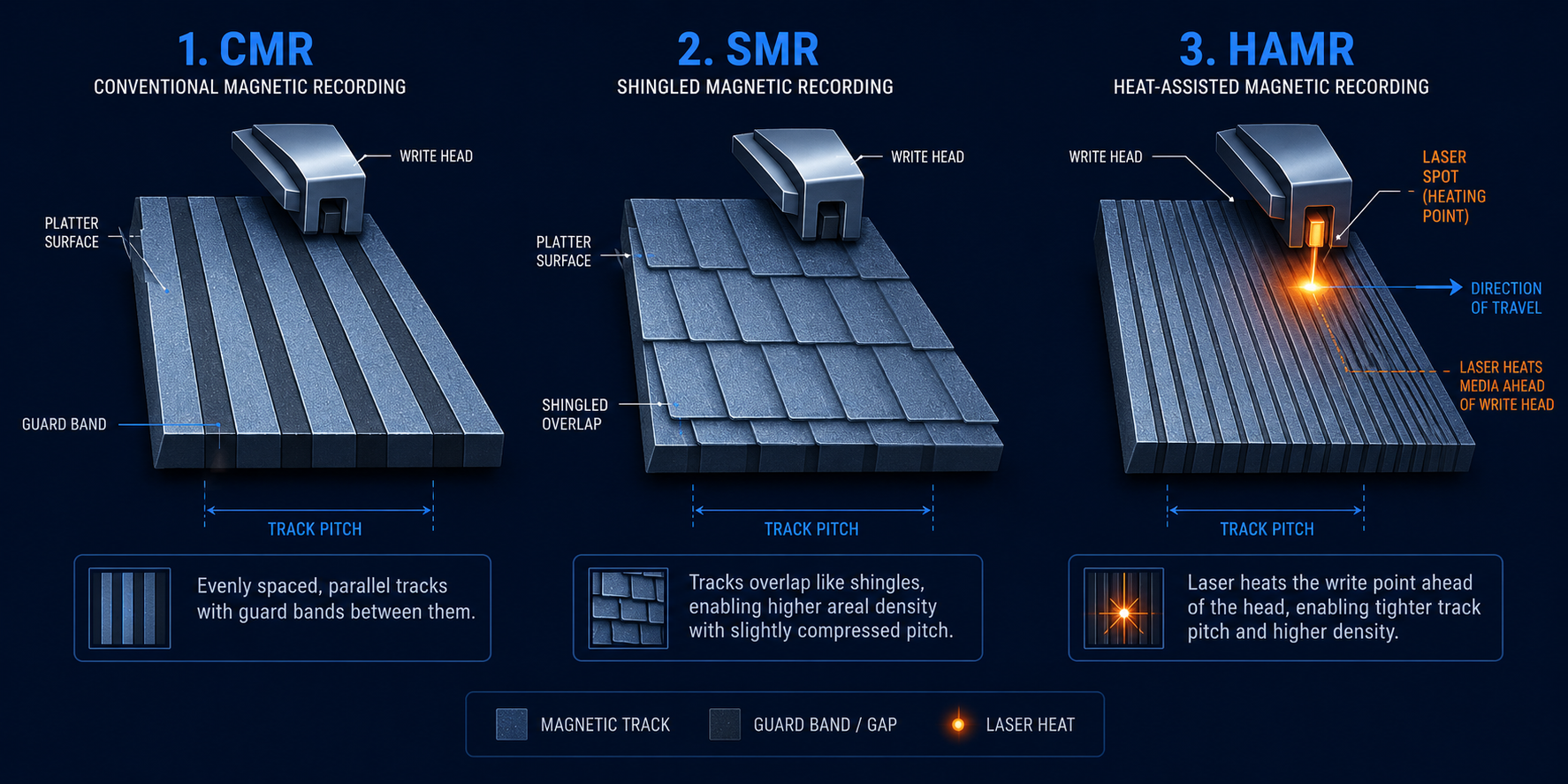
The second leap was organizational rather than physical: Shingled Magnetic Recording (SMR), which reached the market around 2020. Conventional recording (CMR) writes tracks with guard bands of empty space between them so each track can be rewritten independently. SMR removes those guard bands and overlaps each new track partially on top of the previous one — like shingles on a roof — because the read head is physically much narrower than the write head and can still reliably read a track even after part of its edge has been overwritten. This packs meaningfully more tracks into the same radius, but at a real cost: overwriting a shingled track that has valid, still-needed data above it requires the drive to first read and buffer that upper data in DRAM, then rewrite both the target track and the data that was sitting on top of it — a performance penalty that makes SMR drives noticeably worse at sustained random writes, which is exactly why they're marketed for cold storage and archival workloads rather than active databases.
The leap defining the current decade is Heat-Assisted Magnetic Recording (HAMR), which uses a tiny, precisely focused laser to briefly heat the exact spot being written. Heating the media temporarily lowers its coercivity — how strongly it resists having its magnetic orientation changed — making it easier for the write head's field to flip a domain that would otherwise be too magnetically "stiff" to write reliably at its shrunken size. This is the technology finally breaking through PMR's superparamagnetic ceiling. As of 2026, Seagate's HAMR-based Mozaic platform is shipping in volume to hyperscale cloud providers at capacities up to 44TB, built from ten platters averaging 4.4TB each, and lab prototypes have already demonstrated 6.9TB on a single platter — with a roadmap targeting 10TB-per-platter drives around 2028. Western Digital, meanwhile, is combining its own ePMR technology with SMR and a newer vertical-laser HAMR approach, targeting 60TB drives through ePMR alone and 100TB-class drives via HAMR by around 2029. Toshiba has taken a third path — pushing mechanical density instead, becoming the first vendor to verify a 12-platter stack inside a standard 3.5-inch enclosure by switching from aluminum to thinner, more dimensionally stable glass platter substrates, shipping 30-34TB drives in 2026.
⚡ Myth-Busting: HDDs Aren't Being Replaced by SSDsIt's tempting to assume spinning disks are a dying technology now that SSDs dominate consumer laptops — but that mixes up two different markets. For latency-sensitive, high-IOPS workloads, SSDs won years ago and HDDs aren't coming back. But for cold storage, backups, and the sheer bulk capacity that hyperscale cloud providers need to store exabytes of infrequently accessed data, the dollar-per-terabyte economics of HDDs remain dramatically better than flash, and HAMR is actively widening that gap rather than closing it. That's precisely why Seagate and Western Digital are racing each other toward 100TB-class drives instead of exiting the category.
🖼️
// synthesisHow It All Connects: One Write, One Read
Zoom back out and the whole drive is one continuous feedback loop between mechanics and magnetism. The spindle motor spins the platter to a constant velocity so that timing-based encoding stays consistent regardless of which track is being accessed. The voice coil motor positions the head over a target track using the address information embedded in each sector's preamble. The write head magnetizes a sequence of domains representing your data, timed against that same preamble reference. Later, the read head passes back over those domains, and its GMR sensor detects the pattern of transitions, which the drive's controller decodes into bits, checks against the ECC, and hands off over SATA to your operating system — all while the platter spins at highway speed and the head hovers closer to the surface than a virus is wide.
What makes this remarkable isn't any single component — it's that every part of the system was engineered around the same central constraint: cramming more bits into less area without losing reliability. Perpendicular recording bought more thermal stability per bit. GMR sensors bought more read sensitivity per transition. Shingled recording and HAMR both bought higher track density, using organizational cleverness and physics, respectively. None of these technologies exist in isolation; they compound.
// getting startedInspect Your Own Drive's Specs and Health
All of this becomes a lot more concrete once you look at what's actually spinning inside your own machine. Every major OS ships a way to query the drive's reported geometry, interface, and SMART health data — the same self-monitoring statistics the drive's controller collects internally.
On Linux:
terminal — inspect drive geometry and health# List block devices, sizes, and rotational vs. flash lsblk -d -o NAME,SIZE,ROTA,MODEL # Full SMART health report (install smartmontools first) sudo smartctl -a /dev/sda # Key fields to check: # Rotation Rate → confirms RPM (7200, 5400, etc.) # Reallocated_Sector_Ct → domains the drive has quietly remapped # Power_On_Hours → cumulative spindle runtime
On Windows (PowerShell):
powershell — physical disk inventoryGet-PhysicalDisk | Select-Object FriendlyName, MediaType, Size, HealthStatus # MediaType will show "HDD" or "SSD" # HealthStatus surfaces the drive's own SMART self-assessment
If Reallocated_Sector_Ct is climbing over time, that's your GMR read head and ECC logic telling you domains are becoming unreliable in specific spots — the exact failure mode this article walked through. It's a good early warning to back up before a head crash turns a slow decline into total data loss.
See the mechanics move in the lab below ↓
Four live experiments: platter/sector explorer, read/write cycle simulator, capacity calculator, and a CMR/SMR/HAMR density comparison.
Open Platter Lab 🔬// FAQFrequently Asked Questions
How do hard disk drives store data? + Hard drives store data magnetically on a spinning platter coated with a roughly 120-nanometer-thick cobalt-chromium-tantalum alloy layer. That layer is divided into billions of microscopic magnetic domains, each of which can be polarized "up" or "down" by a write head. A read head later detects the pattern of magnetic transitions between adjacent domains and the drive's controller decodes that pattern into binary data, organized into tracks and sectors across the platter's surface. Why does the read head detect transitions instead of reading domains directly as 1s and 0s? + A single magnetic domain pointing in one steady direction produces a relatively weak, hard-to-distinguish signal. The magnetic field at the boundary where two adjacent domains point in opposite directions is much stronger and easier for a GMR sensor to detect reliably. So HDDs encode a "1" as a transition between domains and a "0" as the absence of one, using the sector's preamble to establish precise timing so the drive can tell how many "0"s occurred between transitions. What is giant magnetoresistance (GMR) and why does it matter for hard drives? + GMR is a quantum-mechanical effect in which a multilayer stack of alternating ferromagnetic and non-magnetic materials changes its electrical resistance in response to an external magnetic field. Hard drive read heads use GMR (and its successor, tunneling magnetoresistance) sensors to convert the magnetic field variations coming off the spinning platter into a measurable electrical signal, which is what actually gets decoded into bits. The discovery of GMR in 1988 won its researchers the 2007 Nobel Prize in Physics and enabled the areal density gains that made multi-terabyte drives possible. What's the difference between CMR, SMR, and HAMR hard drives? + CMR (Conventional Magnetic Recording) writes tracks with empty guard bands between them, so any track can be rewritten independently — best for random-write performance. SMR (Shingled Magnetic Recording) overlaps tracks like roof shingles to raise density, but rewriting a track can require reading and rebuffering the data on the track partially overlapping it, hurting sustained random-write performance — best suited to archival and write-once workloads. HAMR (Heat-Assisted Magnetic Recording) uses a focused laser to briefly heat the media during writing, temporarily lowering its resistance to being magnetized so smaller, more thermally stable domains can be written reliably — this is the technology currently pushing areal density past what perpendicular recording alone can achieve, with commercial drives already shipping past 40TB. How close does the read/write head actually get to the platter? + Modern hard drive heads fly roughly 15 nanometers above the platter surface — about 100 atoms of clearance, thinner than a sheet of aluminum foil. That clearance is maintained aerodynamically: the slider's underside is shaped to catch the airflow generated by the spinning platter and use it as lift, similar to how an airplane wing generates lift from moving air. This is also why a single stray dust particle (which can be far larger than the fly height) is one of the most common causes of a head crash. How many terabytes can fit on one hard drive platter in 2026? + As of 2026, Seagate's shipping HAMR-based Mozaic 4+ platform delivers about 4.4TB per platter in commercial drives reaching 44TB total across ten platters, while lab prototypes have already reached 6.9TB per platter. Western Digital and Toshiba are pursuing parallel paths — ePMR-enhanced perpendicular recording and higher platter counts using thinner glass substrates, respectively — with industry roadmaps targeting roughly 10TB per platter and 100TB-class drives by around 2028-2029. Why do hard drives need to be sealed or filled with helium? + Traditional HDDs are filled with filtered, dry air because the read/write head relies on aerodynamic lift generated by that specific air density to fly at a stable height above the platter. Some high-capacity enterprise drives are instead sealed with helium, which is about one-seventh the density of air. Lower density means less aerodynamic drag and turbulence, which lets manufacturers pack in more, thinner platters (often 10 or more) into the same enclosure without the airflow around each disk interfering with its neighbors. Are hard disk drives becoming obsolete now that SSDs are common? + No — HDDs and SSDs have split into different roles rather than one replacing the other. SSDs dominate performance-sensitive, high-IOPS workloads like operating system drives and databases, where their lack of moving parts gives them a decisive latency advantage. HDDs remain dramatically cheaper per terabyte for bulk, infrequently accessed storage — backups, archives, and hyperscale cloud "cold storage" — which is exactly why Seagate, Western Digital, and Toshiba are all actively racing toward 60-140TB HAMR-based drives rather than winding the category down.🔬 Platter Mechanics Lab
Four experiments: platter/sector explorer, read/write cycle simulator, capacity calculator, and recording-technology comparison.
Click a sector on the platter to inspect its structure
// Platter / Sector Explorer Tracks shown 12 Sectors per track 16 Click any sector wedge to inspect its preamble / address / data / ECC breakdown. 192 Sectors shown 500,000+ Real tracks/surface 4KB Typical sector size 7,200 Spindle RPMClick ▶ to write a byte, then read it back via transition decoding
// Read/Write Cycle Simulator Bit pattern to write 10110010 IDLE Phase — Decoded bits 15nm Head fly height GMR Sensor typeStacked platters showing total drive capacity
// Drive Capacity Calculator Number of platters 10 Recording tech HAMR (Mozaic 4+) 44 TB Total capacity 4.4 TB Per platter ~11M Photos (4MB avg) $0.02 Est. cost per TB* *Illustrative hyperscale bulk-media estimate, not retail pricing.Track density comparison — CMR vs SMR vs HAMR
// Recording Technology Comparison Technology HAMR — Relative density — Random write perf. — Best use case — Market status (2026)Keep reading
Related articles
 General
How Microchips Are Made: The Complete CPU Fabrication Process Step by Step | Zetsapp
Here's the thing most chip articles miss: the "nm" number in modern process node names (TSMC 3nm, Intel 4nm, Samsung 3nm) does not correspond to any physical dimension on the chip. This was true when Intel's 45nm node launched in 2007 and became increasingly disconnected from reality thereafter. TSMC's "3nm" node has a gate pitch (the distance between gates) of approximately 48nm — not 3nm.
 General
How GPUs Actually Work: The Nvidia GA102 Architecture Decoded Inside the RTX 3090
GPU acceleration is limited by the fraction of your workload that's actually parallel. Amdahl's Law states: if 90% of a program can be parallelized, the maximum speedup from infinite parallel processors is 10× — not infinite. The 10% sequential bottleneck always limits total speedup. In GPU-accelerated ML training, the actual workload split is typically: 85-95% embarrassingly parallel tensor operations
 General
How GPUs Actually Work: The Nvidia GA102 Architecture Decoded Inside the RTX 3090 | Zetsapp
GPU acceleration is limited by the fraction of your workload that's actually parallel. Amdahl's Law states: if 90% of a program can be parallelized, the maximum speedup from infinite parallel processors is 10× — not infinite. The 10% sequential bottleneck always limits total speedup. In GPU-accelerated ML training