LLM-memoryepisodic-memorysemantic-memoryprocedural-memoryconversation-bufferRAGAI-agentscontext-windowvector-databasechatbot
AI
LLM Memory: How to Give AI a Persistent Memory
TL;DR When you have a multi-turn conversation with ChatGPT or Claude, neither system is "remembering" in any intrinsic sense. The entire conversation history is being concatenated into the context window and sent with every message — the model sees the full history as part of its current input.
Read this article as text (accessible version)
AI Memory Architecture · Deep Dive
·
3,800 words · 4 interactive labs · April 2026
LLM Memory:
LLM Memory:
How to Give AI
a Persistent Memory
Your chatbot forgets everything the moment the session ends. Your AI agent has no idea who the user is, what they prefer, or what they did last week. LLMs are stateless by design — but with the right architecture, you can simulate memory so convincingly that users will never notice the difference.
Read the Deep Dive ↓ Open the Lab 🧠 ⚡Short-term: Conversation buffer (context window) 📅Episodic: Past events and interactions 📚Semantic: Facts, preferences, user profile ⚙️Procedural: Rules, strategies, task methods Table of Contents- Why LLMs Are Stateless by Design
- Short-Term Memory: The Conversation Buffer
- Long-Term Memory: The Three Types
- Episodic Memory: Remembering Events
- Semantic Memory: Storing Facts
- Procedural Memory: Rules and Strategies
- The 4-Step Memory Lifecycle
- The Future: Intrinsic Memory in Transformers
01Why LLMs Are Stateless by Design
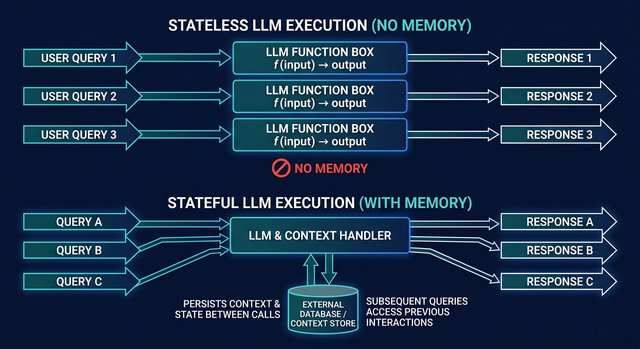
Imagine you're talking to the world's most knowledgeable expert. Every time you call them, they answer your questions brilliantly. But the moment you hang up the phone, they forget everything — your name, your project, your last conversation, all of it. The next call starts completely fresh. That's not a bug in their intelligence. It's a fundamental property of how they were built.
At inference time, a Large Language Model is a pure mathematical function. It takes an input (your prompt) and produces an output (the response). That's it. There's no persistent state between calls, no accumulating memory, no record of what questions were asked before. The model's weights — the billions of numerical parameters trained on vast datasets — encode broad world knowledge, but they don't change between inferences. Every API call is stateless: f(input) → output, with no side effects.
This is a deliberate design choice, not an oversight. Stateless functions are parallelizable, cacheable, horizontally scalable, and reproducible. The same prompt sent twice will (with the same temperature settings) produce the same output. This predictability is what makes LLMs reliable components in larger systems. But it also means that every "memory" you want the model to have must be explicitly constructed, stored externally, and injected back into the input on every relevant call.
🚨 The Illusion of Conversational MemoryWhen you have a multi-turn conversation with ChatGPT or Claude, neither system is "remembering" in any intrinsic sense. The entire conversation history is being concatenated into the context window and sent with every message — the model sees the full history as part of its current input. When you start a new browser tab and begin a new conversation, that history is gone. The "memory" you experience is just increasingly long text that gets prepended to your current message.
02Short-Term Memory: The Conversation Buffer
The simplest and most widely used form of AI memory is the conversation buffer: you maintain a list of all previous messages in the current session and prepend them to every new request. The model receives the full conversation history as part of its input and can reference anything said earlier in the session. From the user's perspective, the AI "remembers" the conversation. From the engineering perspective, you're just sending increasingly long text.
This works remarkably well for short-to-medium conversations — customer support tickets, coding sessions, document analysis. The model can maintain coherent context, reference earlier statements, and build on previous answers. But it's fragile in two important ways. First, it's session-scoped: when the session ends, the conversation buffer is discarded. The next session starts fresh. Second, it's context-window-bounded: modern LLMs have context windows of 128K–200K tokens, which sounds enormous but fills up faster than you'd expect in a long technical session with large code snippets, document excerpts, and extensive dialogue.
Here's the thing most tutorials miss: naive conversation buffers have a critical failure mode at scale. When the buffer approaches the context window limit, you have four options: truncate the oldest messages (losing early context), summarize the buffer (losing detail), use sliding window strategies (keeping recent context only), or implement a smarter retrieval system. Each has tradeoffs. Production chatbots with high engagement need to think about this from day one, not when users start complaining that the bot "forgot" something they said twenty messages ago.
⚠️ Buffer Management Is a Day-One ConcernDon't wait until users hit context limits to implement buffer management. Design your buffer strategy upfront. Options include: (1) Rolling window — keep the last N messages, (2) Importance-weighted — score messages by relevance and prune low-importance ones, (3) Summarization — periodically summarize older portions of the conversation, (4) Hybrid — combine rolling window for recent context with retrieval for older context. The right strategy depends on your use case: factual Q&A needs different memory management than multi-day project collaboration.
conversation_buffer.pyfrom anthropic import Anthropic
from typing import List, Dict
client = Anthropic()
class ConversationBuffer:
def __init__(self, max_tokens=100000, system=""):
self.messages: List[Dict] = []
self.max_tokens = max_tokens
self.system = system
def chat(self, user_message: str) -> str:
self.messages.append({"role": "user", "content": user_message})
# Trim if approaching context limit
while self._estimate_tokens() > self.max_tokens and len(self.messages) > 2:
self.messages.pop(0) # drop oldest message
response = client.messages.create(
model="claude-sonnet-4-6",
max_tokens=1024,
system=self.system,
messages=self.messages # full history sent every time
)
assistant_msg = response.content[0].text
self.messages.append({"role": "assistant", "content": assistant_msg})
return assistant_msg
def _estimate_tokens(self) -> int:
# Rough estimate: 1 token ≈ 4 characters
total_chars = sum(len(m["content"]) for m in self.messages)
return total_chars // 4
03Long-Term Memory: Why Sessions Aren't Enough
Session-scoped memory is fine for a customer support chatbot where each ticket is independent. But imagine building a personal productivity assistant, a coding companion, or a healthcare support agent. These applications need to know who the user is, what they've accomplished, what they prefer, and how they like to work — information that accumulates over days, weeks, and months of interaction. No single session buffer can hold this.
Long-term memory requires external persistence: information that survives beyond the current session, stored in a database, and retrieved and injected into future sessions when relevant. This transforms the AI from a brilliant amnesiac into something that genuinely learns the user over time. The first time a user mentions they prefer concise answers without excessive caveats, that preference is stored. Six months later, every response is automatically calibrated to that preference — and the user never had to repeat themselves.
Cognitive science divides human long-term memory into categories that map surprisingly well onto what AI systems need. The three types — episodic, semantic, and procedural — each address a different dimension of what it means to "remember" and require different storage, retrieval, and injection strategies. Building a complete long-term memory system means building all three, calibrated to your application's specific requirements.
💡 Not All Applications Need All Three Memory TypesA coding assistant primarily needs semantic memory (user's tech stack, coding style, project context) and procedural memory (preferred code organization, test writing style). A journaling app primarily needs episodic memory (past entries and themes). A customer support agent primarily needs semantic memory (customer account details, past issues) and episodic memory (previous support interactions). Map your use case to the memory types it actually requires before building. Over-engineering memory infrastructure for types you don't need adds complexity without value.
04Episodic Memory: Remembering Events and Interactions
Episodic memory is the "what happened when" layer. In humans, episodic memory stores autobiographical events — your first day at a new job, a specific conversation with a friend, the sequence of events in a project. For AI systems, episodic memory stores past interactions: what the user asked about, what tasks were completed, what problems were encountered, what outcomes were achieved.
In practice, episodic memory is typically implemented as a vector database of conversation summaries, interaction logs, or extracted event records, indexed by embeddings that allow semantic retrieval. When a user starts a new session and asks "where did we leave off?", the retriever searches the episodic store for recent relevant interactions, retrieves the most pertinent records, and injects them into the current context. The model can then provide continuity: "Last week you were debugging the payment webhook — you resolved the timeout issue but were still investigating the duplicate event problem."
The critical design decision for episodic memory is granularity: what constitutes an "episode" worth storing? Storing every individual message creates a noisy, redundant database. Storing only session-level summaries loses resolution. A practical middle ground: store session-level summaries with links to the full conversation transcript, and extract key events (problems encountered, decisions made, tasks completed) as structured records. This gives you both the searchability of structured data and the richness of full context when needed.
✅ Extract Key Events, Not Just SummariesThe most useful episodic memory systems extract structured "events" rather than just prose summaries: {type: "problem_encountered", description: "payment webhook timeout", resolved: true, date: "2026-03-15"}. These structured records are easier to query, easier to reason over, and easier to inject precisely. Use the LLM itself to extract structured events from conversation sessions — this is one of the best uses of LLM processing power in a memory pipeline. Pair structured events with full session summaries for both queryability and richness.
05Semantic Memory: Building a Living Knowledge Graph of the User
Semantic memory is the "what is true" layer — factual knowledge about the user, their context, their preferences, and the world they operate in. In humans, semantic memory stores general knowledge: facts, concepts, relationships. For AI systems, semantic memory stores user-specific facts: "Alex is a senior backend engineer at a fintech company, works primarily in Python and Go, prefers TDD, uses VSCode, and is currently building a payment reconciliation service."
Semantic memory is more structured than episodic memory. Rather than storing raw interaction records, you're maintaining a dynamic profile — a set of facts and relationships that get updated as new information emerges. This might be represented as a structured document (a user profile JSON), a knowledge graph (entities and relationships in a graph database), or a hybrid approach. The key property: semantic memory should be updateable. When a user switches languages, changes projects, or updates their preferences, the semantic store should reflect the current state, not accumulate contradictory history.
The hardest problem in semantic memory is contradiction handling: when a user says something that conflicts with what's stored ("I'm not using VSCode anymore, switched to Neovim"), the system needs to update the relevant fact rather than storing both. This requires either maintaining versioned fact histories (keeping old facts with timestamps) or active contradiction detection (using the LLM to identify when new information conflicts with stored facts and prompting an update). Most production systems take a pragmatic approach: store facts with timestamps, and during retrieval, prefer more recent facts when contradictions exist.
⚠️ Semantic Memory Requires Active MaintenanceA common mistake: treating semantic memory as append-only. User profiles become increasingly contradictory and bloated if you only add facts and never update or remove them. Build contradiction detection from the start. A simple approach: whenever you extract a new fact, query the semantic store for related existing facts and use the LLM to determine if an update or contradiction resolution is needed. This adds a small overhead per extraction but prevents the "memory drift" problem where an AI continues referencing stale information.
06Procedural Memory: Teaching the Agent How to Work
Procedural memory is the "how to do things" layer. In humans, procedural memory stores skills and strategies — how to ride a bike, how to solve a type of equation, how to approach a particular kind of problem. For AI systems, procedural memory stores the rules, workflows, and strategies that should guide how the agent behaves for a specific user or context.
Procedural memory looks different from episodic and semantic memory. Instead of storing facts or events, it stores instructions: "When the user asks for code review, always start with high-level architecture concerns before line-level issues." "When writing documentation, use the user's preferred format: numbered steps for procedures, prose for concepts." "For data analysis tasks, always show the code before the interpretation, and always include confidence intervals." These are behavioral rules derived from user feedback and preferences over time.
The counterintuitive thing about procedural memory: it's the most powerful type but the most underimplemented. Episodic and semantic memory make the AI seem more personalized. Procedural memory makes it more useful — the difference between an assistant that knows who you are and one that knows how to work the way you work. Procedural memory is essentially dynamic CLAUDE.md or system prompt content, refined through interaction. When a user corrects the AI repeatedly in the same way, that correction should crystallize into procedural memory and change how the AI behaves going forward — automatically, without the user needing to keep repeating themselves.
🔬 Procedural Memory Is Dynamic System Prompt EngineeringThink of procedural memory as the system prompt content that the AI earns through interaction, not just what you write at deployment. After enough interactions with a user, the system should automatically discover their workflow preferences, common corrections, and task-specific preferences — and encode those as procedural rules that get injected into future sessions. This creates an AI that genuinely improves for a specific user over time, not just one that knows more facts about them.
07The 4-Step Memory Lifecycle: Architecture for Production Systems
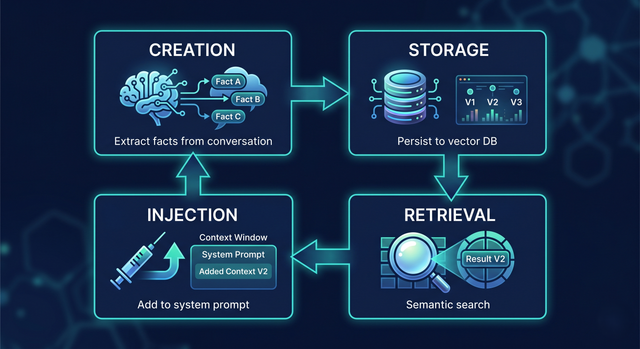
Building a working long-term memory system requires four interconnected components, each doing a specific job in the memory pipeline: Creation, Storage, Retrieval, and Injection. Skip any one of them and the whole system breaks down. Get all four right and you have an AI that genuinely accumulates knowledge about its users over time.
Creation is where raw conversation is transformed into durable memory. At the end of a session (or periodically during a long session), the LLM processes the conversation and extracts the following: key facts learned (semantic), events that occurred (episodic), and behavioral patterns or preferences observed (procedural). This is LLM-powered extraction — you're using the model's language understanding to structure unstructured conversational data. The quality of extraction directly determines the quality of memory, so prompt engineering for the extraction step deserves significant attention.
Storage means persisting extracted memories in a durable, queryable database. Vector databases (Pinecone, Weaviate, Chroma) are commonly used because they support semantic similarity search, which is how you'll retrieve memories later. Relational databases work better for highly structured semantic facts. Many production systems use both: vector search for episodic and unstructured semantic memories, relational tables for structured user profile data. Retrieval is the process of finding the relevant memories for a given query — typically using embedding similarity search to find the semantically closest stored memories, often combined with metadata filters (date range, memory type, user ID).
Injection is the final step: taking retrieved memories and adding them to the current context window in a way the model can effectively use. Typically this means constructing a "memory summary" section in the system prompt: "Here is what I know about the user: [semantic facts]. Recent interactions: [episodic events]. Working preferences: [procedural rules]." The quality of the injection format matters — a well-structured memory injection is much more usable than a raw dump of retrieved records.
💡 The Memory Lifecycle Is an Async Background ProcessMemory creation and storage should not happen in the critical path of the user's request. Don't make users wait for memory extraction to complete before responding. Run creation asynchronously after the session ends (or in the background during the session). Only retrieval and injection happen synchronously — and these should be fast enough (sub-100ms for a well-optimized vector search) that users don't notice them. Design your system so that memory operations that are slow run in the background, and only the fast retrieval step is synchronous.
memory_lifecycle.py — full pipelineimport asyncio
from anthropic import Anthropic
from dataclasses import dataclass
from typing import List
import json, datetime
client = Anthropic()
# ── STEP 1: CREATION — extract memories from conversation ────
async def extract_memories(conversation: List[dict]) -> dict:
conv_text = "\n".join([ff"{m['role']}: {m['content']}" for m in conversation])
response = client.messages.create(
model="claude-sonnet-4-6", max_tokens=1024,
system="Extract memories from the conversation. Return JSON with keys: episodic (list of events), semantic (list of facts), procedural (list of preferences/rules).",
messages=[{"role": "user", "content": conv_text}]
)
return json.loads(response.content[0].text)
# ── STEP 2: STORAGE — persist to vector database ─────────────
async def store_memories(memories: dict, user_id: str, db) -> None:
ts = datetime.datetime.now().isoformat()
for mem_type, items in memories.items():
for item in items:
await db.upsert({
"text": item, "type": mem_type,
"user_id": user_id, "timestamp": ts
})
# ── STEP 3: RETRIEVAL — semantic search for relevant memories ─
async def retrieve_memories(query: str, user_id: str, db, top_k=8) -> List[dict]:
return await db.search(query=query, user_id=user_id, top_k=top_k)
# ── STEP 4: INJECTION — add memories to system prompt ─────────
def build_memory_context(memories: List[dict]) -> str:
ep = [m["text"] for m in memories if m["type"]=="episodic"]
sem = [m["text"] for m in memories if m["type"]=="semantic"]
proc =[m["text"] for m in memories if m["type"]=="procedural"]
return f"""
## Memory Context
**About this user:** {'; '.join(sem)}
**Recent events:** {'; '.join(ep)}
**Working preferences:** {'; '.join(proc)}
"""
08The Future: Intrinsic Memory in Transformer Architectures
All of the memory techniques described above are external scaffolding — workarounds for the fundamental statelessness of current transformer architectures. They work well, but they add engineering complexity, latency, and cost to every AI application. The natural question: can we build transformers that have genuine intrinsic memory, without external databases?
Ongoing research is exploring several approaches. Retrieval-augmented architectures (like RETRO) integrate retrieval directly into the transformer's computation, allowing the model to attend to external memory as part of its forward pass rather than requiring pre-injection. Memory-augmented neural networks (like Neural Turing Machines and their successors) add learnable read/write memory operations to the model itself. Recurrent architectures with compressed state (like Mamba) maintain a fixed-size hidden state that carries information forward between inputs without the quadratic scaling of attention.
None of these have yet achieved the combination of performance, scalability, and practicality that would make external memory systems obsolete. The transformer's attention mechanism, despite its quadratic cost, remains exceptionally good at handling complex relationships within a context window. But the research trajectory is clear: the complexity of external memory management is a friction that the field is highly motivated to eliminate. In five to ten years, it's plausible that production AI systems will have built-in, efficient long-term memory that requires no external database, no extraction pipeline, and no injection engineering.
💡 Build for Today's Architecture, Design for Tomorrow'sDon't build your memory system so tightly coupled to the current external-database approach that you can't migrate when transformer architectures improve. Abstract the memory interface behind a clean API (store_memory, retrieve_memories, inject_context) so the underlying implementation can be swapped out without changing the rest of your application. Today it's a vector database + LLM extraction pipeline. In two years, it might be a native model capability. Good architecture anticipates this migration path.
synthesisHow It All Connects: The Complete Memory Stack
The complete AI memory architecture is a layered system. The context window provides short-term working memory for the current session — fast, always available, but session-scoped and finite. External long-term memory stores what needs to persist: episodic records of what happened, semantic facts about the user and their world, procedural rules for how to work with them. The 4-step lifecycle (create, store, retrieve, inject) bridges these layers, continuously extracting durable knowledge from transient conversations and making it available to future sessions.
A well-designed memory system doesn't just make an AI more personalized — it fundamentally changes what kinds of applications are possible. Personal assistants that genuinely improve over time. Agents that maintain context across complex multi-week projects. Customer systems that remember service history across years of interactions. The technology to build these exists today. The engineering investment required is real, but so is the payoff in user experience quality and application capability.
FAQFrequently Asked Questions
Why don't LLMs have built-in memory between sessions? + LLMs are mathematical functions — they take an input and produce an output, with no persistent state between calls. The model's weights (which encode general knowledge) don't change during inference. This is a deliberate architectural choice: stateless functions are parallelizable, scalable, cacheable, and reproducible. The "memory" in a single session is simulated by sending the full conversation history with every request. Cross-session memory requires external systems because the model architecture itself has no mechanism for persisting information between inference calls. Ongoing research into memory-augmented architectures and recurrent neural networks aims to address this, but no production solution has yet matched the performance of the current stateless transformer architecture. What is the difference between episodic, semantic, and procedural memory in AI? + These three types of memory each handle a different dimension of "what needs to be remembered." Episodic memory stores events and interactions — what happened, when, in what context. For AI systems, this means past conversations, task completions, and interaction history. Semantic memory stores facts and knowledge — who the user is, what they're working on, what they know, what they prefer. For AI systems, this is the user profile: their role, tech stack, preferences, goals. Procedural memory stores how to do things — workflows, strategies, behavioral rules. For AI systems, this translates to behavioral instructions derived from user feedback: formatting preferences, communication style, task-specific approaches. Together, they enable continuity (episodic), personalization (semantic), and effectiveness (procedural). What is a conversation buffer and how does it work? + A conversation buffer is a list of all messages in the current session (user and assistant messages) that gets concatenated and sent with every API request. The LLM receives the full conversation history as part of its input context and can reference anything said earlier in the session. This creates the appearance of within-session memory. The technical mechanism is simple: you maintain a messages array, append each user and assistant message to it, and send the entire array with every call to the LLM API. The limitation is that this buffer is session-scoped (discarded when the session ends) and context-window-bounded (when the buffer exceeds the model's context window, older messages must be dropped, summarized, or managed through a retrieval strategy). What database should I use for AI long-term memory? + The right database depends on your memory type. For episodic and unstructured semantic memories, a vector database is usually best — Pinecone, Weaviate, Chroma, Qdrant, or pgvector (for PostgreSQL). Vector databases support semantic similarity search, which is how you'll retrieve relevant memories given a user's current query. For highly structured semantic memories (user profile attributes, preferences), a relational database (PostgreSQL) or document store (MongoDB) works better. Many production systems use both: vector search for semantic retrieval, relational tables for structured profile data. Start with a simple setup (pgvector if you already use PostgreSQL, or Chroma for a local vector DB) and migrate to more specialized infrastructure as scale demands. How do I handle contradictions in AI memory when user facts change? + Contradiction handling is one of the hardest problems in semantic memory. Three main approaches: (1) Versioned facts — store all facts with timestamps and prefer the most recent version when contradictions exist. Simple to implement but requires logic to detect and resolve contradictions at query time. (2) Active deduplication — when a new fact is extracted, query for related existing facts and use the LLM to determine if the new fact updates, contradicts, or confirms existing ones. More accurate but adds extraction overhead. (3) Entity-attribute model — store facts as structured (entity, attribute, value) triples in a relational store, where an UPDATE on the attribute naturally replaces the old value. Best for highly structured fact types but requires up-front schema design. A pragmatic production approach: use versioned facts with timestamp-based preference plus periodic "memory consolidation" runs that detect and resolve obvious contradictions. How should memory be injected into the LLM context? + Memory injection should happen in the system prompt, not the user message. Structure it clearly with labeled sections: "## What I know about you: [semantic facts]", "## Recent context: [episodic records]", "## Your working preferences: [procedural rules]". The quality of the injection format matters significantly — a structured, clearly labeled injection is much more effectively used by the model than a raw dump of retrieved records. Limit injected memory to what's actually relevant to the current query (retrieved via semantic search) rather than injecting the entire memory store. A typical target: 500–2000 tokens for memory injection, leaving the majority of the context window for the current conversation and any referenced documents. Always inject memory before the conversation history so the model treats it as background knowledge rather than part of the current dialogue. Can memory make an AI chatbot "learn" from feedback? + Yes, through procedural memory. When a user corrects or rates the AI's behavior ("don't use bullet points," "please be more concise," "I prefer to see the code first"), those corrections should be extracted as procedural memory — behavioral rules that get injected into future sessions and change how the AI responds going forward. This is distinct from model training (which updates the model's weights) — it's prompt-based behavioral adaptation that works within the existing model's capabilities. The result is an AI that improves for a specific user through interaction without any retraining. For teams: if you find users consistently giving the same corrections, those corrections should become part of the base system prompt or CLAUDE.md rather than relying on procedural memory accumulation. What is the difference between RAG and AI memory systems? + RAG (Retrieval-Augmented Generation) and memory systems use similar underlying technology (vector databases, semantic search, context injection) but serve different purposes. RAG retrieves from a fixed knowledge base — a collection of documents, a product catalog, a knowledge base — that doesn't change based on user interactions. Memory systems retrieve from a dynamic, user-specific store that grows and changes through interaction. A customer support bot using RAG might retrieve relevant policy documents for every query. The same bot with a memory system would also retrieve the customer's history, preferences, and past issues. They're complementary: most production AI applications use both RAG for domain knowledge and memory for user personalization, with the combination injected into the context for every request.🧠 Memory Lab
Four interactive experiments exploring LLM memory architecture from buffers to long-term stores.
Conversation Buffer Simulator Conversation (simulated session) 0 Messages 0 Est. tokens 0% % of 200K window Empty Buffer status Buffer Management Max window (tokens) 50K Management strategy What gets sent with each requestKey insight: The entire buffer is sent with EVERY request. As conversation grows, API cost grows proportionally. Design your buffer strategy before hitting limits.
Input: Conversation Snippet Extracted Memories Episodic Past events Semantic User facts Procedural Working rules 0 Episodic 0 Semantic 0 Procedural 0 Total memoriesContext window budget breakdown (200K token limit)
Context Budget Planner System prompt (tokens) 800 Injected memory (tokens) 1500 Retrieved documents (tokens) 5000 Conversation history (tokens) 8000 — Total used — Left for response — % utilized — Health4-step memory lifecycle — watch memories flow from conversation to injection
Memory Lifecycle Demo Simulate a session ending Lifecycle Log 0/4 Current step 0 Memories storedKeep reading
Related articles
 AI
AIEnterprise RAG: How to Build Accurate, Private AI Systems | Zetsapp
Teams frequently ask "should we fine-tune or use RAG?" as if it's binary. In production, the strongest systems use both: RAG for dynamic factual grounding, and light fine-tuning (or just careful prompting) for output style, tone, and domain-specific reasoning patterns. Don't fine-tune to teach the model facts — that's what retrieval is for.
 AI
AIAI Agents for Business: Use Cases, Implementation Guide & ROI in 2026 | Zetsapp
The most common mistake in discovery calls is a stakeholder describing a chatbot project using agent language ("it should be smart and handle anything"). Before scoping anything, get explicit about which systems the agent needs write access to. If the answer is "none, it just answers questions," you likely need a well-grounded RAG chatbot, not an agent — simpler, cheaper, faster.
 AI
AIThe Shift to Cloud 3.0: Architecting Low-Latency Apps With Distilled On-Device AI | Zetsapp
The Shift to Cloud 3.0: Architecting Low-Latency Apps With On-Device AI :root { --sp: 0.28s; } [data-theme="dark"]…