brain-computer interfaceBCI technologyneural dustoptogeneticsclosed-loop neuromodulationAI neuroscienceneuroprostheticsBCANneural decodingneurotechnology
Science
Your Brain Is About to Get a Software Update: Inside the Next Generation of Brain-Computer Interface Technology
TL;DR We're no longer just reading the brain — we're writing back to it. This deep-dive unpacks the three most consequential leaps in brain-computer interface technology: closed-loop biological feedback, AI that decodes thought into speech, and microscopic wireless neural implants that fit on a grain of salt. Whether you're a neuroscientist,
Read this article as text (accessible version)
Description
Beyond robotic arms: how closed-loop BCIs, AI-decoded speech, neural dust & optogenetics are building seamless brain-silicon networks — and what it means for medicine and humanity.

Short Description: We're no longer just reading the brain — we're writing back to it. This deep-dive unpacks the three most consequential leaps in brain-computer interface technology: closed-loop biological feedback, AI that decodes thought into speech, and microscopic wireless neural implants that fit on a grain of salt. Whether you're a neuroscientist, a developer, or just someone who'd rather not lose their voice to ALS, this is the story you need to read.
Picture this: it's 3:17 a.m. in an ICU somewhere in Boston. A 58-year-old software architect named David hasn't spoken in eleven months. A degenerative motor disease has locked him inside his own skull — intellect fully intact, body almost completely unresponsive. A nurse adjusts his pillow, and David desperately wants to say "thank you." He can't.
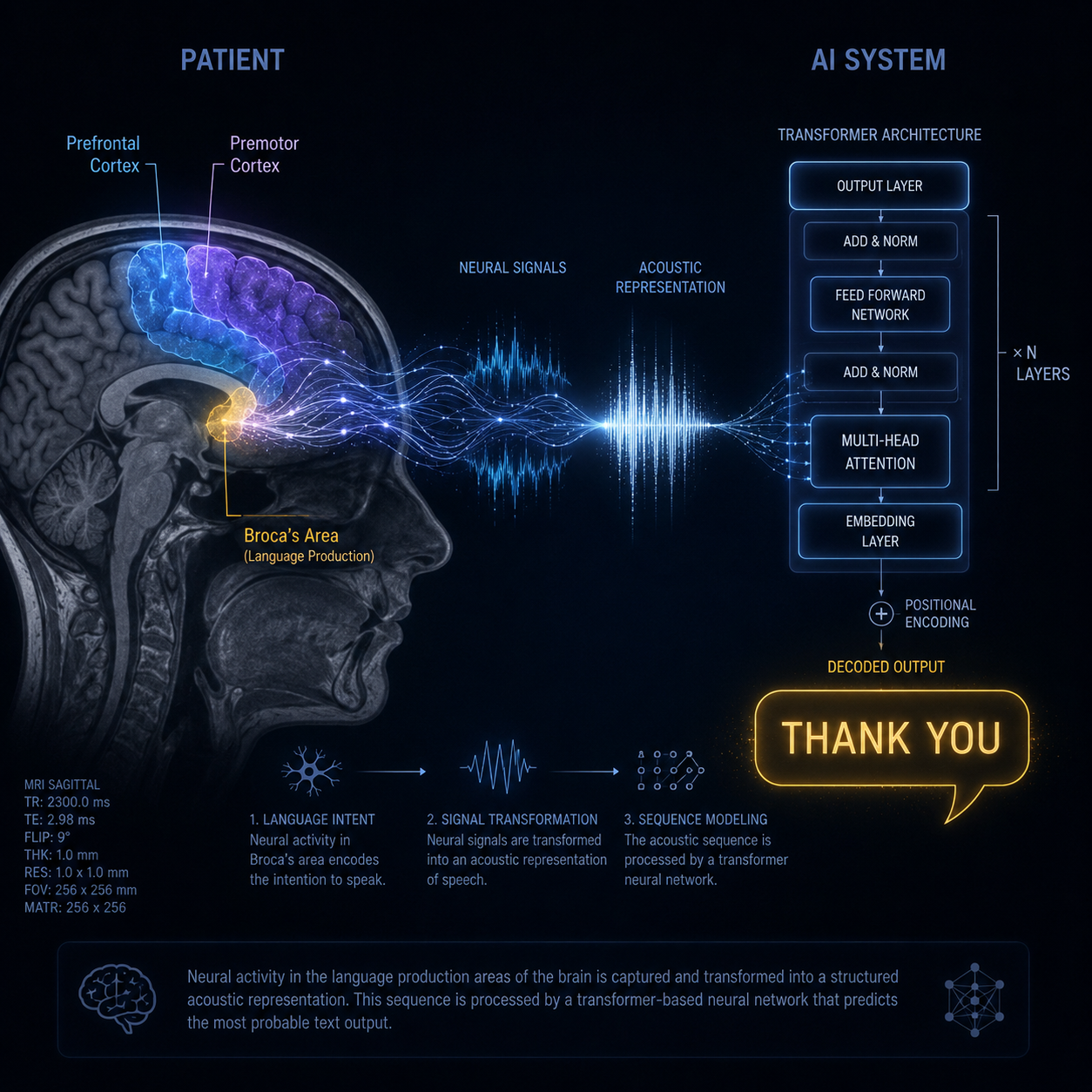
Now picture the same scene, except David has a cluster of sensors the size of a few grains of sand implanted near his speech cortex. An AI model trained on six weeks of his brain's electrophysiology patterns silently decodes the neural intent behind the phrase he never said aloud. A synthesizer — calibrated to his own pre-illness voice recordings — speaks the words into the room: "Thank you."
This isn't speculative fiction. Versions of this exact scenario are being tested in clinical trials right now. We are living through the most consequential era in the history of human-machine communication, and most people don't even know it's happening. Brain-computer interfaces (BCIs) have quietly graduated from laboratory curiosities into genuine medical technology — and the leap forward in the last three years alone has been staggering.
What changed? Three things converged simultaneously: the miniaturization of wireless neural sensors, the maturation of deep learning models capable of parsing ambiguous biological signals, and a new paradigm called the closed-loop system — where machines don't just read the brain, they talk back to it. What follows is a comprehensive breakdown of where BCI technology stands in 2025, what the next five years look like, and why engineers, clinicians, and policy-makers all need to be paying very close attention.
01The Closed-Loop Revolution: When Silicon Starts Talking Back
Here's the thing most tutorials miss about classical brain-computer interfaces: they were fundamentally deaf. The original BCI paradigm was a one-way radio — neural signals go out, a computer listens, a cursor moves. Full stop. The problem is that the brain doesn't work that way. Every motor output you make is accompanied by a torrent of sensory feedback. When you reach for a coffee mug, your fingertips are sending real-time pressure, temperature, and slip-detection signals back to your somatosensory cortex roughly 30 to 50 times per second. The motor system uses that feedback to constantly correct course. Strip that loop away and you get jerky, imprecise, deeply frustrating control — exactly what first-generation BCI patients experienced.
The closed-loop BCI paradigm fixes this at the source. Instead of simply reading motor intent and translating it into robotic movement, a closed-loop system simultaneously delivers artificial sensory feedback back into the nervous system. In practice, this means a prosthetic arm equipped with pressure sensors that trigger precisely calibrated microstimulation of the somatosensory cortex. The patient doesn't just move the arm — they feel the arm. The neural circuitry that evolved over millions of years to perform dexterous manipulation can finally engage fully, because it's finally getting the input it was always designed to receive.
The therapeutic implications go beyond prosthetics. Consider closed-loop deep brain stimulation (DBS) for Parkinson's disease. Traditional DBS delivers a constant electrical pulse to the subthalamic nucleus — it's like leaving a fire hose on 24/7. Closed-loop DBS instead monitors real-time local field potentials in the basal ganglia and delivers stimulation only when pathological beta-band oscillations exceed a threshold. Early trials show a 30–50% reduction in side effects like dysarthria (speech difficulties) and significantly better motor outcomes. The device is no longer just a pacemaker for the brain — it's a conversational partner.
A useful analogy: think of the difference between a thermostat that runs your heating at a fixed schedule and a smart thermostat that reads room temperature continuously and adapts. One wastes energy and makes you uncomfortable. The other is almost invisible — it just quietly maintains the conditions you want. Closed-loop BCI is the smart thermostat for your nervous system.
Pro Tips & Common Mistakes — Closed-Loop Systems
- Don't conflate latency with bandwidth. Closed-loop effectiveness is gated by feedback latency, not raw channel count. A system with 16 channels and sub-10ms round-trip delay outperforms a 1024-channel system with 50ms lag for fine motor tasks.
- Signal drift is your enemy. Electrode impedance changes over weeks as glial scar tissue forms. Production-grade closed-loop systems must include adaptive calibration algorithms, not static decoding models.
- Common mistake: Treating stimulation parameters as fixed. Closed-loop means dynamic — amplitude, frequency, and pulse width should all be modulated by real-time neural state, not hardcoded at implant time.
- Overfitting neural decoders to short recording sessions is rampant in academic papers. Real-world closed-loop BCIs need decoders that generalize across days, sleep states, and emotional arousal levels.
02AI-Decoded Speech: Turning Brain Waves Into Words (and the Messy Parts Nobody Talks About)
The counterintuitive insight that surprised even seasoned neuroscientists: you don't have to be trying to speak for your brain to be generating speech-like patterns. Research from UCSF and Columbia published between 2021 and 2024 has demonstrated that the prefrontal and premotor cortices are almost continuously running low-level speech simulations — sub-vocalizations, internal monologue fragments, the neural equivalent of a browser with 30 tabs open. This means that for AI speech decoding, the raw signal is richer — and far more ambiguous — than anyone initially expected.
Current clinical systems take two distinct approaches to this problem. The first is attempted speech decoding: the patient is asked to try to say a word or phrase, and the neural correlates of that motor attempt are decoded even though no sound is produced. The second, more ambitious approach is imagined speech decoding, which attempts to decode speech from pure inner thought — no muscle activation required. The first approach achieves word error rates in the 20–40% range for limited vocabularies in the best current systems. The second is still largely pre-clinical, with error rates that would make Siri in 2011 look impressive, but the trajectory is steep.
What makes the AI component so critical — and so technically challenging — is the nature of the neural signal itself. Brain signals are not like audio files. They're massively high-dimensional, non-stationary (the same neuron's firing pattern shifts over hours and days), and deeply personalized. The mapping between neural activity and phonemes is unique to each individual's neural architecture in ways that prevent simple transfer learning. This is why current systems require weeks of calibration sessions where the patient attempts to speak known phrases, allowing the decoder — typically a transformer-based architecture not dissimilar from the language models powering AI chatbots — to learn that individual's neural-to-phoneme mapping.
Here's an aspect that rarely makes it into press releases: the system also learns the prosody of thought. The subtle timing differences between an "um" and a genuine pause, the neural signature of hesitation versus confident articulation — these micro-signals carry enormous pragmatic information. Research mapping these patterns from the prefrontal cortex is opening a pathway toward restoring not just the words patients mean to say, but the communicative texture — the personality — of their speech. For someone who lost their voice to ALS or a locked-in stroke, that distinction is not cosmetic. It's the difference between surviving and actually living.
# Simplified pseudocode: Neural speech decoder inference pipeline
# (Based on architecture patterns from published BrainToText systems)

def decode_speech_intent(neural_array: np.ndarray,
 patient_model: PersonalizedDecoder) -> str:
 # 1. Preprocess: high-pass filter + common-average reference
 filtered = bandpass_filter(neural_array, low=70, high=150) # high-gamma band
 car_signal = filtered - filtered.mean(axis=0)

 # 2. Extract features: short-time power in key frequency bands
 features = extract_high_gamma_envelope(car_signal, window_ms=50)

 # 3. Patient-specific transformer decoder (fine-tuned from base LM)
 phoneme_logits = patient_model.forward(features)

 # 4. CTC beam search with language model prior
 transcription = ctc_beam_search(
 logits=phoneme_logits,
 lm_prior=patient_model.language_prior,
 beam_width=50
 )
 return transcription

# Key insight: the language model prior is enormous in practice.
# Raw phoneme decoding error rate: ~45%
# With LM prior beam search: ~23%
# With patient-specific fine-tuning: ~15% on trained vocabulary
Common Mistakes — AI Speech Decoding
- Benchmark inflation: Many published word error rates are measured on closed-set vocabularies (50–250 words). Open-vocabulary decoding in real conversational contexts is dramatically harder. Always ask what vocabulary set the benchmark was tested on.
- Ignoring non-stationarity: A decoder trained Monday morning may perform poorly Friday afternoon as electrode impedances drift and neural representations shift. Production systems need online recalibration protocols — typically a 5-minute re-alignment session at session start.
- The prosody gap: Decoded text without prosodic reconstruction can feel robotic and impersonal. Systems that only target word-level accuracy miss 40% of communicative intent. Push vendors on whether their system restores inflection and timing.
03Neural Dust: Microscopic Wireless Sensors That Could Replace Everything You Know About Brain Implants
Imagine you're a neurosurgeon looking at the implant requirements for a state-of-the-art BCI in 2015. You'd be drilling a hole in the skull, threading multi-electrode arrays through delicate cortical tissue, running wires to a transcutaneous connector, connecting those to an external amplifier the size of a lunch box, and managing the inevitable inflammatory cascade around the implant. For a patient who might live with this hardware for 20 years, every one of those steps is a liability. Infection risk. Cable failures. Tissue damage. It's a remarkable technology surrounded by a deeply unsatisfying engineering story.
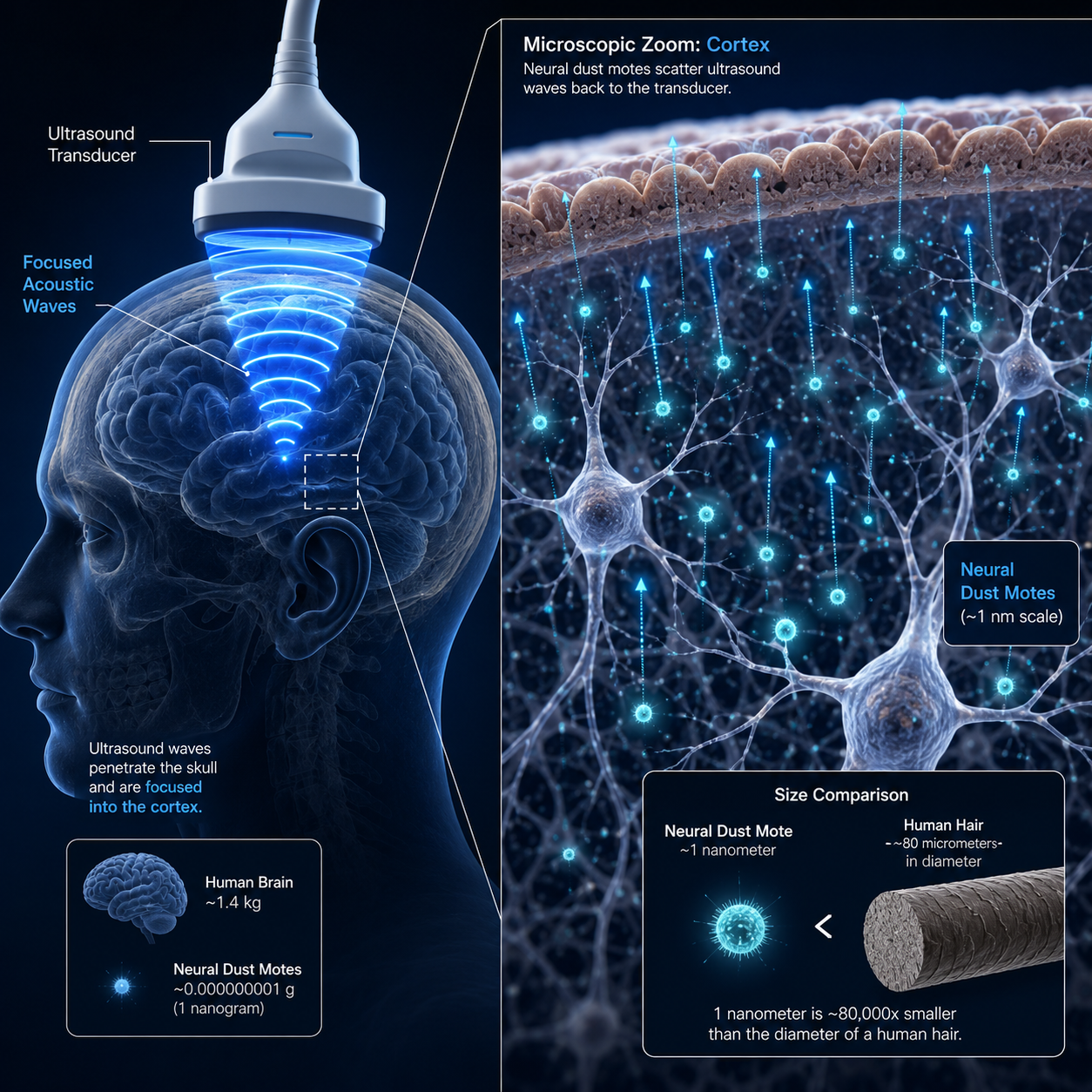
Neural dust is the attempt to rewrite that story entirely. First proposed by researchers at UC Berkeley, neural dust refers to untethered, wireless motes — some only tens of micrometers across — that can be implanted in cortical or peripheral neural tissue without cables or batteries. Power and data communication are handled via ultrasound. An external transducer on the scalp transmits focused ultrasonic pulses; each mote harvests that acoustic energy with a piezoelectric crystal, powers a tiny CMOS chip that amplifies and ADCs the local neural voltage, then backscatters a modulated ultrasonic signal encoding the data. The transducer detects the backscatter and reads the signal out.
The elegance here is almost offensive. You've replaced a wired, battery-powered, infection-prone implant with a passive wireless system that can, in principle, distribute hundreds of sensors across centimeters of cortex with minimal footprint. Because each mote is passive and the interrogating transducer is external, there's no implanted battery to replace (avoiding a major source of revision surgeries), and the absence of transcutaneous wires eliminates the primary infection pathway in current implant designs. Current motes have been demonstrated at under 100 micrometers in some configurations — smaller than the diameter of a human hair.
The engineering challenges remaining are not trivial. Ultrasound doesn't penetrate bone with arbitrary precision — the skull attenuates and distorts the acoustic beam, so targeting motes with sub-millimeter spatial resolution through intact bone is an active research problem. Data rates achievable via ultrasonic backscatter are currently modest compared to wired electrode arrays, which limits the bandwidth of the neural recording. And the long-term biocompatibility of microscopic foreign bodies in cortical tissue over decades remains to be established in large-scale longitudinal studies. None of these are dealbreakers — they're engineering problems with tractable solution paths. But they explain why neural dust, despite being in animal studies for over a decade, is still years from routine clinical use in humans.
# Conceptual neural dust interrogation system — signal chain overview

## Hardware layers:
External Transducer Array
 ├── Focused ultrasound beam: ~700 kHz center frequency
 ├── Transmit burst: 200–500 ns pulses at ~MPa pressure
 └── Receive mode: 128-element phased array, ADC @ 40 MSPS

Neural Mote (per-unit specs, current gen):
 ├── Dimensions: 65 μm × 30 μm × 30 μm (bulk piezo variant)
 ├── Power harvest: ~10 nW from acoustic beam
 ├── Recording: Single-channel neural voltage (bandpass 300Hz–5kHz)
 ├── ADC resolution: 8-bit @ 20 kSPS
 └── Backscatter: Amplitude-shift keying on reflected US beam

## Signal decoding (host system pseudocode):
for each interrogation_cycle:
 transmitted_pulse = fire_us_burst(freq=700e3, duration=500e-9)
 raw_rf = capture_backscatter(window_us=200)
 mote_signals = beamform_and_demux(raw_rf, mote_positions)
 neural_voltages = [demodulate_ask(s) for s in mote_signals]
 store_neural_data(neural_voltages, timestamp=cycle_time)
Pro Tips — Neural Dust Implementation
- Skull compensation algorithms are non-optional. Before running any protocol, characterize the subject-specific skull acoustic transfer function — it varies by 15–30 dB across individuals and changes beam focus dramatically.
- Mote localization first: You must run a mote-localization scan (broadband ping, matched-filter beamforming) before each recording session. Motes shift with tissue compliance changes. Assuming fixed coordinates from implant day is a guaranteed source of data corruption.
- Temperature monitoring: Sustained ultrasound exposure can produce tissue heating. For chronic recording, duty cycle your interrogation bursts. The FDA's mechanical index (MI) and thermal index (TI) guidelines apply — don't assume animal-study parameters translate to human safety margins.
04Optogenetics: The Most Precise Tool in Neuroscience Has a Fundamental Problem — And Why That Matters for BCAN
There's a myth worth busting upfront: optogenetics is not a clinical brain-computer interface technology — yet. It is, however, the most powerful tool neuroscientists have ever built for understanding exactly which neurons do what, and that foundational knowledge is the prerequisite for every other BCAN advancement on this list. Understanding optogenetics means understanding why the entire field can, for the first time, talk about single-neuron precision as something other than a dream.
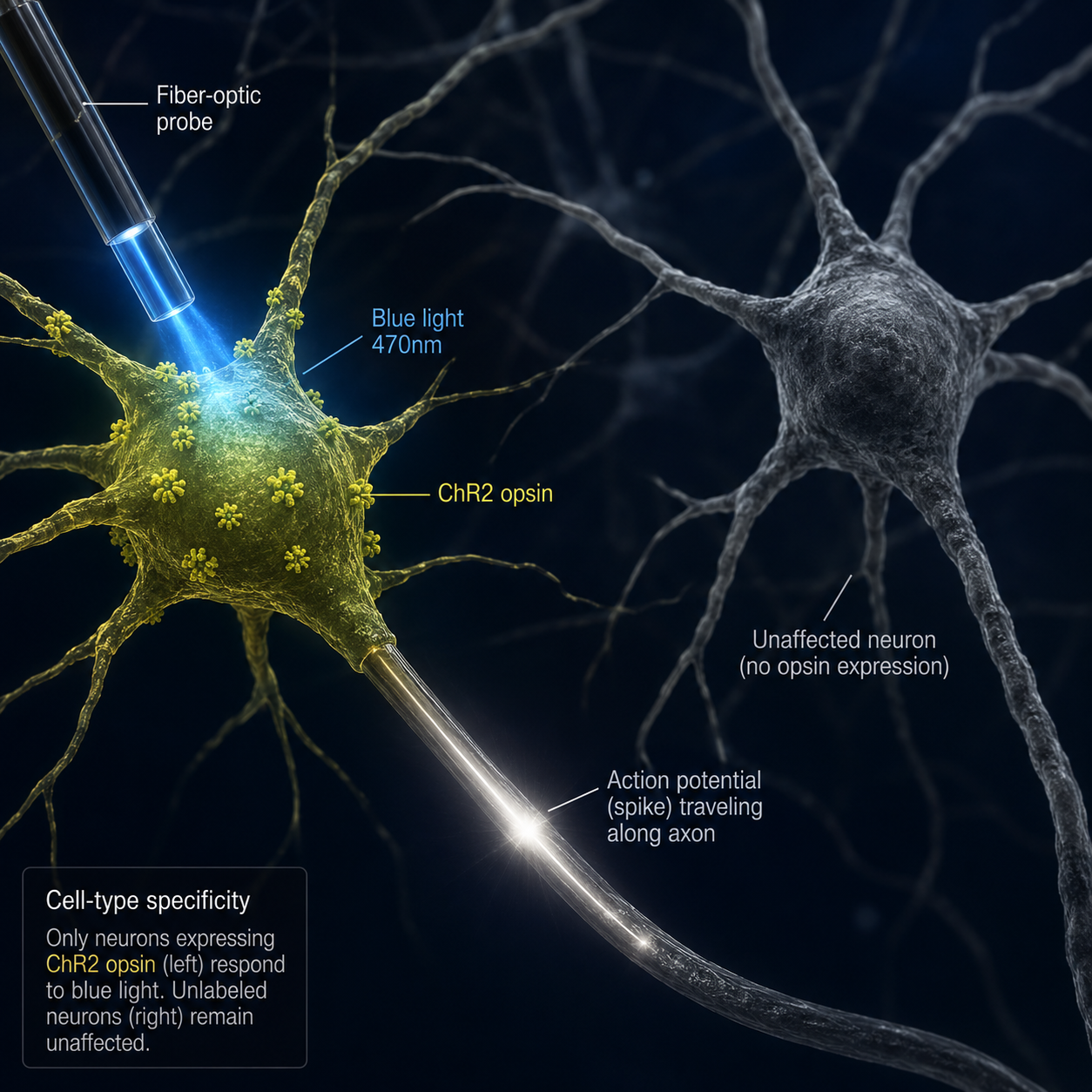
The core idea is almost surreally elegant. Using viral vectors (typically adeno-associated viruses, or AAVs), researchers introduce light-sensitive ion channel proteins called opsins — originally found in algae and archaea — into specific populations of neurons. Once expressed, these neurons become controllable with pulses of light delivered via an implanted optical fiber. Channelrhodopsin-2 (ChR2) activates neurons when illuminated with blue light (~470 nm). Halorhodopsin silences them with yellow light (~580 nm). You can, with millisecond precision, turn specific neurons on and off, creating a reversible, cell-type-specific switch that no electrical stimulation method can come close to matching. This is how neuroscientists have been able to identify, for example, the specific hippocampal engram cells that encode individual memories — and then reactivate those memories on command in mice.
The clinical pathway for optogenetics in humans has been cautious, for good reason. Gene therapy (the delivery mechanism) carries small but non-zero risks of immune reactions and off-target insertions. The light delivery hardware is still relatively bulky for cortical-depth stimulation. And crucially, opsin expression is permanent — unlike a pharmaceutical, you can't just stop taking it. Despite these caveats, the first human optogenetic therapy reached a landmark milestone in 2021, when a patient with retinitis pigmentosa partially recovered light perception after AAV-delivered ChR2 expression in retinal ganglion cells combined with light-intensifying goggles. The retina is an easier target than deep cortex, but the proof-of-principle in humans is now on the books.
The BCAN relevance is this: as optogenetics matures and the viral delivery and hardware miniaturization challenges continue to be addressed, it represents a potential pathway to write to neural circuits with a specificity that electrical stimulation simply cannot achieve. Combined with neural dust for reading and closed-loop AI systems for interpreting, you can begin to sketch the outlines of a three-layer architecture — sense, decode, write — that operates at the resolution of individual neurons rather than brain regions. That shift in resolution is roughly equivalent to going from manipulating file folders on a hard drive to editing individual bytes.
# Conceptual optogenetic stimulation protocol (research context)
# Light delivery via chronically implanted fiber-optic cannula

PROTOCOL: Closed-loop optogenetic feedback during spatial navigation task
TARGET: CA1 place cells (hippocampus), ChR2-expressing, AAV9-CamKII vector
OPSIN: Channelrhodopsin-2 (ChR2-H134R variant, faster kinetics)

## Stimulation parameters:
light_wavelength = 470 nm # blue, matches ChR2 peak
pulse_duration = 5 ms # single spike reliable at 5ms
pulse_power = 1–5 mW/mm² # at fiber tip, tissue-dependent
max_frequency = 40 Hz # above this: opsin desensitization

## Closed-loop trigger logic:
while recording_session_active:
 theta_phase = get_real_time_lfp_phase(channel='CA1_stratum_radiatum')
 if theta_phase in target_phase_window: # e.g., trough ± 20°
 trigger_light_pulse(duration=pulse_duration, power=2.5)
 record_spike_trains(all_units)
Pro Tips — Optogenetics for BCAN Research
- Opsin selection is everything. ChR2 is the textbook choice but not always optimal. For high-frequency stimulation (>20 Hz), use faster variants like ChETA or ChRmine. For inhibition, consider archaerhodopsins (ArchT) over halorhodopsin — less chloride accumulation, more reliable suppression.
- Light scatter is underestimated. In brain tissue, 50% of light intensity is lost within ~0.2 mm of the fiber tip at 470 nm. Don't assume uniform activation across your target volume — map your light spread empirically before drawing conclusions about spatial specificity.
- Heat artifacts: Even modest light power can produce photothermal artifacts on nearby electrodes, mimicking neural spikes. Always run light-stimulation controls on ChR2-negative animals to characterize photoelectric artifacts in your recording setup.
05How It All Connects: The Three-Layer Brain-Silicon Architecture
You've just read about four distinct technologies, and it might feel like a tour through unrelated exhibits in a very complicated museum. But here's the synthesis that ties it all together, and it's the most important paragraph in this entire post:
These four innovations — closed-loop feedback, AI-decoded speech, neural dust, and optogenetics — are not parallel tracks. They're complementary layers of a single architectural stack for seamless bio-digital communication. Neural dust (and its successors) is the sensing layer — massively parallel, minimally invasive, wireless neural recording. AI-decoded speech is the interpretation layer — the natural language processing engine that turns high-dimensional biological noise into actionable intent. Optogenetics (and electrical closed-loop stimulation in the near term) is the write layer — the mechanism for sending information back into neural circuits with precision. And closed-loop systems are the architectural paradigm that binds the three layers into something genuinely bidirectional.
When you stack them, here's what you get: a system that can continuously read distributed neural activity across hundreds of points in the cortex (sensing), infer what a person intends to say or do from that activity in real time (interpretation), and respond by modulating neural circuits to either confirm the decoded intent, deliver artificial sensory feedback, or suppress pathological activity (write). The brain experiences this loop not as hardware — but as an extension of its own function. That's the vision. Not a cyborg aesthetic. Not a gadget. A prosthesis so well-integrated that the neural tissue can no longer tell where biology ends and silicon begins.
The conditions where this matters most in the next decade are well-defined: ALS and locked-in syndrome (communication restoration), treatment-resistant depression and OCD (closed-loop neuromodulation), spinal cord injury (sensorimotor bypass), and early Alzheimer's intervention (hippocampal memory prosthetics). The commercial and humanitarian stakes are enormous. The regulatory and ethical frameworks are, candidly, still being written. Engineers building in this space have an obligation to be part of that conversation — not just the part about bits and bandwidth.
06Getting Started: A Practical Entry Point into BCAN Research & Development
Whether you're a neuroscience PhD student, a hardware engineer considering a career pivot, or a developer curious about the signal-processing side of BCIs, the following steps will give you a practical, non-hand-wavy path from "I find this interesting" to "I'm actually doing meaningful work in this space."
Build Fluency in Neural Signal Processing
Before anything else, you need to understand what you're working with. EEG data (freely available via PhysioNet and OpenNeuro) is your zero-barrier entry point. Learn to filter, epoch, artifact-reject, and compute time-frequency representations (spectrograms, Morlet wavelets) in Python using MNE-Python. The core skill: understanding why high-gamma power (70–150 Hz) is the most informative band for motor and speech decoding, and why it's also the hardest to record reliably from scalp EEG.
# Install and begin with MNE-Python
pip install mne
python -c "import mne; mne.datasets.sample.data_path()"

# Load and visualize a sample EEG dataset
raw = mne.io.read_raw_edf('your_eeg_file.edf', preload=True)
raw.filter(l_freq=1, h_freq=40)
raw.plot_psd(fmax=50)
Understand the Hardware Landscape
Spend time with the spec sheets and published characterizations of the main electrode/amplifier platforms: Neuropixels (academic gold standard for animal research, dense silicon probe), Blackrock Cereplex (clinical-grade intracortical), and open-source options like the OpenBCI Cyton board for non-invasive work. The key parameters to internalize: channel count, input-referred noise (µV RMS), sampling rate, CMRR, and power consumption. For wireless systems, also study the BLE and UHF telemetry implementations — RF coexistence with medical devices is a regulatory minefield.
Engage With a Research Dataset for Neural Decoding
The BrainTreebank and SEEG speech datasets provide real intracranial EEG during language tasks. The NeuroBench initiative offers standardized benchmarking tasks for neural decoders. Start with a classification task (imagine left vs. right hand movement) before attempting continuous decoding of speech. Your first model should be a regularized linear discriminant analysis (LDA) or a shallow CNN — not a transformer. Learn the baseline before you innovate on top of it.
# Simple motor imagery classifier using MNE + sklearn
from sklearn.discriminant_analysis import LinearDiscriminantAnalysis
from mne.decoding import Vectorizer, cross_val_multiscore
import numpy as np

# Assume X: (n_epochs, n_channels, n_times), y: labels
pipeline = sklearn.pipeline.make_pipeline(
 Vectorizer(),
 LinearDiscriminantAnalysis(solver='svd')
)
scores = cross_val_multiscore(pipeline, X, y, cv=5)
print(f"Mean accuracy: {scores.mean():.2%}")
Follow the Clinical Trial Literature Directly
The fastest-moving BCAN developments are not in review articles — they're in trial registrations (ClinicalTrials.gov), preprints (bioRxiv), and conference proceedings (NeurIPS NeuroAI Workshop, SfN annual meeting). Set up alerts for "BCI speech decoding", "closed-loop deep brain stimulation", and "intracortical neural interface" on Google Scholar and Semantic Scholar. The gap between what's in textbooks and what's in preprints in this field is currently about 4 years wide.
Engage With the Ethics and Regulatory Frameworks Early
This step is non-optional for anyone who wants to work on human-applicable systems. Read the FDA's Breakthrough Device guidance for BCIs (the Neural Interface Device Classification, 21 CFR Part 882). Engage with the Neurorights Foundation's framework on cognitive liberty. Understand the IEEE P2731 standard for neural interface terminology. The engineers who will shape this technology most are those who arrive at ethics conversations with technical fluency — not those who show up after the product is already launched.
07Frequently Asked Questions
What is a closed-loop brain-computer interface and how is it different from a traditional BCI?
A traditional BCI reads neural signals and translates them into outputs (cursor movement, prosthetic limb control) without providing any sensory feedback back to the brain. A closed-loop BCI adds a feedback path: it reads brain signals, computes an appropriate response, and stimulates the nervous system — delivering artificial touch sensation, suppressing pathological oscillations, or otherwise modifying neural activity in real time. This bidirectional communication makes closed-loop BCIs dramatically more natural and effective because the brain's own sensorimotor circuits can engage with the feedback, just as they do with normal biological sensation.
How accurate is AI-based brain-to-speech decoding in 2025?
For patients with intracortical electrode arrays and attempted-speech paradigms, the best published systems achieve word error rates (WER) in the 15–25% range on constrained vocabularies (typically 50–1000 words), with some systems reaching under 10% WER in highly controlled conditions. Open-vocabulary, natural-conversation decoding remains significantly harder, with error rates in the 30–50% range depending on speech rate and vocabulary diversity. Imagined speech (without any motor attempt) is in earlier stages, with substantially higher error rates. The trajectory of improvement is steep — WER has dropped by roughly half in each of the last three major publication cycles (2021, 2023, 2024).
Is neural dust safe for humans? Are there FDA-approved neural dust devices?
As of 2025, neural dust remains in pre-clinical and early-phase human research stages. No FDA-approved neural dust devices exist for general clinical use, though research protocols for peripheral nerve applications have advanced further than cortical applications. The primary safety questions under active investigation include long-term biocompatibility of the piezoelectric motes, potential for ultrasound-mediated tissue heating with chronic interrogation, and the immunological response to sub-100-micrometer foreign bodies in neural tissue. The peripheral nervous system pathway (for prosthetic limb sensory feedback and chronic pain management) is considered the nearer-term clinical translation target.
Can optogenetics be used as a brain-computer interface in humans today?
The first successful human optogenetic therapy was demonstrated in 2021 for a patient with retinitis pigmentosa (retinal degeneration causing blindness), who partially recovered light perception. However, cortical optogenetic BCIs — the kind used in rodent and primate research for high-precision neural control — are not yet in human clinical trials for BCI applications. The barriers include: AAV gene therapy safety and permanence, the need to implant light-delivery hardware into the brain, and the requirement for further clinical-grade opsin characterization. Research-grade cortical optogenetics remains a non-human primate model at present, though the pathway to human translation is actively being studied.
What are the biggest ethical concerns with advanced brain-computer interfaces?
The most substantive ethical concerns fall into four categories: privacy (neural data is perhaps the most intimate personal data conceivable — decodable thoughts represent a fundamentally new category of surveillance risk), cognitive liberty (the right not to have one's neural processes read or modified without consent), identity and agency (closed-loop systems that modulate mood or decision-making raise deep questions about authenticity and autonomy), and equity of access (if cognitive enhancement BCIs become available commercially before medical BCIs are covered for people with disabilities, the technology could deepen existing inequality rather than reduce it). The Neurorights Foundation and the Council of Europe have both begun formal policy frameworks addressing these questions.
How does deep brain stimulation differ from a full brain-computer interface?
Deep brain stimulation (DBS) is a mature, FDA-approved neurostimulation therapy where implanted electrodes deliver electrical pulses to specific deep brain structures to treat conditions like Parkinson's disease, essential tremor, and treatment-resistant OCD. It is not a BCI in the traditional sense because it doesn't decode neural intent or enable external device control — it simply modulates neural activity therapeutically. However, next-generation adaptive DBS (aDBS) and closed-loop DBS systems, which sense local field potentials and adjust stimulation parameters in real time, represent a convergence of DBS and BCI technology. These systems are increasingly being classified under the BCAN umbrella.
What programming languages and tools are most used in BCI research and development?
Python is overwhelmingly dominant for signal processing, neural decoding, and machine learning pipelines — the MNE-Python library is the closest thing to a community standard for EEG/MEG analysis. MATLAB remains common in older lab codebases and for real-time signal processing with hardware SDKs (Blackrock, Ripple). C/C++ is used for embedded firmware on the implant side and for latency-critical real-time decoding loops. Julia is gaining traction for its combination of Python-like ergonomics with near-C performance. For neural network model development, PyTorch is the dominant framework, with TensorFlow Lite increasingly relevant for edge deployment on low-power neural interface processors.
What is the difference between EEG-based BCIs and intracortical BCIs?
EEG (electroencephalography) records electrical potentials from the scalp surface, which are the summed activity of large populations of neurons filtered through skull and scalp tissue. This makes EEG non-invasive, inexpensive, and safe — but with poor spatial resolution (centimeter scale) and weak high-frequency content. Intracortical BCIs use electrodes implanted directly in the cortex, recording single-unit activity (individual neuron spikes) and local field potentials with millisecond precision and sub-millimeter spatial resolution. The trade-off is invasiveness, surgical risk, and electrode longevity challenges. ECoG (electrocorticography) is a middle ground — electrode grids on the cortical surface, requiring craniotomy but less invasive than intracortical arrays, with resolution between EEG and intracortical.
08Conclusion: The Most Important Engineering Problem of the Next 20 Years
Let's come back to David in the ICU for a moment. The reason the scenario that opened this article is emotionally resonant — even to people who will never develop motor neuron disease — is that it touches something fundamental about what it means to be human. Language is not just communication. It's cognition made visible. The ability to say "thank you" is not a convenience. It's a form of participation in the world, in relationships, in the irreducible experience of being a person who affects and is affected by others.
What brain-computer interface technology is building toward — through the jagged, hard-fought increments of closed-loop feedback, AI decoding, wireless neural sensing, and light-based neural writing — is nothing less than a prosthesis for that participation. Not a gadget. Not an upgrade. A way back in, for people locked out by biology.
The counterintuitive reality most narratives miss: the biggest barriers to BCAN progress right now are not physics or biology. They're fragmentation and incentive misalignment. Academic neuroscience optimizes for publication metrics. Medical device companies optimize for reimbursement pathways. Tech companies optimize for scale. None of those incentive structures naturally produces the long-term, patient-centered, multi-disciplinary collaboration that actually solves the signal longevity problem, the immune response problem, the decoder drift problem, or the regulatory data gap. The engineers and researchers who understand all four layers of the BCAN stack — sensing, decoding, writing, and closing the loop — are genuinely rare. And they are genuinely needed.
Whether you're here as a curious technologist, a clinician trying to understand what's coming, or a developer who wants to work on the most consequential software in human history, the field needs you to engage — deeply, carefully, and with a clear view of both the breathtaking potential and the serious responsibilities involved.
Go Deeper — Join the Conversation
Subscribe for deep-dives on neural interface engineering, AI neuroscience, and the future of human-machine cognition — delivered without hype and without oversimplification.
Subscribe for Weekly Updates Join the Discussion Below