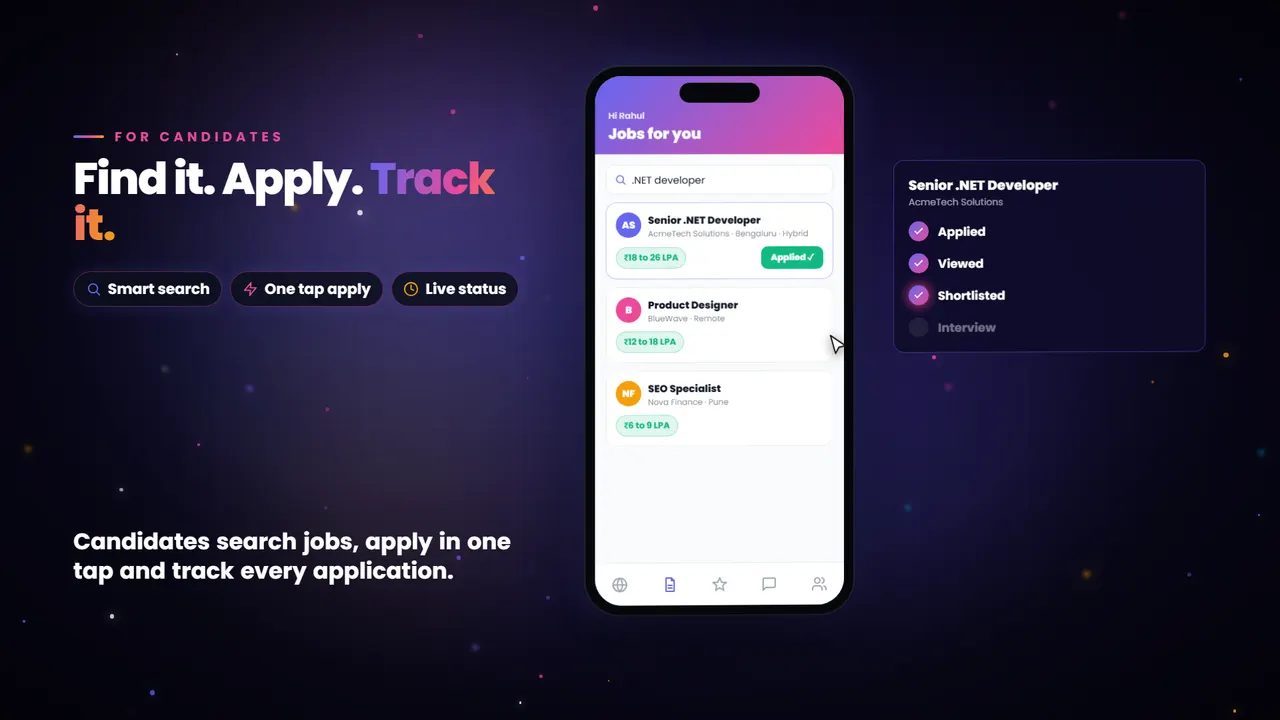
Short answer: you need two marketplaces in one product: a job board (employers post jobs, candidates apply, interviews and alerts) and a freelance marketplace (gigs, project bids and escrow-protected orders), plus admin moderation, payments and a mobile app.
Feature map
| Area | Features |
|---|---|
| Job board | Job posts, search and filters, applications, interview scheduling, job alerts |
| Freelance | Gigs with packages, project posts, bids, orders, deliveries, reviews |
| Payments | Escrow: funds held until the client accepts the delivery |
| Admin | Listing approval, user management, disputes, fees |
| Mobile | Both sides of the marketplace in one app |
| API | Documented REST API for integrations |
Escrow done right
Order states (placed, funded, delivered, accepted, released, disputed) must change inside database transactions so balances can never drift. Get this right before launch; fixing money bugs later is expensive.
Launch plan for a niche marketplace
- Pick one niche and one city or skill category
- Seed supply first (freelancers, candidates)
- Invite a small group of employers and clients
- Moderate every early listing for quality
- Add categories only when the first one has liquidity
How Workvance fits
Workvance Talent Platform combines a job board and freelance marketplace with escrow-protected orders, admin moderation, a mobile app and a documented API, delivered white-label under your brand.
Revenue models for talent marketplaces
- Job posting fees or job packs for employers
- Commission on freelance orders
- Featured listings for gigs and jobs
- Subscriptions for recruiters or agencies
Most niche marketplaces start with one model and add others once both sides are active.
Trust and safety from day one
- Approve listings before they go live in the early months
- Verify employer email domains
- Hold payments in escrow until delivery is accepted
- Give both sides a dispute process with clear timelines
- Rate-limit messages to stop spam
Common mistakes
- Launching in too many categories at once
- Building custom payments logic without transactions
- Ignoring mobile, where most candidates search
- No job alerts, so candidates never return
Glossary
- Liquidity: enough supply and demand that matches happen quickly.
- Gig: a fixed-scope service a freelancer sells at a set price.
- Escrow: funds held by the platform until the buyer accepts the work.
Build vs buy vs customise
| Approach | Time to launch | Control | Best for |
|---|---|---|---|
| Build from scratch | Many months | Total | Unusual business models with funding for a long build |
| Off-the-shelf script | Days to weeks | Low | Testing demand in a simple job niche |
| Customise a ready platform | Weeks | High | Launching a serious niche marketplace quickly |
Data model essentials
- Users with roles: candidate, employer, freelancer, client and admin, often one person holding several roles.
- Listings: jobs, gigs and projects with categories, skills, location and budget.
- Transactions: applications, bids, orders and their status history.
- Money: escrow balances, fees and payouts recorded as ledger entries, never as editable totals.
- Trust: reviews tied to completed orders only, reports and dispute records.
SEO for a job board
Job pages should carry JobPosting structured data with salary, location and closing date, expire cleanly when filled, and category and city pages should only exist once they list enough live jobs. Thin, empty category pages hurt the whole site.
Frequently asked questions
How much does it cost to build a job portal?
Building from scratch usually takes many months; starting from a ready platform and customising it is faster and cheaper. Ask for a quote based on your niche and features.
What is escrow in a freelance marketplace?
The client pays into escrow when ordering; the money is released to the freelancer only after the client accepts the delivery.
Can one platform handle full-time jobs and freelance gigs?
Yes, if it is designed with both a job board and a freelance marketplace sharing users, profiles and messaging.