antimatterCERNmatter-antimatter-asymmetryCPT-symmetryPenning-trapbaryon-asymmetryWu-experimentantihydrogenparticle-physicsbaryogenesis
Universe
Antimatter Explained: The Mystery That Shouldn't Let Us Exist
TL;DR Most physicists would have thrown away the negative solution as unphysical. Dirac didn't. He proposed that the negative-energy solution corresponded to an entirely new particle — the same mass as an electron, but opposite charge. Four years before anyone had seen one, he predicted the positron.
Read this article as text (accessible version)
CERN Antimatter Factory — Deep Dive
·
4,100 words · 4 interactive simulations · April 2026
Antimatter Explained:
Antimatter Explained:
The Mystery That Shouldn't Let Us Exist
One in a billion. That's the rounding error in the Big Bang that created every atom in the universe — every person, planet, and galaxy. CERN is spending billions of dollars and decades of research to find out why. Here's the full story.
Read the Deep Dive ↓ Open Physics Lab ⚛️ Table of Contents- What Is Particle Annihilation?
- The Matter-Antimatter Asymmetry Crisis
- CPT Symmetry: The Unbreakable Rule
- The Wu Experiment: God Was Left-Handed
- CERN's Antimatter Factory
- How Do You Store Antimatter?
- Does Antimatter Fall Up or Down?
- Getting Started: The Physics Calculations
01What Is Particle Annihilation? The Most Violent Process Physics Allows
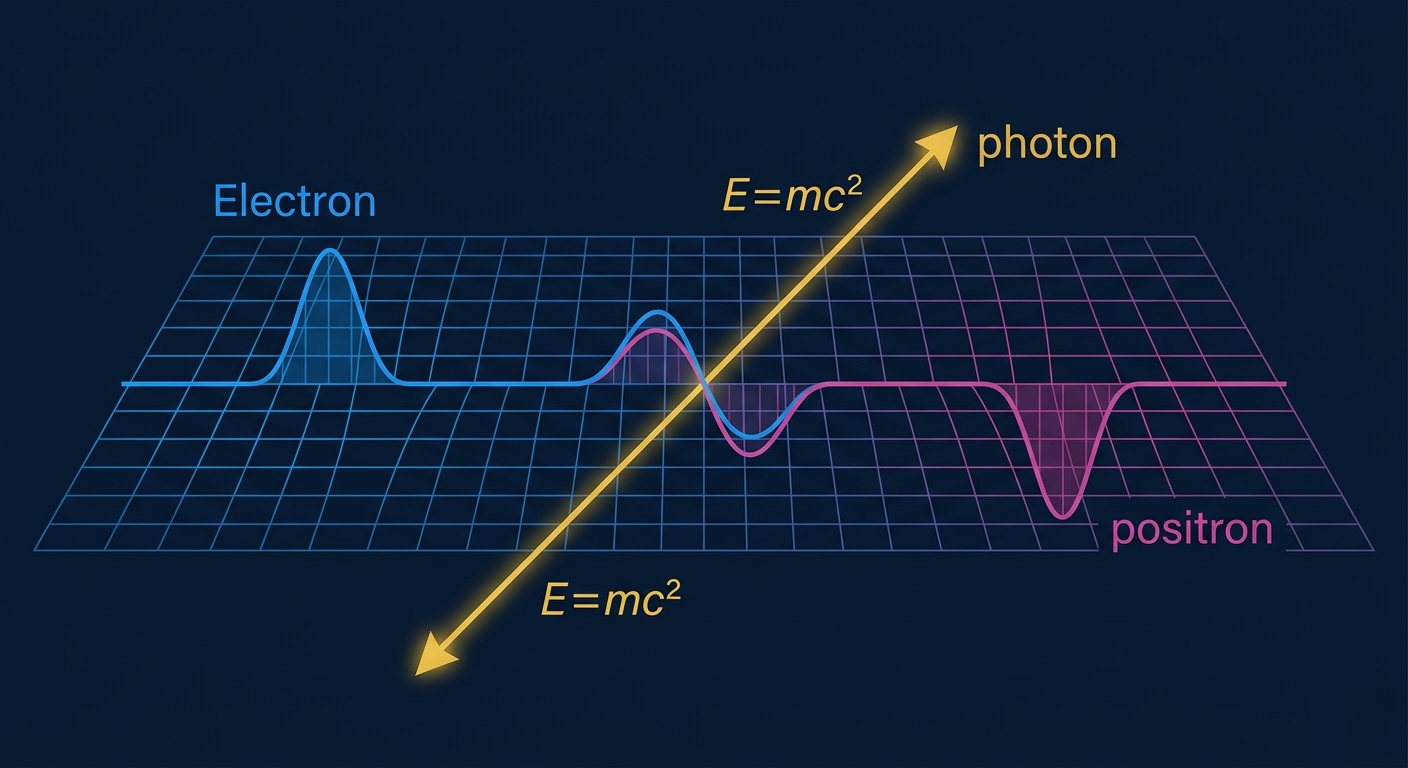
In 1928, Paul Dirac was trying to write a single equation that unified quantum mechanics with Einstein's special relativity. He succeeded — but his equation had a disturbing extra solution. For every electron at rest, the math predicted two possible energies: E = mc² and E = −mc². Most physicists would have thrown away the negative solution as unphysical. Dirac didn't. He proposed that the negative-energy solution corresponded to an entirely new particle — the same mass as an electron, but opposite charge. Four years before anyone had seen one, he predicted the positron.
When a positron meets an electron, something remarkable happens. They're mirror images of each other — field excitations that are exact opposites. When they overlap, their opposite charges cancel, the excitations vanish, and the quantum field returns to its ground state. But where does the mass go? It can't disappear — conservation of energy is sacrosanct. The mass converts entirely into energy via E = mc², transferred into photons. Two particles weighing roughly 9×10⁻³¹ kg each produce two gamma ray photons totaling 1.022 MeV. This is annihilation: matter and antimatter converting nearly 100% of their combined mass into pure energy, with no waste. For comparison, nuclear fission converts about 0.1% of mass to energy. Antimatter is roughly 1,000 times more efficient.
Here's the thing most physics explainers miss: every fundamental particle has an antiparticle twin because the math demands it. Quantum field theory describes particles as excitations of quantum fields that permeate all of space. The equations that describe any field require a mirror-opposite excitation to exist — the antiparticle. There are only two exceptions: the photon and the Higgs boson, which are their own antiparticles. Every quark, every lepton, every boson with charge has an antimatter twin waiting in the equations.
💡 Why Antimatter Is $100 Trillion Per GramAntimatter's cost comes entirely from production efficiency. Making antiprotons requires slamming protons into an iridium target at 99.93% the speed of light. For every trillion proton collisions, you might produce a few million antiprotons — then you have to slow them down, capture them, and store them without touching matter. CERN produces about 10¹⁰ antiprotons per year. A gram of antiprotons would require 10²³ of them. At current production rates, a gram would take 10¹³ years — about 700 times the age of the universe. The $100 trillion/gram figure doesn't account for whether it's even physically achievable.
annihilation_energy.py# Calculate energy released by matter-antimatter annihilation
import math
# Physical constants
c = 299_792_458 # speed of light (m/s)
m_e = 9.1094e-31 # electron mass (kg)
m_p = 1.6726e-27 # proton mass (kg)
J_per_eV = 1.6022e-19 # joules per eV
def annihilation_energy(mass_kg):
"""Energy from total mass-energy conversion E = mc²"""
energy_J = mass_kg * c**2
energy_MeV = energy_J / (1e6 * J_per_eV)
energy_TNT = energy_J / 4.184e9 # 1 ton TNT = 4.184e9 J
return energy_J, energy_MeV, energy_TNT
# Positron + electron annihilation
e_J, e_MeV, e_TNT = annihilation_energy(2 * m_e)
print(f"e⁻+e⁺ annihilation: {e_MeV:.3f} MeV") # 1.022 MeV
# 1/8 gram of antimatter (like Angels & Demons)
gram_8th = 0.125e-3 # 0.125 grams in kg
mass_total = 2 * gram_8th # matter + antimatter together
tot_J, tot_MeV, tot_TNT = annihilation_energy(mass_total)
print(f"1/8g antimatter: {tot_J:.2e} J = {tot_TNT:.0f} tons TNT")
# → 1/8g antimatter: 2.25e13 J = 5,383 tons TNT
# Hiroshima bomb ≈ 15,000 tons TNT
# So: ~36% of the Hiroshima bomb yield
02The Matter-Antimatter Asymmetry: Why Anything Exists at All
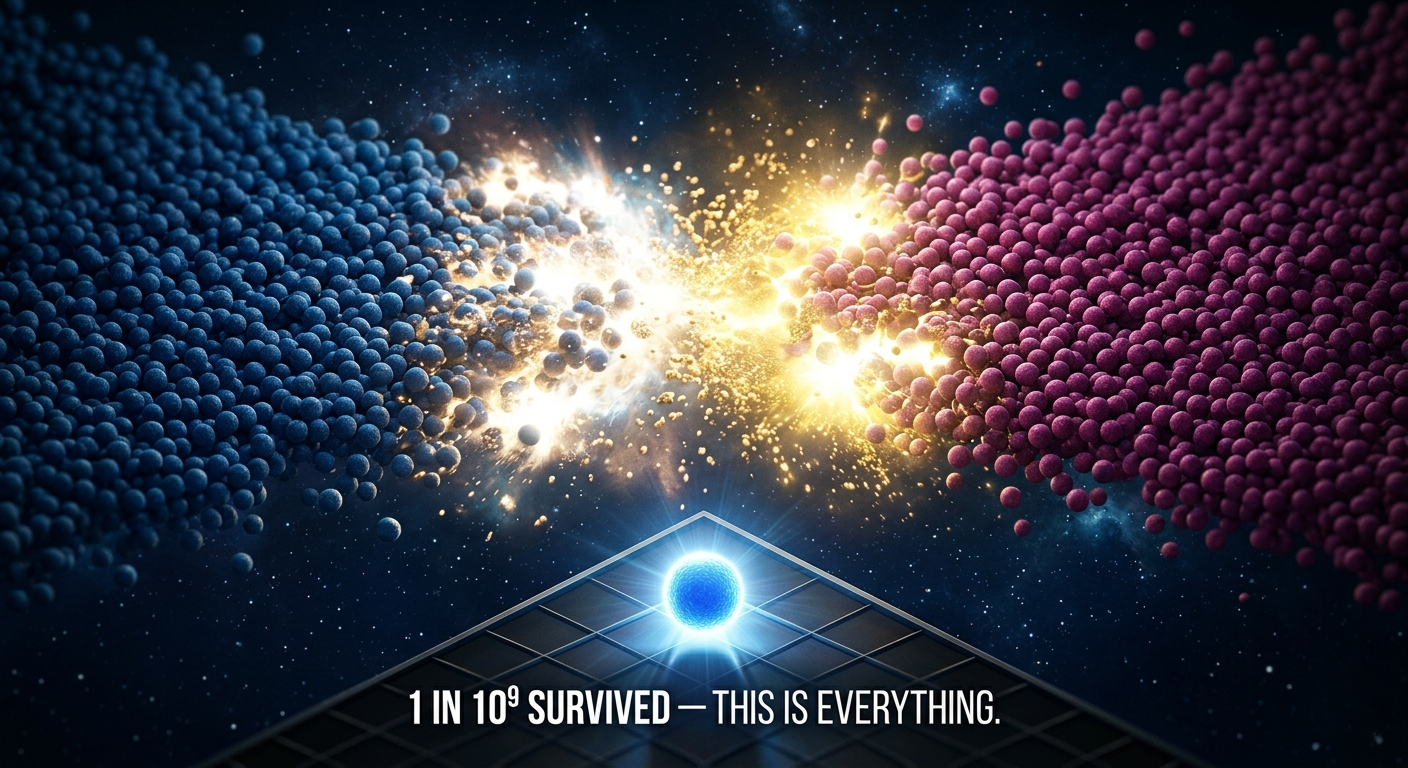
Here's the existential crisis at the heart of physics. In the first fraction of a second after the Big Bang, conditions were so extreme that photons spontaneously converted their energy into matter-antimatter pairs. The universe was a seething plasma of particles and antiparticles popping in and out of existence. As the universe expanded and cooled, pair production stopped — about 3 seconds after the Bang. Every particle should have found its antiparticle twin. Every proton should have annihilated with an antiproton. Every electron with a positron. What should have remained was a cold, dark universe filled with nothing but photons.
Instead, you're reading this. Which means something went wrong — or rather, incredibly right. For reasons still unknown, the universe produced slightly more matter than antimatter in those first moments. The asymmetry is tiny: for every billion antimatter particles and billion matter particles, there was one extra matter particle. Everything in the observable universe — every atom in every star, planet, and person — is descended from those lucky 1-in-a-billion survivors. We exist because of a cosmic rounding error that physicists have spent 60 years failing to fully explain.
We can actually measure the size of this asymmetry by counting the Cosmic Microwave Background. The CMB contains about 10⁸⁹ photons — the leftovers from all that annihilation. There are about 10⁸⁰ ordinary matter particles (protons, neutrons) in the observable universe today. This means for every billion antimatter + billion matter particles that annihilated, one matter particle survived. The ratio is roughly 1 in 10⁹. This is called the baryon asymmetry, and it's one of the most important unsolved problems in all of physics.
🔮 Myth: Maybe There Are Antigalaxies SomewhereIn the 1930s, Paul Dirac speculated that half the stars might be made of antimatter. Even entire antigalaxies. The idea was appealingly symmetric — equal amounts of matter and antimatter just happened to be spatially separated. This was ruled out by looking for the boundary regions where matter and antimatter zones would meet. Those regions would be sources of intense gamma radiation from continuous annihilation. Surveys found no such hotspots anywhere in the sky. The universe is genuinely matter-dominated. There's no symmetric antimatter mirror universe hiding somewhere. The asymmetry is real and global.
03CPT Symmetry: The Rule Physics Must Not Break
In the 1950s, physicists believed the universe obeyed three fundamental symmetries: Charge (C), Parity (P), and Time reversal (T). Charge symmetry means swapping all positive and negative charges produces identical physics — there's nothing special about positive versus negative. Parity symmetry means the mirror universe is physically identical to ours — you can't tell whether you're in our universe or its reflection. Time reversal symmetry means individual particle interactions work equally well forwards or backwards in time (your intuition that you can't unshatter a wine glass is correct, but that's statistics, not fundamental physics — at the level of individual particles, every interaction is reversible).
These three symmetries combine into CPT symmetry: if you simultaneously swap charges, reflect everything in a mirror, and reverse time, the physics is unchanged. CPT symmetry is special because it's not just empirically observed — it's mathematically required by any quantum field theory that obeys special relativity. Specifically, the Schwinger-Lüders-Pauli theorem (1951) proved that any Lorentz-invariant quantum field theory must be CPT symmetric. Since special relativity's core principle — that physics looks the same for all inertial observers — is among the most well-tested claims in science, CPT is about as solid as physics gets.
The crisis: if matter-antimatter asymmetry requires different physics for particles versus antiparticles, it requires a violation of C or CP symmetry. But if you break both C and CP completely, you've broken CPT, which brings down the entire standard model and special relativity with it. What we need — and what makes this so maddening — is a C and CP violation that's real but not so severe that it destroys CPT. We need a tiny, asymmetric crack in an otherwise perfect symmetry. And we need that crack to be roughly a billion times larger than what we've found so far.
🚨 CPT Violation Would Break Physics As We Know ItIf CPT symmetry were broken, the consequences would be catastrophic for theoretical physics. The principle that the speed of light is the same for all inertial observers would break down. Quantum field theory — the framework underlying all of the Standard Model — would require fundamental revision. Particles would no longer be identical excitations of the same field. Every electron in the universe would not necessarily be exactly alike. The fact that CPT must hold is precisely why physicists are both desperate to find CP violation (to explain our existence) and terrified of finding CPT violation (which would invalidate their best theories).
04The Wu Experiment: God Turned Out to Be a Weak Left-Hander
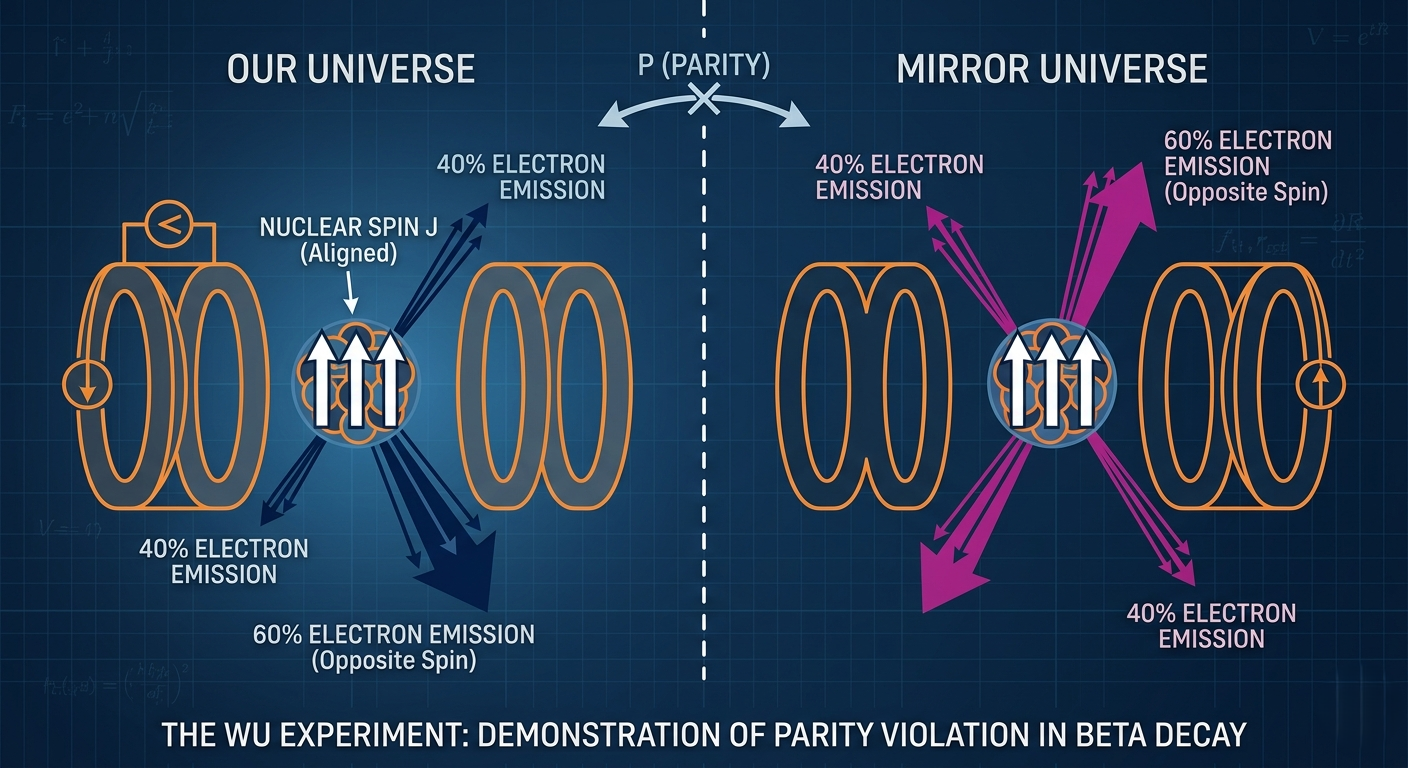
In 1956, theorists Tsung-Dao Lee and Chen-Ning Yang noticed a gap in the experimental record: nobody had tested whether parity — mirror symmetry — holds for the weak nuclear force specifically. Every other force had been checked. The weak force, which governs radioactive decay, had not. They wrote a paper pointing this out, and recruited one of the world's leading experimentalists, Chien-Shiung Wu, to test it. Wolfgang Pauli, one of the architects of quantum mechanics, was so confident in parity conservation that he said he was "ready to bet a very high sum" the experiment would show perfect symmetry.
Wu's experiment used cobalt-60, a radioactive isotope whose nuclei have intrinsic spin. She aligned all the spins with a strong magnetic field, then measured which direction the electrons from radioactive decay were emitted. The logic was simple: if parity holds, the number of electrons going parallel to the spin should equal those going antiparallel. She found it wasn't 50/50. Around 60% of electrons went in the opposite direction to the nuclear spin. This is a measurable, physical distinction between our universe and its mirror image. The universe favors left-handedness in the weak force.
The physics community was shocked. Pauli, upon learning of the result, exclaimed "That's total nonsense!" The experiment was repeated by multiple independent teams. By 1957, the result was unambiguous. God really is a weak left-hander. Lee and Yang won the 1957 Nobel Prize. Wu, who designed and performed the experiment, was not nominated — widely considered the most egregious omission in Nobel history. The 1988 Nobel laureate Jack Steinberger called it the committee's "biggest mistake." Wu did receive the first Wolf Prize in Physics, the National Medal of Science, and is now recognized as the "First Lady of Physics."
⚠️ CP Violation Is Real but Not Big EnoughAfter the Wu experiment broke parity (P), physicists hoped that the combined CP symmetry might still hold. In 1964, Cronin and Fitch found that kaon decays also violated CP symmetry. Two fundamental symmetries were broken. In 1973, Kobayashi and Maskawa showed how to incorporate CP violation into the Standard Model, which earned them the 2008 Nobel Prize. But the amount of CP violation their model predicts corresponds to only 10⁻¹⁸ of the required baryon asymmetry. It's a billion times too small. The Standard Model explains the mechanism of CP violation but not its magnitude. This is the smoking gun that new physics must exist beyond the Standard Model.
05CERN's Antimatter Factory: Making Anti-Atoms in Real Life
At the southern edge of CERN's Large Hadron Collider complex, there's a smaller, quieter facility that does something quietly astounding: it manufactures antimatter. Protons from CERN's Proton Synchrotron are accelerated to 99.93% the speed of light — carrying up to 26 GeV of energy — and fired at an iridium rod 3 mm in diameter and 55 mm long. Iridium was chosen because it's the second densest element on Earth, packing the maximum number of nuclei into the minimum space, increasing collision probability.
When a proton hits an iridium nucleus at that energy, it doesn't bounce. It penetrates the nucleus and collides with an individual neutron or proton inside. At those energies, the proton's constituent quarks are traveling near the speed of light, held together by the strong force — mediated by gluons — acting like rubber bands under extreme tension. When enough energy is added, those rubber bands snap, creating new quark-antiquark pairs. A shower of particle-antiparticle pairs erupts in 10⁻²³ seconds. Occasionally — not very often — three antiquarks (two anti-up and one anti-down) happen to come close enough to bind together, forming an antiproton. Every run produces roughly 30 million antiprotons out of trillions of collisions.
But raw antiprotons from the collision are traveling at 96% the speed of light and must be slowed down for experiments. The Antiproton Decelerator ring and its successor ring, ELENA, progressively slow them from 96% to 1.5% the speed of light — still 16.2 million km/h. From there, antiprotons flow to five experiments, each probing a different aspect of antimatter. The entire facility achieves 86% efficiency from capture to delivery. This is one of the most precisely engineered antimatter handling systems ever built.
💡 Making Antihydrogen Is Even HarderTo test gravity on antimatter, you need neutral antiatoms — antihydrogen (one antiproton + one positron). But you can't just combine antiprotons with positrons directly. CERN's GBAR experiment first makes positronium (an electron-positron bound state that lives only 142 nanoseconds), then fires antiprotons through the positronium cloud at precisely the right moment. When a few of the 3 million antiprotons passing through steal a positron, you get antihydrogen — typically 1-5 antiatoms per run. The entire elaborate apparatus — particle accelerator, tungsten target, magnetic lenses, separation coils, accumulation trap, positronium converter — exists to produce a handful of antiatoms per experimental run.
antiproton_production.py# Estimate total antimatter ever produced at CERN
antiprotons_per_year = 1e10 # ~10 billion antiprotons/year
years_operating = 25 # facility operational since ~2000
total_antiprotons = antiprotons_per_year * years_operating
# Convert to grams (proton mass ≈ 1.67e-24 g)
proton_mass_g = 1.6726e-24 # grams
total_grams = total_antiprotons * proton_mass_g
avogadro = 6.022e23 # particles per mole
grams_per_mole = 1.008 # hydrogen molar mass
grams_needed = 1.0 # 1 gram target
print(f"Total antiprotons produced: {total_antiprotons:.2e}")
print(f"Total mass: {total_grams:.2e} grams")
print(f"That's 10^{int(math.log10(grams_needed/total_grams)):.0f} grams short of 1 gram")
# Output:
# Total antiprotons produced: 2.50e11
# Total mass: 4.18e-13 grams (0.4 picograms!)
# 12 orders of magnitude away from 1 gram
# A gram would take ~10^13 years at current rates
06How Do You Store the Substance That Destroys on Contact?
Storing antimatter sounds like science fiction. If it touches any matter, it annihilates. There's no container you can make from normal matter. The solution is elegant: don't use a physical container. Use electromagnetic fields as invisible walls. A Penning trap — named after Dutch physicist Frans Penning — combines a strong magnetic field (from superconducting magnets) with electric fields from end-cap electrodes. The magnetic field confines charged particles to circular orbits in the center. The electric fields prevent escape through the ends. Cool the entire apparatus to 4 Kelvin (-269°C) and pump it to ultra-high vacuum comparable to outer space, and you have a volume of space where antiprotons can orbit indefinitely, touching nothing.
The current world record for antiproton storage is 614 days — nearly two years. That's 614 days of anti-particles cycling in a magnetic bottle, not annihilating, stored by a team at CERN's BASE experiment. But BASE didn't just store antiprotons — they took the Penning trap mobile. They built a self-contained trap with its own power supply, cooling system, and vacuum maintenance, capable of operating independent of CERN's infrastructure. On March 24, 2026, an 800-kilogram trap containing 92 antiprotons was loaded onto a truck and driven on a 10-kilometer loop around the CERN campus. The first antimatter transport.
The implications are significant. If antimatter can be stored for years and transported, then the single biggest bottleneck in antimatter physics — the fact that only one facility on Earth produces it — starts to dissolve. Experiments at universities around the world could theoretically receive antiproton deliveries like a scientific supply chain. The physics community is imagining a network where CERN serves as the antimatter factory, distributing to ambitious experiments globally. The Angels & Demons scenario of stolen antimatter remains comically implausible (92 antiprotons weighs about 10⁻²² grams), but the principle is no longer science fiction.
✅ Why Antihydrogen Is Harder to Store Than AntiprotonsAntiprotons are negatively charged, which means electric and magnetic fields can hold them easily. Antihydrogen is electrically neutral, so you can't use electric fields on it at all. It has a very weak magnetic moment, so a magnetic trap can hold it only if it's extremely cold and extremely slow. At room temperature, antihydrogen atoms zip around so fast they escape the magnetic trap instantly. ALPHA-g can trap antihydrogen atoms only when they're cooled to about 0.5 Kelvin. The GBAR experiment's entire elaborate setup — the antihydrogen ion, the laser cooling, the beryllium sympathetic cooling — exists to get antihydrogen to 10 micro-Kelvin, 50,000 times colder, to improve gravity measurement precision to 1%.
07Does Antimatter Fall Up or Down? The Answer That Surprised No One (But Could Have)
For decades, a small community of physicists entertained an audacious idea: antigravity. What if antimatter is gravitationally repulsive? What if an antiproton dropped in Earth's gravity field would fall upward? This would explain the matter-antimatter asymmetry — if antimatter repels gravity while matter attracts it, then in the early universe, matter would have clumped together while antimatter spread out, eventually resulting in our matter-dominated world. It's a beautiful idea. And it turns out to be wrong.
Testing gravity on antimatter sounds simple: drop an antiproton and see which way it falls. But antiprotons are electrically charged, and the electric force is 10³⁶ times stronger than gravity. Even the tiniest stray electric field would overwhelm any gravitational signal. You need a neutral antiatom. In 2023, CERN's ALPHA-g experiment was the first to directly measure the gravitational acceleration of antihydrogen. They trapped 100 antihydrogen atoms, slowly weakened the magnetic trapping field, and counted whether more atoms escaped through the top or bottom of the trap. More escaped through the bottom, confirming that antihydrogen falls in the same direction as ordinary hydrogen. Gravity is attractive for antimatter, not repulsive.
ALPHA-g measured the gravitational acceleration as 0.75 ± 0.13(statistical) ± 0.16(systematic) times normal gravity — consistent with normal gravity but with enormous error bars. The GBAR experiment is designed to reduce this error to 1%, and ultimately to 0.001%. At that precision, they might detect subtle differences predicted by certain quantum gravity theories. Gravity is special in this context precisely because it doesn't obey special relativity in the way the Standard Model does — which means it doesn't have to obey the CPT theorem. It's theoretically possible for gravity to behave differently for matter and antimatter even while maintaining CPT everywhere else. This is one reason why measuring gravity on antimatter to high precision is considered one of the most important experiments in physics.
💡 Why Temperature Matters So Much for Gravity ExperimentsThe precision of a free-fall gravity measurement scales with how slow the falling object is at the start. If you drop a hot, fast-moving antihydrogen atom from a 20 cm height, it completes the fall in roughly 0.2 seconds — but it was already moving so fast from thermal energy that the gravitational effect is a tiny perturbation you can barely measure. If the atom is essentially stationary at 10 micro-Kelvin before being released, the fall time can be measured with exquisite precision, and gravity's acceleration is the dominant effect. This is why GBAR's entire apparatus — the positronium converter, the antihydrogen ion, the laser cooling, the sympathetic cooling with beryllium — exists: to make the atom as cold and still as possible before releasing it.
08Getting Started: The Calculations Behind the Mystery
Want to run the actual physics calculations? Here's a self-contained Python module covering the key quantities in antimatter physics — annihilation energy, baryon asymmetry, Penning trap dynamics, and the GBAR free-fall precision estimate.
antimatter_physics.pyimport math
# ── Physical constants ──────────────────────────────────────
c = 299_792_458 # m/s
m_p = 1.6726e-27 # proton mass (kg)
g = 9.80665 # gravitational acceleration (m/s²)
k_B = 1.38065e-23 # Boltzmann constant (J/K)
# ── 1. Baryon Asymmetry Calculation ────────────────────────
cmb_photons = 1e89 # CMB photon count (from observations)
baryons = 1e80 # observable universe baryon count
asymmetry = baryons / cmb_photons
print(f"Baryon asymmetry η ≈ {asymmetry:.0e}") # ≈ 10^-9
print(f"1 matter particle survived per {int(1/asymmetry):,} annihilations")
# ── 2. GBAR Free-Fall Precision Estimate ───────────────────
T_micro_K = 10e-6 # target temperature (10 μK)
drop_height = 0.20 # 20 cm drop
# Thermal velocity of antihydrogen at T_micro_K
m_H = 1.67e-27 # antihydrogen mass ≈ proton mass
v_thermal = math.sqrt(3 * k_B * T_micro_K / m_H)
print(f"Thermal velocity at 10μK: {v_thermal*100:.2f} cm/s")
# Fall time from rest over 20 cm: h = ½gt² → t = √(2h/g)
t_fall = math.sqrt(2 * drop_height / g)
print(f"Free-fall time: {t_fall*1000:.1f} ms")
print(f"Target precision: ~1% in g measurement")
# ── 3. Annihilation energy per kilogram ────────────────────
def energy_per_kg(fraction_of_c=1.0):
"""Energy density of matter-antimatter annihilation"""
return 2 * fraction_of_c * c**2 # both matter and antimatter
print(f"Annihilation energy: {energy_per_kg()/1e15:.0f} petajoules/kg")
# 1 kg of antimatter + 1 kg matter → 180 petajoules
# Compare: Hiroshima bomb ≈ 0.063 petajoules
# 1 kg antimatter ≈ 2,857 Hiroshima bombs
synthesisHow It All Connects
The matter-antimatter mystery is a chain of connected puzzles. Dirac's equation predicted antiparticles → quantum field theory showed why every particle must have an antiparticle twin → Big Bang cosmology predicted equal creation of matter and antimatter → observation shows matter dominance → the asymmetry requires CP violation beyond what the Standard Model provides → CPT must remain intact or all of modern physics collapses → therefore there must be new physics, somewhere, waiting to be found.
CERN's antimatter factory is our sharpest probe of this new physics. By measuring the properties of antiprotons, antihydrogen, and soon the gravitational behavior of antiatoms at unprecedented precision, they're looking for tiny cracks in the symmetry between matter and antimatter — cracks that could point toward the new physical mechanism that tipped the balance one in a billion times in favor of matter. It's a billion-to-one long shot. It's also why anything exists.
FAQFrequently Asked Questions
How much antimatter does CERN actually produce? + About 10¹⁰ antiprotons per year — 10 billion. That sounds like a lot until you realize a gram of antiprotons would require 10²³ of them. At current production rates, making a gram of antiprotons would take roughly 10¹³ years — about 700 times the age of the universe. The total antimatter ever produced at CERN in 25 years of operation is approximately 4×10⁻¹³ grams — less than a trillionth of a gram. The Angels and Demons scenario of stealing an eighth of a gram is not just dangerous, it's physically impossible with any technology that could be built in the foreseeable future. What is the difference between an antiproton and antihydrogen? + An antiproton is just the antimatter version of a proton — three antiquarks (two anti-up, one anti-down) bound together by the strong force, carrying a negative charge. Antihydrogen is a complete antiatom: one antiproton as the nucleus, orbited by one positron (anti-electron). Antihydrogen is electrically neutral, which makes it much harder to trap (no electric fields can hold it) but essential for gravity experiments (charged particles are dominated by electromagnetic forces, not gravity). Making antihydrogen requires merging antiprotons with positrons — a process that produces only a handful of antiatoms per run. If matter and antimatter annihilate, why doesn't CERN's antimatter factory blow up? + Because the antimatter is stored in an ultra-high vacuum, surrounded by magnetic and electric fields, with essentially nothing to annihilate with. The Penning trap maintains vacuum conditions comparable to outer space — about 10⁻¹⁵ atm pressure. At those pressures, there are so few residual gas molecules that collisions (and annihilations) are extremely rare. The current leakage rate is about 14% over the full capture-to-delivery cycle — mostly from antiprotons annihilating with residual gas. The 92 antiprotons transported in March 2026 weighed approximately 1.5×10⁻²² grams. The energy from their complete annihilation would be about 1.3×10⁻⁵ joules — roughly equivalent to a mosquito's kinetic energy in flight. What would antigravity mean for antimatter? + Antigravity — antimatter being gravitationally repulsive — was seriously proposed by some physicists in the 1950s and 1960s. The idea was appealing because it would provide a natural explanation for baryon asymmetry: in the early universe, matter and antimatter were produced equally, but gravity caused them to separate. The ALPHA-g experiment at CERN directly tested this in 2023 and confirmed that antihydrogen falls downward, just like normal matter. The gravitational acceleration measured (0.75 ± ~0.29g) is consistent with normal gravity within the large error bars. Antigravity is ruled out as a simple explanation for the asymmetry. Whether gravity is precisely equal for matter and antimatter, or differs by tiny amounts predicted by quantum gravity theories, remains to be tested at the ~1% precision level that GBAR aims for. What is Baryogenesis and why hasn't it been solved? + Baryogenesis is the theoretical process by which the matter-antimatter asymmetry arose in the early universe. Sakharov conditions (1967) describe three requirements for any mechanism that could produce it: (1) baryon number violation — processes that create more matter than antimatter, (2) C and CP violation — the laws of physics must treat matter and antimatter differently, and (3) departure from thermal equilibrium — the universe must be "out of balance" for any asymmetry to stick. All three conditions are satisfied by the Standard Model in principle, but the amount of CP violation it contains is about a billion times too small. New physics — possibly supersymmetry, leptogenesis, or something not yet theorized — must supply the additional asymmetry. The challenge is that most proposed mechanisms operate at energy scales (10¹⁵ GeV or higher) that no particle accelerator can reach. Could antimatter ever be used as a fuel or weapon? + Theoretically, antimatter has an energy density about 100 billion times higher than chemical fuels and about 1,000 times higher than nuclear fission. Star Trek warp drives use matter-antimatter annihilation for exactly this reason. Practically, the energy cost of producing antimatter exceeds the energy it releases by roughly 10 billion to 1 — you'd have to spend 10 billion joules of electricity to create antimatter that releases 1 joule. NASA's Institute for Advanced Concepts studied antimatter propulsion and concluded that milligrams of antimatter could theoretically power interplanetary missions, but producing even a microgram would require decades and trillions of dollars. As a weapon, the 92 antiprotons in CERN's transport truck would release less energy than a mosquito's wing beat upon annihilation. Any "antimatter bomb" scenario requires production capabilities that don't exist and may never exist. What is CPT symmetry and why does it matter so much? + CPT symmetry states that if you simultaneously reverse the charge (matter ↔ antimatter), mirror the spatial coordinates (left ↔ right), and reverse time, the laws of physics are unchanged. The Schwinger-Lüders-Pauli theorem (1951) proves that any quantum field theory consistent with special relativity must be CPT symmetric. This is why CPT breaking would be catastrophic — it would mean special relativity is fundamentally wrong, quantum field theory is invalid, and the Standard Model must be rebuilt from scratch. The theorem is why physicists simultaneously need CP violation (to explain the matter-antimatter asymmetry) but are terrified of CPT violation. The Standard Model cleverly incorporates CP violation through the CKM matrix while maintaining CPT — but the CP violation it predicts is 10⁻¹⁸, a billion times too small to explain what we observe. Is there a way to distinguish a matter star from an antimatter star with telescopes? + The spectra — the light emitted at different wavelengths — of a star made of antimatter would be identical to a star made of matter. Atomic energy levels are determined by the electromagnetic interaction, which is perfectly CP symmetric. An antiatom has exactly the same electron (positron) energy levels as a normal atom. This is exactly what Dirac pointed out in his 1933 Nobel lecture. The only way to detect antimatter stars would be at the boundaries where matter and antimatter regions meet — intense gamma radiation from continuous annihilation would create bright hotspots in gamma-ray surveys. Such surveys have been conducted with no results, ruling out antimatter domains in the observable universe and confirming the asymmetry is global, not just local.⚛️ Antimatter Lab
Four interactive physics simulations — from particle annihilation to Big Bang cosmology to storing antimatter in a magnetic bottle.
Blue = matter · Pink/magenta = antimatter · Gold = photons/energy · Click to place particles
Annihilation Simulator Particle Type Number of Pairs 10 Relative Velocity (%c) 50% 0 Pairs Left 0 Energy Released (MeV) 0 Photons Created 99.9% EfficiencyTry: Add many pairs at high velocity to see the energy cascade. Compare e⁻+e⁺ (1.022 MeV each) vs p+p̄ (1876.5 MeV each). Notice nearly 100% mass-to-energy conversion — compare to nuclear fission's 0.1%.
Early universe: photons create matter-antimatter pairs. Watch the asymmetry emerge.
Big Bang Cosmology Simulator Universe Temperature 10¹² K Matter-Antimatter Asymmetry 1 in 10⁹ 0 Matter Particles 0 Antimatter Particles 0 Photons (CMB) 0 Survivors Adjust temperature and click Big Bang to begin...Antiproton orbits in magnetic field (blue) confined by electric end-caps (gold lines)
Penning Trap Simulator Magnetic Field Strength 5.0 T End-Cap Voltage -10 V Temperature (Kelvin) 4.2 K Vacuum Quality Space-like 0 Antiprotons Stored — Estimated Lifetime 0 Annihilation Losses 614 days CERN RecordAntihydrogen free-fall test — measure gravitational acceleration
ALPHA-g / GBAR Gravity Experiment Temperature of Antiatom 0.5 K True Gravity Factor 1.0× Drop Height (cm) 20 cm — Measured g (m/s²) — Precision (%) 0 Trials — Antigravity?Try: At 0.5 K (ALPHA-g), run 100 trials to see the spread. Drop to 10 μK (GBAR target) and watch precision improve dramatically. Even at 1.0× gravity, the measurement tells us antigravity doesn't exist.