
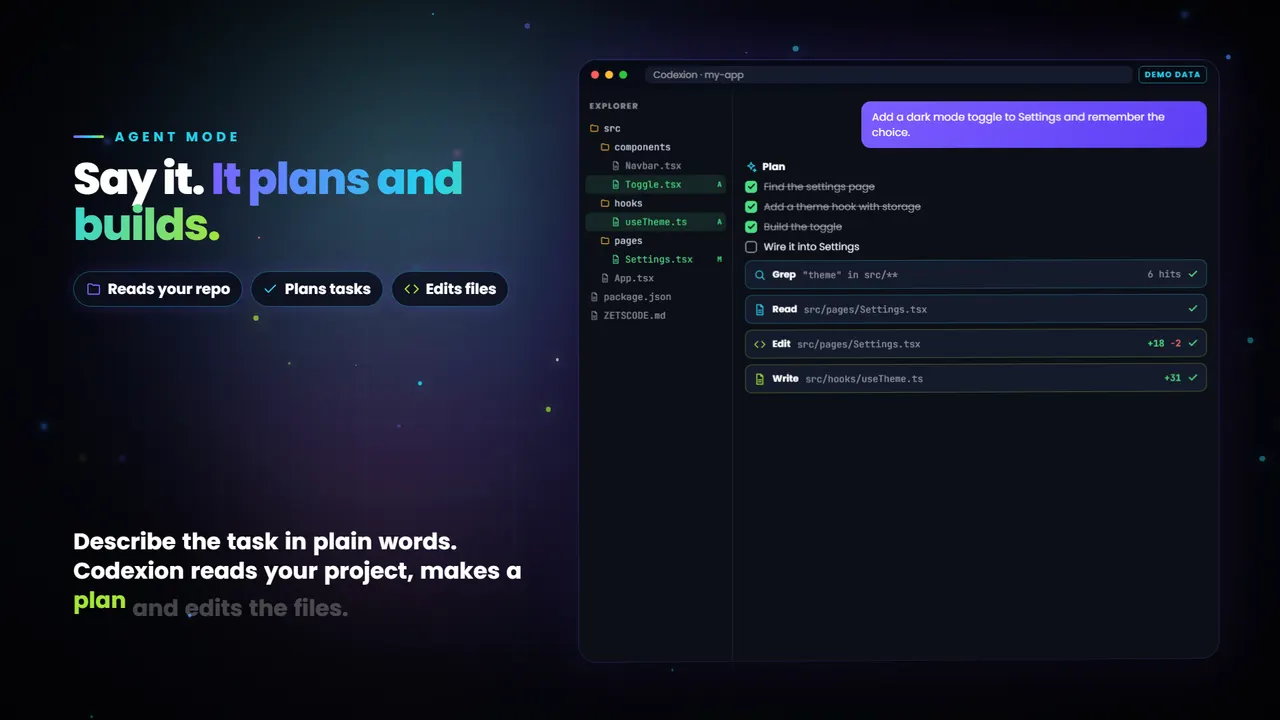
Short answer: an AI coding agent is software that completes a programming task end to end: it reads the relevant files, makes a plan, edits code, runs builds and tests, and fixes what fails, while you review every change as a diff.
Agent vs chat assistant vs autocomplete
| Tool | Sees | Does | Best for |
|---|---|---|---|
| Autocomplete | Current file | Suggests the next lines | Typing faster |
| Chat assistant | What you paste | Explains and drafts code | Questions and snippets |
| Coding agent | Whole project, on demand | Plans, edits, runs tests, iterates | Completing tasks |
The agent loop
- Read: open the files related to the task
- Plan: list the steps
- Edit: change files, shown as diffs
- Verify: run the build and tests in a terminal
- Fix: repeat until green, then hand back for review
Using agents safely
- Choose a permission mode: ask before edits, accept edits, plan only, or full autonomy for trusted tasks
- Review diffs; keep, revert or undo a whole turn
- Use a local model when code must not leave your network
- Give the agent project memory: conventions, commands and do-not-touch areas
- Connect tools through MCP servers instead of sharing credentials in prompts
What agents do well today
- Refactors across many files
- Writing and fixing tests
- Bug fixes with a clear reproduction
- Boilerplate features that follow existing patterns
- Upgrading dependencies with build verification
How Codexion fits
Codexion AI Coding Agent is ZetsApp's Windows coding agent: any model (Claude, GPT, Gemini, OpenRouter or local via Ollama), inline diffs with undo, permission modes, a built-in terminal, sub-agents, MCP tools and project memory. Building your own agents? See AI agent development and MCP server development.
Writing a good task for an agent
- State the outcome: "Add a dark mode toggle to Settings and remember the choice".
- Point to the right place: files, modules or a similar feature to copy.
- Name the checks: which tests or build command must pass.
- Set limits: files or folders that must not change.
Short, specific tasks with a clear definition of done give better results than broad instructions.
Common mistakes
- Running in full-autonomy mode on unfamiliar code.
- Accepting large diffs without reading them.
- Pasting secrets into prompts instead of using environment variables.
- Skipping tests because "the agent ran them": run them in CI too.
Local models vs hosted models
Hosted frontier models are usually stronger at planning across many files. Local models running through tools such as Ollama keep code on your machine and cost nothing per call, at the price of more guidance and smaller tasks. Many teams use hosted models for general work and local models for sensitive repositories.
Glossary
- MCP: Model Context Protocol, a standard way to connect AI agents to tools and data.
- Sub-agent: a helper agent given one part of a bigger task.
- Diff: the exact lines added and removed by a change.
Frequently asked questions
What is an AI coding agent?
Software that completes programming tasks rather than suggesting lines: it reads the project, plans, edits files, runs builds and tests, and fixes failures while you review.
Is an AI coding agent safe to use on company code?
Use permission modes, review every diff and, for sensitive code, run a local model so nothing leaves your network.
Which AI models work best for coding agents?
Strong reasoning models from Anthropic, OpenAI and Google are common choices; local open models work for private code with some trade-offs.
Will AI coding agents replace developers?
They remove repetitive work; developers still define the task, review the changes and own the design.


