
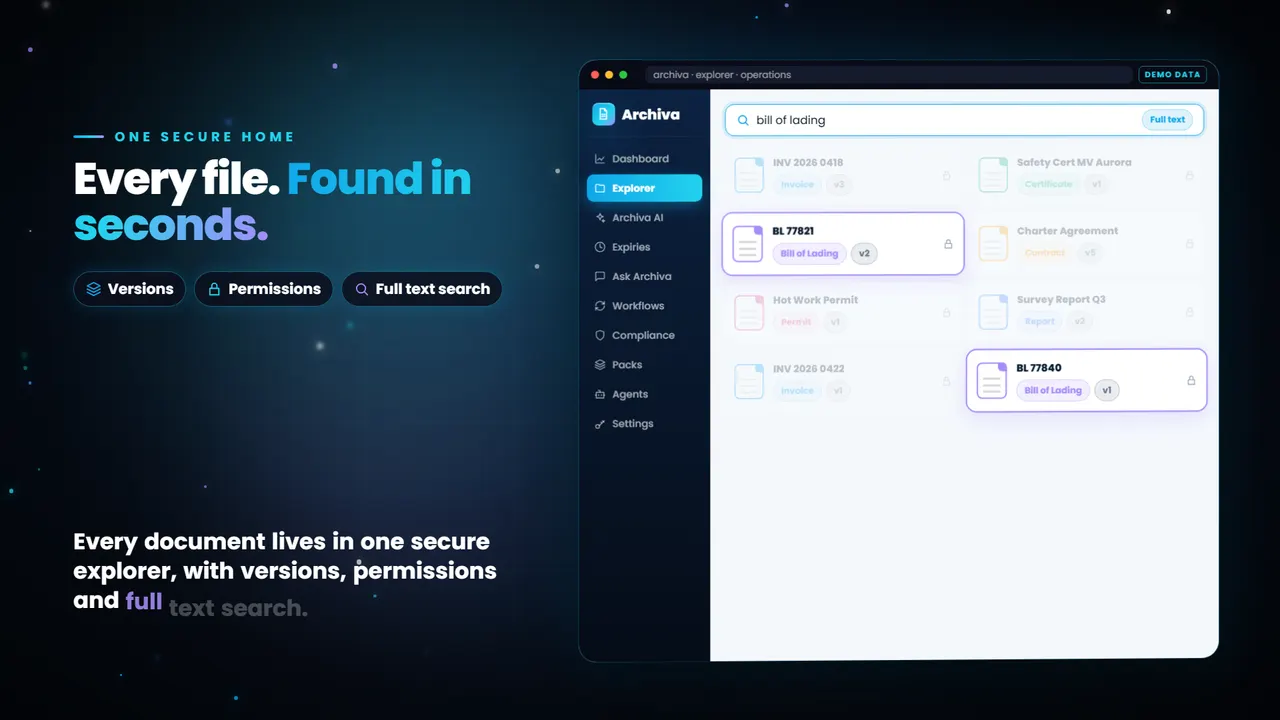
Short answer: an AI document management system (DMS) reads every uploaded document, fills in type, numbers and expiry dates for a person to review, runs approval workflows, sends expiry reminders and shows a compliance matrix of what is held and what is missing.
Shared drive vs document management system
| Need | Shared drive | AI DMS |
|---|---|---|
| Find a document | Folder hunting | Search by type, field or text |
| Data entry | Typed by hand | AI-suggested, human-reviewed |
| Approvals | Email threads | Workflow with history |
| Expiry | Spreadsheet, often forgotten | Automatic reminders at set intervals |
| Audits | Days of collecting evidence | Compliance matrix and export |
How AI extraction works
- A file is uploaded on the web, by email-in or from a phone camera
- The AI (or a rule engine for strict environments) proposes the document type and key fields
- A person reviews and confirms; status changes only through the workflow
- Dates feed reminders; the document counts towards compliance requirements
Use cases
- Shipping and ship management: vessel and crew certificates, survey windows
- Manufacturing: licences, permits, calibration and quality records
- Healthcare: accreditations, staff credentials and policies
- Construction: permits, insurance and subcontractor documents
Checklist
- Choice of AI provider, or no external AI at all
- Human review before anything is filed
- Reminders at configurable intervals
- Compliance matrix by site, vessel or team
- Two-step sign-in and audit log
- API keys for integrations
- Mobile upload
How Archiva fits
Archiva Document Management offers AI document reading with your choice of provider or a built-in rule engine, workflow approvals, expiry reminders, a compliance matrix, two-step sign-in, API keys and a mobile app. Related: AI automation services.
Designing document types and required fields
Start with the ten document types that cause the most work or risk, for example licences, insurance, certificates, contracts and invoices. For each, define the fields you search by (number, issuer, issue date, expiry date, counterparty), who approves it, and how many days before expiry reminders should start. The AI then has a clear target, and people review fields instead of typing them.
Compliance matrix in practice
A compliance matrix lists what each site, vessel, team or supplier must hold and marks each requirement as valid, expiring or missing. Auditors get one view instead of a folder hunt, and managers see gaps weeks before they become findings.
Common mistakes
- Uploading everything without types, so search and reminders never work.
- Letting AI change document status without human approval.
- One reminder only, on the expiry day.
- No owner for each requirement.
Glossary
- Metadata: fields that describe a document, such as type, number and dates.
- Workflow: the review and approval steps a document passes through.
- Rule engine: extraction based on defined patterns, useful where external AI is not allowed.
Frequently asked questions
What is an AI document management system?
A document management system that uses AI to read uploaded files and fill in metadata such as type, numbers and expiry dates, so people review instead of typing.
Can a DMS track certificate expiry dates?
Yes. Every document with an expiry date gets automatic reminders, and a compliance view shows what is missing or expiring.
Is AI document processing safe for confidential files?
Choose a system that lets you pick the AI provider or use a local rule engine, keeps status changes in a human-approved workflow and logs every action.
Does a DMS replace SharePoint or Google Drive?
It can, or it can sit alongside them for controlled documents that need approvals, expiry tracking and audits.
ZetsApp software related to this guide
 Archiva Document ManagementAI document managementEvery document found, approved and renewed on timeSee Archiva →AI Chatbot for WebsiteAI Chat & MessagingTurn anonymous visitors into booked meetingsSee AI →AI Voice Agent for Sales & Support CallsSales & GrowthCall every lead in under a minuteSee AI →


