
Hey there, have you ever wondered how your smartphone can translate languages in real-time or how AI chatbots like ChatGPT seem to "get" what you're saying? It's all thanks to something called the Transformer architecture – a game-changer in artificial intelligence that flipped the script on how machines handle data. Back in the day, AI struggled with understanding context in sentences, but transformers brought in attention mechanisms to focus on what's important, just like how you tune into key parts of a conversation while ignoring the noise.
Think about popular models like GPT (that's Generative Pre-trained Transformer) and BERT (Bidirectional Encoder Representations from Transformers). These aren't just buzzwords; they're built on this very foundation, enabling everything from writing essays to generating art. Here's the thing: before transformers, AI was like a slow reader plodding through a book page by page. Now, it's like skimming the whole story at once, picking up nuances effortlessly.
In this post, we'll unpack the Transformer architecture step by step. You'll learn about its origins, the core components like encoders and decoders, the magic of self-attention mechanisms, and even how it's branching out beyond text. Whether you're a newbie curious about neural network architecture or a pro diving into deep learning transformers, stick around – you might just see why attention is all you need.
The Problem Before Transformers
Let's rewind a bit. Imagine you're trying to read a massive novel, but you can only process one word at a time, and by the time you reach the end of a chapter, you've forgotten what happened at the start. That's pretty much how older AI models like Recurrent Neural Networks (RNNs) and Long Short-Term Memory (LSTMs) worked. These guys were the stars of natural language processing (NLP) models pre-2017, but they had some serious baggage.
RNNs process data sequentially, meaning they handle inputs one after another. Sounds logical for language, right? But here's the catch: this creates bottlenecks. Long sequences lead to vanishing gradients – where early information fades away like a whisper in a storm. LSTMs tried to fix this with memory cells, but even they struggled with really long dependencies. Picture training an AI on a paragraph where the key pronoun at the end refers back to something in the first sentence; the model might lose track, leading to garbled outputs.
Back in the early 2010s, AI researchers were pulling their hair out over this. Training times were endless because everything had to run in order – no parallel processing meant hours or days for what should be quick. In NLP, tasks like machine translation were hit hardest. Google Translate back then? It was okay, but nothing like today's seamless magic. The frustration was real: why couldn't models "see" the whole picture at once? RNN vs Transformer debates weren't even a thing yet, but the limitations were screaming for a breakthrough. Models were inefficient, prone to errors in context retention, and just not scalable for the big data explosion we were heading into.
You might wonder, what if we ditched the sequence altogether? That's exactly where the innovation sparked. Researchers knew attention mechanisms could help focus on relevant parts, but integrating them fully? That was the missing piece. These pre-transformer woes set the stage for a revolution, showing us that sometimes, to move forward, you gotta throw out the old playbook.
The Breakthrough - "Attention Is All You Need"
Picture this: it's 2017, and a team at Google drops a paper that's basically the mic-drop moment for AI. Titled "Attention Is All You Need," it wasn't just catchy – it was prophetic. Authored by folks like Ashish Vaswani and Noam Shazeer, this gem introduced the Transformer architecture, swapping out clunky recurrences for pure attention mechanisms. No more waiting in line; everything happens in parallel.
The core innovation? Self-attention. Instead of processing words one by one, the model looks at the entire sequence simultaneously, weighing how each part relates to others. It's like having a superpower to spot connections instantly. Why was this revolutionary? Speed, for one – training times plummeted because parallelization meant GPUs could crunch data way faster than RNNs ever dreamed. And context retention? Spot on. No more forgetting the beginning by the end.
Let's dive in with a story. Before this paper, translating "The cat sat on the mat" to French might mix up references if the sentence was longer. But transformers? They assign attention weights, focusing on "cat" when dealing with "sat." Real-world impact hit hard: BERT and GPT architecture exploded from here, powering search engines, assistants, and more. Suddenly, NLP models weren't just better; they were transformative.
You might ask, how did this change AI development? Well, it democratized deep learning. Smaller teams could train massive models without supercomputers. The paper's experiments on translation tasks crushed benchmarks, proving the point. From frustration to fireworks, this breakthrough showed that in neural network architecture, attention truly is all you need. It wasn't just a tweak; it was a paradigm shift, paving the way for the AI boom we're living in today.
Inside the Transformer Architecture
Alright, let's pop the hood on the Transformer architecture and see what makes it tick. At its heart, it's an encoder-decoder model, but don't let that scare you – think of it as a translator's brain: the encoder understands the input, and the decoder crafts the output. The whole thing stacks layers like building blocks, each with attention layers and feed-forward (MLP) layers.
First up, tokenization and embedding. Your input text gets chopped into tokens – words or subwords – then turned into vectors via embeddings. It's like giving each word a unique ID card with personality traits. But order matters, right? Enter positional encoding: clever math (sine and cosine waves) adds position info without messing up the parallelism. For example, "bank" in "river bank" vs. "money bank" – position helps clarify.
Now, the encoder: a stack of identical layers. Each has multi-head self-attention (we'll geek out on that soon) and a feed-forward network. Attention lets tokens "talk" to each other, capturing relationships. Feed-forward? It's like a mini neural net per token, adding depth. The decoder mirrors this but adds masked attention (to prevent peeking ahead) and cross-attention (linking to encoder outputs).
How do tokens interact? Through matrix magic – everything's vectorized for efficiency. Visualize a sentence as a grid where rows are tokens, columns features. Attention computes similarities, updating representations.
The Magic of Attention Mechanism
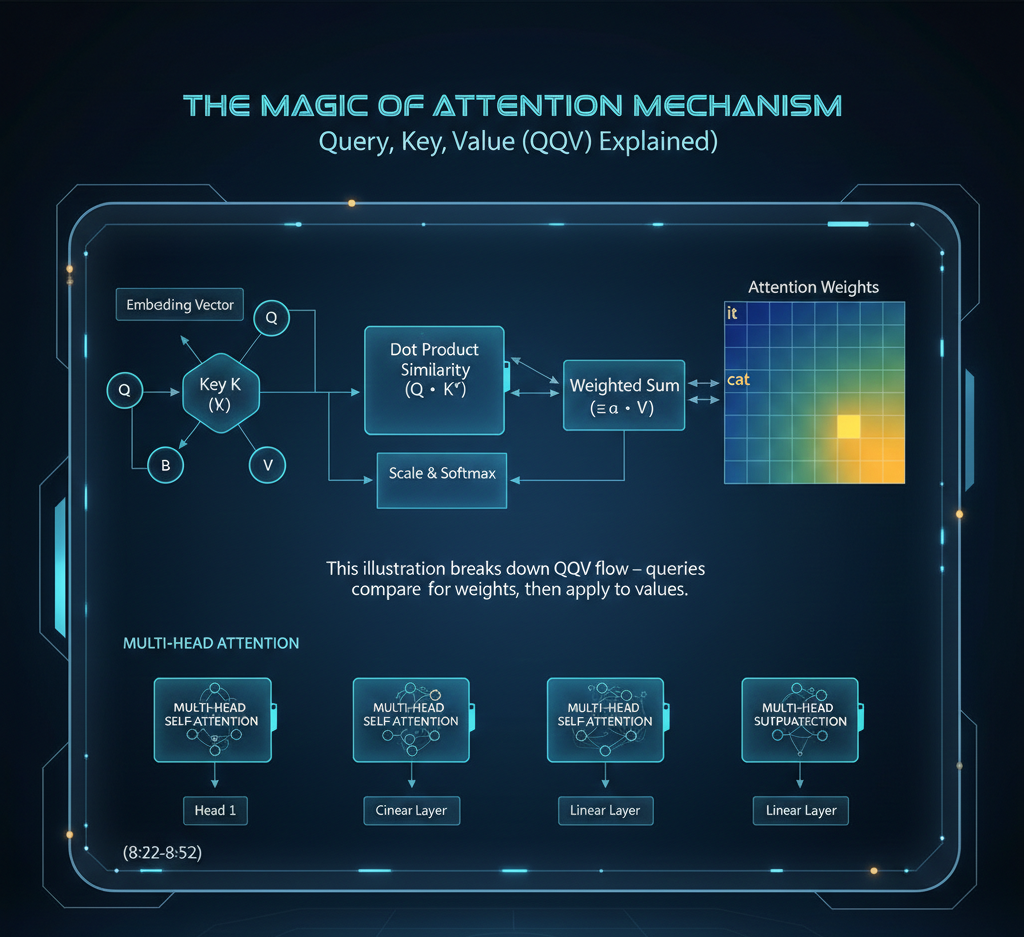
Okay, here's where it gets fun – the attention mechanism is the secret sauce of the Transformer architecture. You might wonder, what's so magical about it? Well, it's how the model decides what's worth "paying attention" to in a sea of data. At its core: Query, Key, Value (QKV). Think of it like a search engine: the query is what you're looking for, keys are database entries, and values are the actual info.
Dive deeper: for each token, we create Q, K, V vectors from its embedding. The dot product between Q and all Ks gives similarity scores – how relevant is each key to this query? Scale it, softmax to probabilities (attention weights), then weighted sum of Vs. Boom – contextualized output.
Conceptually, matrices handle this en masse. Imagine a sentence matrix; QKT (transpose) yields a score matrix, visualizing attention patterns like heatmaps where "it" attends strongly to "cat" in "The cat chased the mouse; it was fast."
During training, the model learns these weights via backpropagation, tweaking to minimize loss. Multi-head attention amps it up: multiple QKV sets in parallel, capturing different relationships – one head for syntax, another for semantics.
Examples? In "She poured the water from the pitcher," attention links "poured" to "water," not "pitcher." For self-attention mechanism pros, it's parallelizable; cons, quadratic complexity, but tricks like sparse attention fix that.
This isn't just theory – it's why BERT aces comprehension. The attention mechanism turns raw data into rich, relational understanding, proving in deep learning, focus is everything.
Beyond Language - Transformer Versatility
Who said transformers are just for words? This powerhouse has gone multimodal, tackling images, audio, and more. Take Vision Transformers (ViTs): they chop images into patches like tokens, then process via the same encoder setup. It's like treating pixels as a sequence – revolutionary for computer vision, outperforming CNNs on big datasets.
Audio? Waveform to spectrograms, then transformer magic for speech recognition or music generation. Models like Whisper use this for top-notch transcription.
Code generation? GitHub Copilot leverages transformers to autocomplete code, understanding syntax like prose.
Multimodal apps blend it all – think CLIP, matching images to text. Future? Robots learning from videos, or AI diagnosing via scans and notes. The encoder-decoder model shines here, proving transformers' adaptability beyond NLP.
Conclusion
Wrapping up, the Transformer architecture has utterly transformed AI, from clunky sequences to attention-driven efficiency. We've seen how it powers GPT and BERT, solves old RNN woes, and extends to visions and sounds. The future? Even bigger models, ethical AI, and seamless human-machine chats.
If you're hooked, dive into the "Attention Is All You Need" paper or tinker with Hugging Face models. What's your take – ready to build something? Let's keep the conversation going!