Introduction
Remember when ChatGPT burst onto the scene and racked up 100 million users in just two months? As a developer who's tinkered with LLMs since the early GPT days, I was blown away – it wasn't just hype; it was a leap in AI usability. At its heart, ChatGPT is powered by a Large Language Model (LLM) like GPT-3.5, a beast trained to mimic human chat with eerie accuracy. But how does it pull off those witty responses without going off the rails?
Here's the thing: I've built chat interfaces that started as clunky scripts and evolved into something resembling intelligence, and ChatGPT's architecture is a masterclass in scaling that. It's not magic; it's clever engineering tackling language prediction, safety, and context. In this post, we'll unpack the LLM basics, tokens and training, prompt engineering's art, RLHF's feedback loop, and the operational plumbing that keeps it humming. You might wonder, in 2026 with even bigger models, why revisit this? Because understanding ChatGPT demystifies AI – and arms you to build your own. Let's chat about it!
The Core: What is a Large Language Model (LLM)?
Dive right in: an LLM is essentially a massive neural network gobbled up on oceans of text data, learning to predict the next word like a supercharged autocorrect. GPT-3.5, ChatGPT's brain, boasts 175 billion parameters across 96 layers – think of parameters as the model's "knowledge knobs," tuned to spot patterns in language.
From my experiments fine-tuning smaller models, it's all about statistics: feed it "The cat sat on the...", and it guesses "mat" based on trillions of examples. But scale matters – bigger models capture nuances, making responses feel human. Drawback? They're black boxes; I've seen them confidently spout nonsense, which leads to the next bits.

Tokens and the Massive Training Data
LLMs don't see words; they munch on tokens – numerical IDs for words or subwords, making processing zippy. GPT-3.5 trained on 500 billion tokens scraped from the web, books, code – a digital feast teaching it grammar, facts, and styles.
You might ask, why tokens? Efficiency: "unbelievable" might split into "un" + "believ" + "able" for better compression. In my projects, token limits (like 4096 for GPT-3.5) force smart context management – overrun it, and the model forgets earlier chat. It's why long convos can loop or hallucinate; training data's breadth is power, but biases creep in too.
Challenges and the Rise of Prompt Engineering
LLMs shine at grammar and mimicry but flop on truthfulness – they hallucinate facts, spew toxicity, or harm if unchecked. Enter prompt engineering: crafting inputs to steer outputs, like "Act as a helpful assistant" to curb wildness.
I've spent hours tweaking prompts for bots; it's an art – add "explain step by step" for reasoning, or "be concise" for brevity. Without it, models are loose cannons; with it, they're tools. This field's exploded since ChatGPT, turning devs into word wizards.
Reinforcement Learning from Human Feedback (RLHF): Taming the Beast
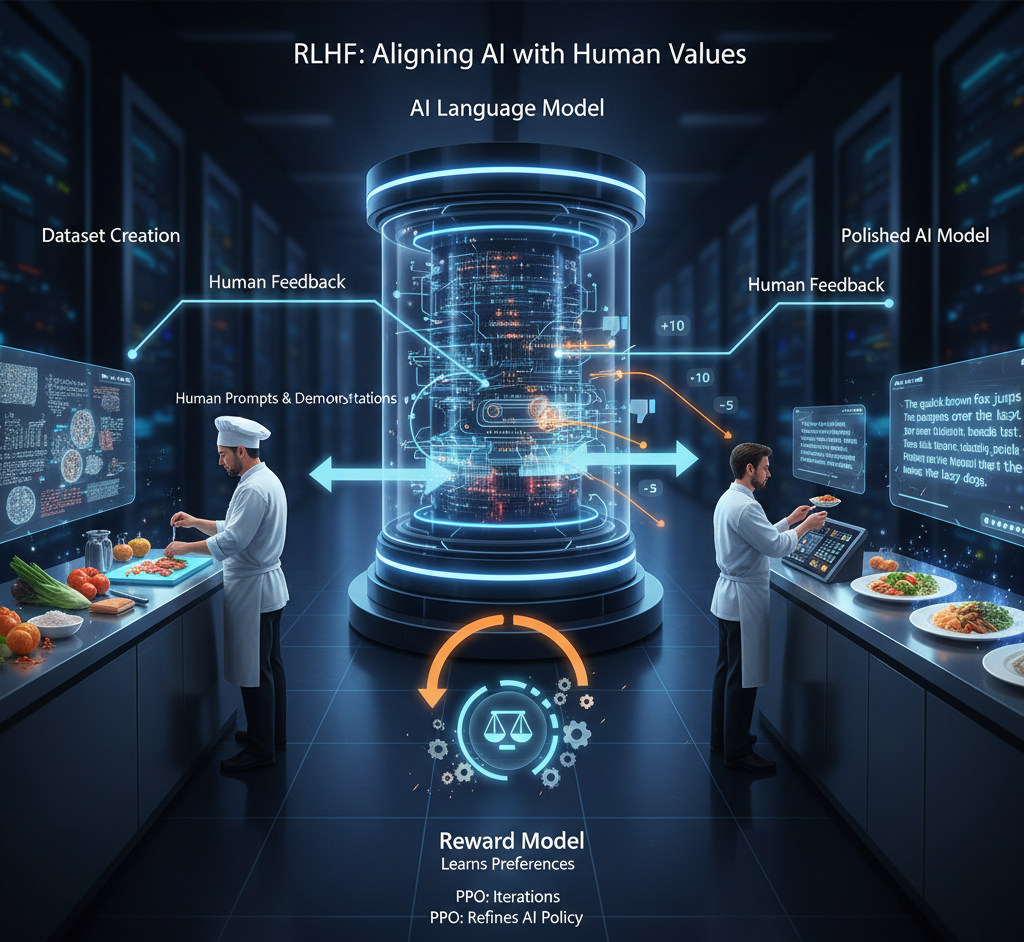
To make GPT-3.5 chatbot-ready and safer, OpenAI used RLHF – think chef refining recipes via diner reviews. It's fine-tuning on human preferences: Create a dataset by ranking model outputs (good vs bad), train a "reward model" to score like humans, then use PPO (Proximal Policy Optimization) to iteratively tweak the LLM.
Analogy hits home: Just as feedback hones skills, RLHF aligns AI to helpful, harmless norms. In my RL experiments, it's transformative – raw models ramble; RLHF'd ones converse. Steps: Gather comparisons, build reward proxy, optimize policy. It's compute-heavy but why ChatGPT feels "trained" for chat.
ChatGPT's Operational Flow: From Prompt to Response
Behind the curtain, ChatGPT's flow is slick: User prompt hits, but it maintains context by feeding the whole conversation history each time – that's why it "remembers" prior turns (up to token limits).
Invisible prompt engineering injects system instructions like "You are helpful and honest" to shape tone. Finally, moderation API scans inputs/outputs for unsafe content, blocking if flagged.
I've replicated similar flows in custom bots; context is key for coherence, but costs add up – optimize by summarizing history. It's this pipeline that makes interactions seamless and safe.
Conclusion
ChatGPT's tech – LLM smarts, token crunching, prompt wizardry, RLHF polish, and clever ops – fueled its meteoric rise. As a dev riding the AI wave in 2026, it's inspiring: understand these, and you're building tomorrow's tools. Challenges remain – ethics, efficiency – but the architecture's a blueprint for intelligent apps.