
Introduction
I’ve spent the last 18 months building and scaling AI applications for fintech and developer tooling companies. Every single one of them runs on a fully open-source stack. Why? Because it gives us complete control over cost, data privacy, model choice, and deployment — something closed platforms simply cannot match at scale.
The video from ByteByteGo nailed the current state of the ecosystem. Here’s the practical, production-grade version of that stack, updated for February 2026, with the exact tools, versions, and patterns my teams are using today.
Front-End Layer: From Rapid Prototyping to Production Streaming
For quick internal tools and demos
- Streamlit or Gradio — still unbeatable for Python-first teams. You can have a working RAG chat interface in under 30 minutes.
For customer-facing, scalable applications
- Next.js 15 (App Router + Server Actions) or SvelteKit — these are the clear winners.
- Native streaming support for token-by-token responses
- Edge-ready deployment
- Excellent TypeScript experience
- Built-in caching and React Server Components that play perfectly with LLM output
In my current production apps we use Next.js with React Server Components to stream responses directly from the edge, cutting perceived latency dramatically.

Data Layer: The Heart of Any Serious AI Application
This is where the real magic happens in 2026.
Core Pattern: Retrieval-Augmented Generation (RAG) Every production system I’ve built uses RAG as the foundation. The flow is now standard:
- Chunking + embedding (LlamaIndex or LangChain)
- Storage in a vector database
- Hybrid retrieval at query time
- Optional reranking (Cohere Rerank or bge-reranker)
Key Tools in the Stack
- LlamaIndex — still the most mature for document pipelines. Its new 0.12+ versions have excellent multi-modal and agentic support.
- Nomic Atlas — indispensable for debugging embeddings. I catch bad chunking strategies in minutes instead of days.
- Apache Tika + custom parsers — for handling the messy real-world documents (PDFs with tables, scanned images, Excel exports).
- Jina AI — best-in-class for multimodal embedding and search when you need text + image + audio in the same vector space.
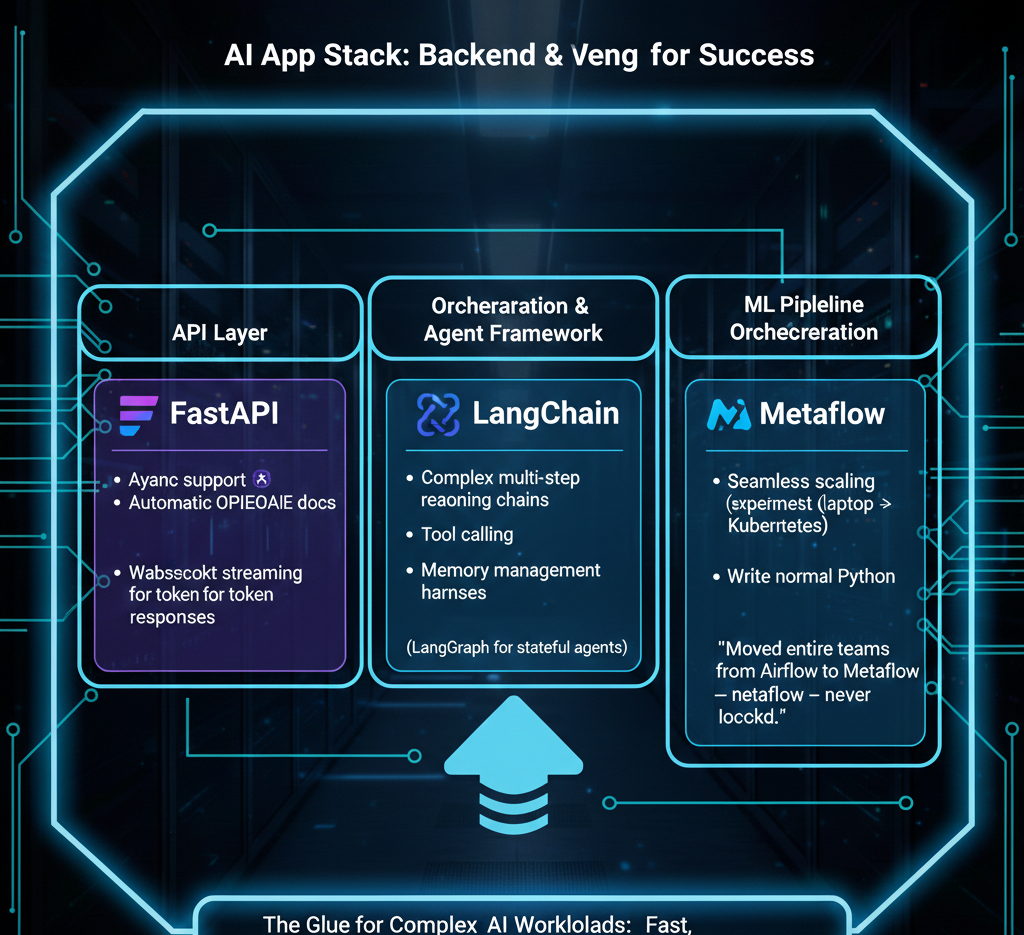
Back-End Layer: FastAPI + LangChain + Metaflow
API Layer FastAPI remains the undisputed king. Async support, automatic OpenAPI docs, WebSocket streaming for token responses — it’s perfect for AI workloads.
Orchestration & Agent Framework LangChain (or LangGraph for stateful agents) is the glue. We use it for:
- Complex multi-step reasoning chains
- Tool calling
- Memory management
- Evaluation harnesses
ML Pipeline Orchestration Metaflow is the hidden gem. You write normal Python, and it handles versioning, experiment tracking, and seamless scaling from laptop → Kubernetes without changing code. I’ve moved entire teams from Airflow to Metaflow and never looked back.
Model Serving & Local Development
Local / Edge Ollama has become the “Docker for LLMs.” Run Mistral, DeepSeek, Llama-3.1, or Phi-3 locally with one command. Perfect for development and air-gapped environments.
Production Serving We run a mix:
- vLLM or TGI for high-throughput inference
- Ollama + OpenWebUI for internal tools
- Hugging Face Inference Endpoints or custom Triton servers for specialized models
Quantization Llama.cpp with GGUF + 4-bit/5-bit quantization lets us run 70B+ models on consumer hardware or single GPU instances. This has been a game-changer for cost-sensitive deployments.
Vector Storage Options (2026 Reality Check)
- PGVector — best choice when you already have PostgreSQL (which is almost always). Excellent hybrid search, great ecosystem.
- Weaviate — my personal favorite for complex semantic search + hybrid + generative feedback loops.
- Milvus / Zilliz Cloud — when you need extreme scale (billions of vectors).
The Current Open-Source LLM Landscape (Feb 2026)
Leading open models right now:
- Mistral Large 2 and Mixtral 8x22B — still incredibly strong
- DeepSeek-V3 — shocking performance at the price point
- Llama-3.1 405B — the current open king for reasoning
- Qwen2.5 series — especially strong in code and multilingual
All of these run beautifully with the stack above.
Final Recommendations from Production Experience
- Start simple — Next.js + FastAPI + LangChain + PGVector + Ollama gets you 80% of the way.
- Add complexity only when you feel pain (RAG evaluation, multi-agent, advanced memory, etc.).
- Invest early in observability (LangSmith + Prometheus + OpenTelemetry).
- Always design for human-in-the-loop — the most successful agent systems still have humans steering.
The open-source AI stack in 2026 gives you more power, more control, and lower costs than ever before. The only real trade-off is the need for deeper engineering expertise — but that’s exactly what makes it rewarding.