
Introduction
Ah, REST – the unsung hero that's been quietly gluing the internet together since the early 2000s. As a developer who's built, broken, and battled more APIs than I care to admit, I can tell you: understanding RESTful APIs isn't just a nice-to-have; it's the foundation for how computers chat over the web. Think of it as the universal language for services like Twilio sending texts, Stripe handling payments, or Google Maps plotting routes. REST stands for REpresentational State Transfer, and at its heart, it's about making APIs predictable, scalable, and easy to use.
Here's the thing: in my early days, I fumbled through clunky endpoints before REST clicked – it's not rocket science, but mastering it saves headaches. An API is just a contract for two systems to talk, and a RESTful one follows REST principles for clean, efficient communication. In this post, we'll unpack what REST really is, dive into the basics like resources and HTTP magic, explore critical attributes that make or break scalability, and wrap with why it endures amid flashy alternatives like GraphQL. If you've ever puzzled over a 404 or debated idempotency over coffee, this is for you. Let's get RESTed!
What Exactly is REST?
Let's cut to the chase: REST is the gold standard for how machines converse online, turning chaotic data exchanges into structured dialogues. Born in the dissertation of Roy Fielding back in 2000, it's evolved into the default for web APIs, powering everything from social feeds to e-commerce backends.
At its core, REST treats everything as resources – think users, products, or posts – accessible via unique identifiers. It's stateless, cacheable, and layered, but we'll dig deeper soon. Why does it matter? Because it makes integrations seamless; I've integrated Stripe into apps faster than brewing coffee, thanks to its RESTful design. If you're new, start here: REST isn't a protocol, it's an architectural style that keeps things simple and predictable.
The Basics of REST: Resources, Requests, and Responses
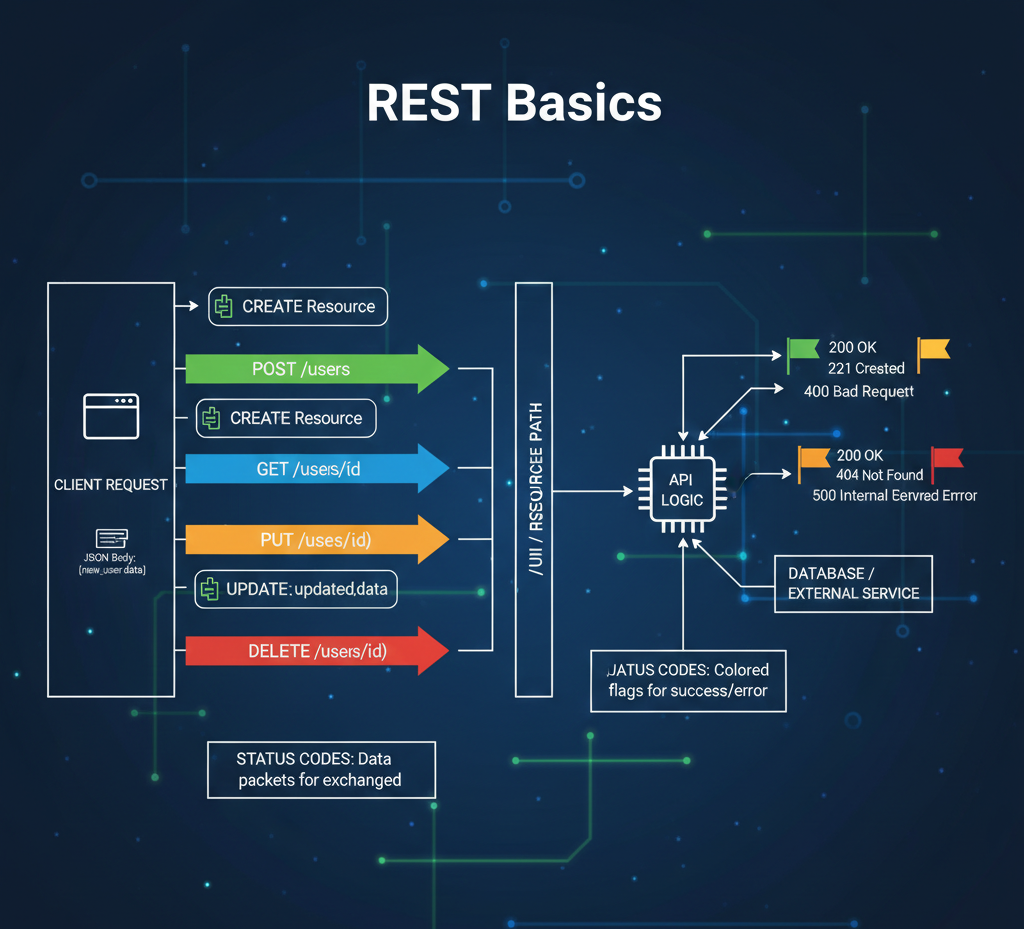
Diving into the nuts and bolts, REST organizes the world into resources identified by URIs – those familiar paths like /users or /products/123. Pro tip from my scars: always use nouns for endpoints, not verbs. So, /products beats /getAllProducts – it's cleaner and more intuitive.
Interaction happens via HTTP verbs mapping to CRUD ops: POST creates (like adding a product), GET reads (fetch details), PUT updates (edit price), and DELETE removes. I've seen teams trip by misusing PUT vs. PATCH – PUT replaces fully, PATCH partial – choose wisely to avoid data mishaps.
Requests might carry a body, often JSON payloads like {"name": "Widget", "price": 9.99}. Responses echo back, with status codes signaling success or snafus: 200s for good vibes (OK, Created), 400s for your faults (Bad Request, Not Found), 500s for server oopsies (Internal Error). And idempotency? It's gold – methods like GET or PUT should yield the same result on retries, unlike POST which might duplicate. In production, I've implemented retry logic only for idempotent calls to dodge disasters.
The beauty? This setup makes debugging a breeze; tools like Postman become your best friend.
Critical Attributes of RESTful APIs: Scaling and Sustainability
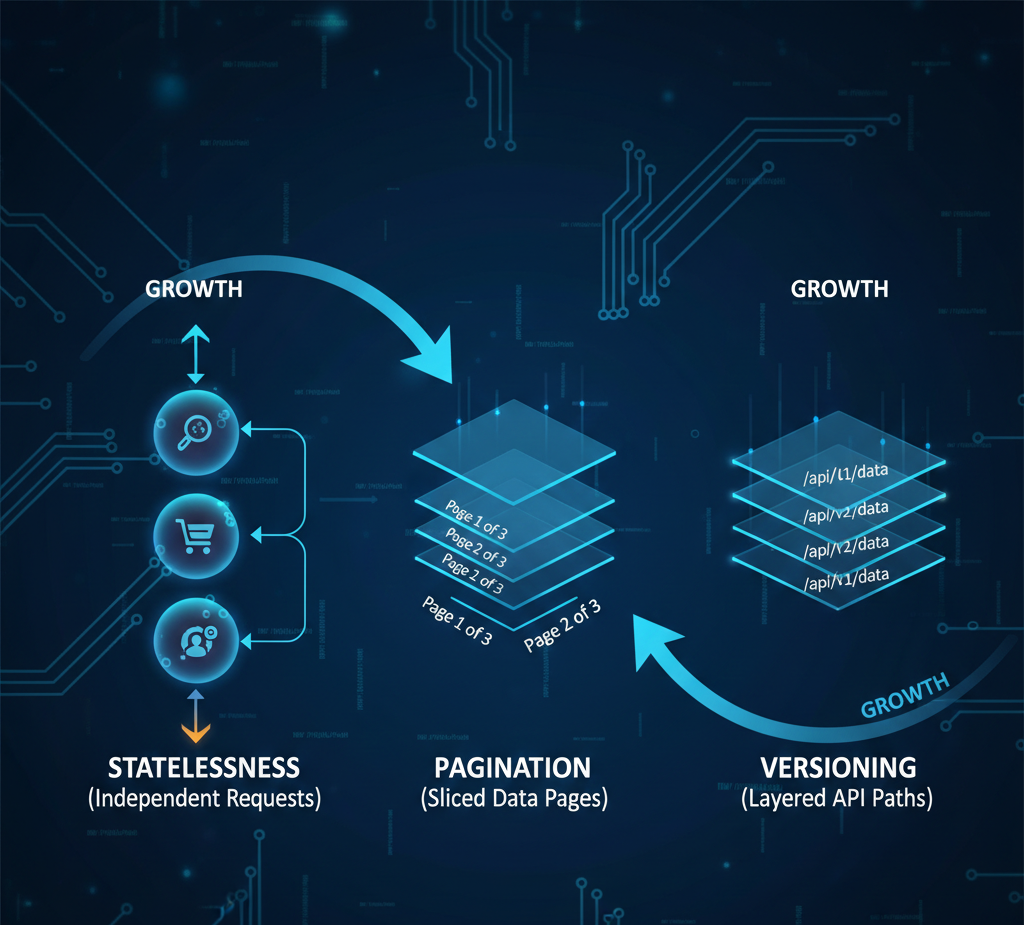
What elevates a good REST API to great? A few pillars I've leaned on in high-traffic projects. First, statelessness: each request stands alone, no server-side session baggage. This lets you scale horizontally – add servers, load balance, done. I've scaled APIs from hundreds to millions of reqs/sec this way; stateful? Nightmare fuel.
Pagination is non-negotiable for big lists: use params like ?limit=20&offset=40 to chunk data, preventing response bloat. I've debugged OOM errors from unpaginated endpoints – learn from my pain.
Versioning keeps peace: prefix like /v1/products to evolve without breaking clients. It buys time for migrations; I've rolled v2 with deprecation warnings, smoothing upgrades.
These aren't fluff – they're the glue for robust, future-proof APIs.
Conclusion
Wrapping up, RESTful APIs remain the simple, battle-tested choice for web comms – effective, ubiquitous, and forgiving for most needs. Sure, GraphQL shines for flexible queries or gRPC for performance hogs, but REST's universality wins for broad use. From my lens, start RESTful, iterate as needs grow. It's powered my career's wins; it'll fuel yours too.