
Introduction
If you’ve ever tried to hook an LLM up to a new database, file system, or API, you know the drill: write custom code, handle auth, manage context windows, debug edge cases… rinse and repeat. As a developer who’s spent years stitching together AI agents with Slack, GitHub, Postgres, and everything in between, I can tell you it’s exhausting.
That’s exactly why Anthropic open-sourced the Model Context Protocol (MCP) in late 2024. It’s the “USB-C for AI” – a single, standardized way for any LLM application to talk to any external tool or data source. No more N×N custom integrations. Just one protocol that both AI vendors and tool builders implement once.
In this post I’ll walk you through exactly how MCP works, its elegant architecture, the five core primitives, and why it’s quickly becoming the de-facto standard in 2026. If you’re building AI agents, IDE plugins, or enterprise copilots, this is the protocol you’ll be using.
The Problem MCP Solves
Before MCP, connecting an AI model to a new data source was expensive and fragile. Every integration was bespoke. Every new tool meant new auth flows, new context-passing logic, and new maintenance headaches. The result? Slow innovation and brittle systems.
MCP replaces that fragmentation with one universal standard. Tool builders implement an MCP server once; LLM apps (hosts) connect via a standard client. Suddenly the integration matrix collapses from N×M to 1×1.
MCP Architecture: Hosts, Clients, and Servers
MCP follows a clean client-server model with three main players:
- Hosts – The LLM application itself (Claude Desktop, Cursor, Windsurf, custom agents, etc.). This is where the user works.
- Clients – Lightweight components inside the host that open one-to-one connections to external servers.
- Servers – Separate processes (local or remote) that expose context, tools, and prompts to the AI.
Local servers usually run via STDIO for speed and security; remote ones use Streamable HTTP. The separation keeps the host lightweight while giving servers full control over their own data and logic.

The Five Core Primitives
MCP’s power comes from five standardized building blocks that servers can expose:
- Prompts – Reusable instruction templates injected into the LLM context.
- Resources – Structured data objects (files, DB schemas, configs) that the model can reference directly in its context window.
- Tools – Executable functions the model can call (read file, query DB, send Slack message, etc.).
- Root Primitive – Creates a secure, scoped channel for file-system access without giving the model blanket permissions.
- Sampling Primitive – Allows the server to ask the LLM for help (two-way interaction), enabling advanced agentic workflows.
These primitives are what make MCP feel like a true operating system for AI agents.
The N×N Problem – Solved
Without a standard, every LLM vendor had to build custom integrations for every tool, and every tool had to build custom integrations for every LLM. MCP flips that: implement the protocol once on each side and you’re instantly compatible with the entire ecosystem.
Real-World Example: Claude + Postgres
Want Claude to analyze your production database? Spin up the official Postgres MCP server. It exposes tables as resources and queries as tools. Claude can now safely read schemas, run SELECTs, and even suggest schema changes – all through the standardized MCP primitives. No custom API wrappers, no credential leakage, no context-window hacks.
Growing Ecosystem in 2026
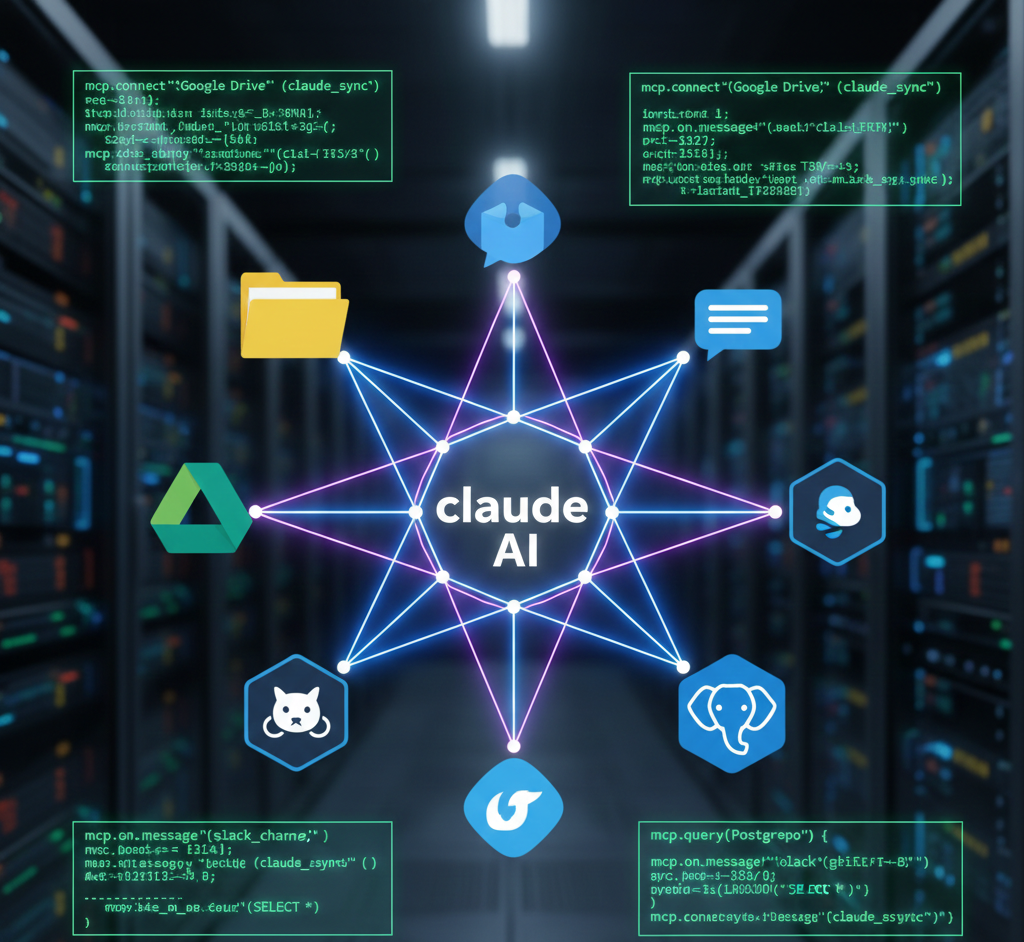
The community has already built MCP servers for:
- Google Drive
- Slack
- GitHub
- Git repositories
- Postgres (and many other databases)
Official SDKs exist for TypeScript and Python, making it trivial to write your own server in an afternoon. The momentum is real – and accelerating.
Future Outlook
MCP is quickly becoming the foundational layer for sophisticated AI applications that need to interact with the real world. Because it’s open source and vendor-neutral, it lowers the barrier for everyone – from indie hackers to enterprise teams.
If you’re building anything that involves an LLM talking to external systems, start experimenting with MCP today. It’s the closest thing we have to a universal plug for AI.
Conclusion
The Model Context Protocol is one of those rare technologies that feels inevitable once you see it in action. It replaces fragile custom glue with a clean, secure, standardized interface – exactly what the AI ecosystem has been missing.