Introduction
Picture this: you're in a system design interview, staring at a vague prompt like "Design a chat app," and your mind races while the clock ticks. As someone who's been on both sides – sweating as a candidate and grilling as an interviewer – I know the panic all too well. But here's the secret sauce: a solid framework turns chaos into clarity, helping you showcase your skills without rambling or missing key points.
This 4-step method isn't some abstract theory; it's battle-tested from my own interviews at big tech and startups. It structures your thoughts, manages that precious 45-60 minutes, and leaves room for collaboration. We'll break it down: understanding the problem, high-level design, deep dives, and wrapping up. You might wonder, why time allocations? Because winging it leads to rushed endings or shallow coverage – I've learned that the hard way. Whether you're prepping for FAANG or your first gig, this guide will arm you to shine. Let's design our way to success!
The Pressure of System Design Interviews and Why a Framework Matters
System design questions aren't about right answers; they're about reasoning under fire. Early in my career, I bombed one by diving straight into databases without scoping – interviewer glazed over, and I got the "thanks but no thanks." The fix? A framework that keeps you methodical, showing you can handle ambiguity at scale.
This 4-step approach allocates time smartly: 5 mins to scope, 20 for high-level, 15 for depths, 5 to close. It's flexible, but sticking to it prevents overthinking one area. Trust me, interviewers notice when you steer the conversation productively.
Step 1: Understand the Problem and Establish Design Scope
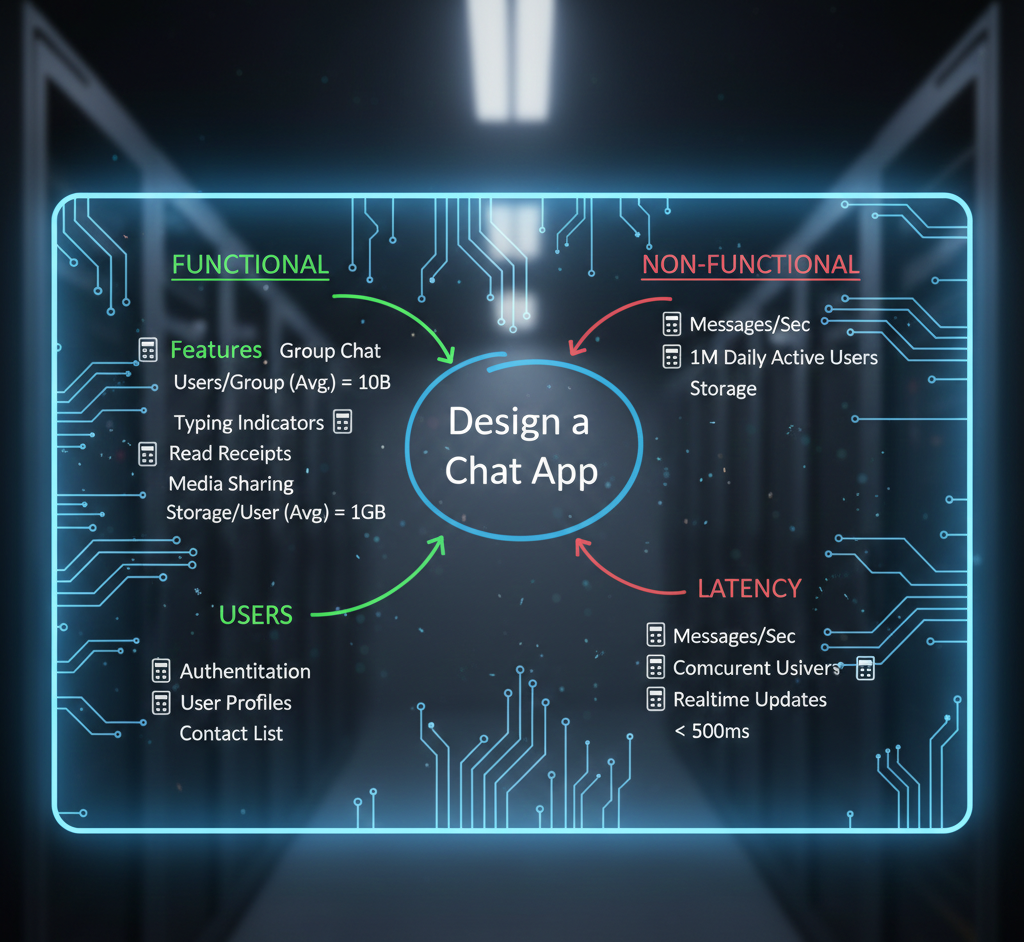
Kick off strong by nailing the basics – don't assume; ask. This step's about clarifying functional requirements: What features? Users? Edge cases? For a chat app, probe: Group chats? Media support? Offline mode?
Then, unearth non-functional needs – scale, performance, reliability – the meat that makes designs interesting. How many users? Peak traffic? Latency goals? Back-of-the-envelope calcs here are gold: Estimate QPS, storage needs, like "1M users, 10 msgs/day = X throughput."
Cap it at 5 minutes to avoid analysis paralysis. In interviews, I've turned vague prompts into crisp scopes this way – sets a collaborative tone and buys interviewer buy-in early.
Step 2: Propose High-Level Design and Get Buy-In
With scope locked, sketch the big picture – this is your 20-minute canvas. Start with APIs: Define endpoints like POST /messages, GET /conversations/{id}. Ensure they align with functions; I've caught mismatches here that saved redesigns.
Next, draw a high-level diagram: Load balancer fronting API gateways, services (chat, auth), databases (SQL for metadata, NoSQL for messages). Factor in data flow and bottlenecks.
Craft the data model: Schemas considering access patterns, read/write ratios – e.g., sharded by user ID for scale. Resist rabbit-holing into details; stay aerial.
Seek feedback: "Does this cover the scope?" It shows humility and refines ideas. In my best interviews, this step sparked great discussions, turning monologues into dialogues.
Step 3: Design Deep Dive
Now, zoom in for 15 minutes – identify bottlenecks and fix them. Collaborate: "Where should we dive – scalability? Reliability?" Often, non-functionals like handling 1M concurrent users.
For each issue: State the problem clearly, brainstorm solutions (e.g., sharding vs replication), weigh trade-offs (cost vs performance), pick one with rationale. Be articulate – "Option A scales better but adds complexity; I recommend B for our scope."
This showcases depth without overwhelming. I've turned potential weaknesses (like single points of failure) into strengths by proposing queues or caches here.

Step 4: Wrap Up
Wind down in 5 minutes: Recap uniquely – "Our design handles scale via sharding, ensures reliability with replication." Highlight innovations or trade-offs.
Flip the script: Ask about the company – "How do you handle similar challenges?" It shows interest and ends positively.
From experience, skipping this leaves loose ends; nailing it seals the impression.
Conclusion
This 4-step framework transformed my system design interviews from stressful scrambles to confident showcases. Scope smart, design high then deep, wrap strong – and practice with real prompts. For more, check out weekly system design newsletters; they've sharpened my edge.
Nailed a design interview lately? Share your framework tweaks below – let's level up together!