Introduction
Hey buddies, if you've ever stared at a sprawling app deployment and thought, "There has to be a better way," welcome to the world of Kubernetes. As a dev with years under my belt scaling everything from startups to enterprise beasts, I can tell you: this open-source container orchestration platform is a game-changer. It automates the nitty-gritty of deploying, scaling, and managing containerized apps, letting you focus on code instead of chaos. Picture it as the conductor of a symphony where containers are the musicians – keeping everyone in harmony, no matter the crowd.
You might be wondering, why dive into k8s now in 2026? Well, with microservices exploding and AI workloads demanding agility, it's not just hype; it's essential. Here's the thing: I remember when containers were novel, but Kubernetes turned them into a powerhouse. In this post, we'll trace its origins, break down the cluster setup, dissect components, weigh the trade-offs, and explore managed options. It's not all sunshine – I'll share the warts too, from my own battle scars. Let's orchestrate some knowledge!
The Origins and Quirky Naming of Kubernetes
Let's start at the beginning, because every great tool has a story. Kubernetes didn't just pop up; it evolved from Google's internal juggernaut called Borg, which handled their massive ops for years. In 2014, Google open-sourced it, gifting the world a slice of their secret sauce. And the name? "Kubernetes" means "helmsman" or "pilot" in Greek – fitting for steering container ships.
Oh, and that "k8s" shorthand? It's the eight letters between 'k' and 's' – a dev's lazy genius for typing less. As someone who's typed it a thousand times in YAML files, I appreciate the brevity. This heritage from Borg means k8s was battle-tested from day one, designed for the kind of scale that makes lesser systems weep.
Kubernetes Cluster Architecture: The Big Picture
Alright, let's zoom into the heart: a Kubernetes cluster is your app's home base, a bunch of nodes (think machines or VMs) running your containerized workloads. It's split into two worlds: the control plane, your strategic HQ managing the cluster's state, and worker nodes, the grunts executing the actual apps.
Everything revolves around Pods – the tiniest, most atomic unit you deploy. A Pod might hold one container (like a Docker image) or a few tightly coupled ones, like a web server and its sidecar logger. I've seen Pods save the day in production, letting you scale replicas effortlessly. Imagine your app as Lego blocks: Pods are the pieces, nodes the table, and the control plane the blueprint keeper. Get this right, and your system hums; mess it up, and you're debugging at 2 AM – been there, trust me.

Control Plane Components: The Brains of the Operation
The control plane is where the magic – and sometimes the headaches – happen. It's the cluster's brain, ensuring desired state matches reality.
Key players:
First, the API Server: your gateway drug to k8s. Everything talks through it – kubectl commands, dashboards, you name it. It's RESTful and extensible, but secure it tight; I've seen misconfigs lead to nasty breaches.
Then etcd: the trusty key-value store holding all cluster data, like configs and states. It's distributed and consistent, but back it up religiously – data loss here is catastrophic.
The Scheduler watches for new Pods and assigns them to nodes based on resources, affinities, and taints. It's like a matchmaking service for workloads.
Finally, the Controller Manager bundles controllers (e.g., ReplicaSet for maintaining Pod counts). These loops reconcile "what should be" with "what is," self-healing your apps. In my experience, understanding these lets you debug faster – nothing beats watching a controller resurrect a failed Pod automatically.
Worker Node Components: Where the Work Gets Done
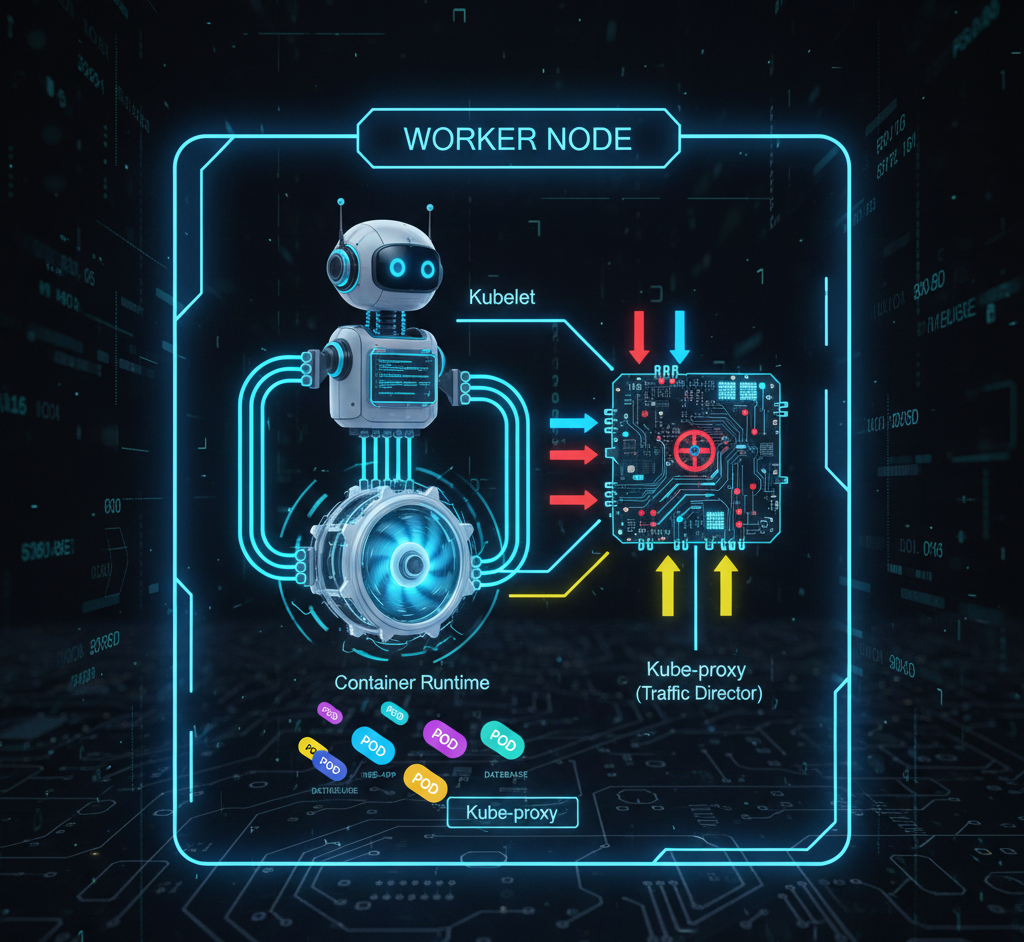
Flip to the workers: these nodes are the muscle, running your apps. Each has a Kubelet, a vigilant agent chatting with the control plane, ensuring Pods run as ordered. It's the node whisperer, handling health checks and restarts.
The Container Runtime (like containerd or Docker) actually spins up containers – the engine under the hood.
And Kube-proxy? It's the network ninja, managing service IPs, load balancing, and routing traffic to Pods. Without it, your services wouldn't discover each other seamlessly.
I've tuned these in high-traffic setups; optimize Kubelet for CPU/memory, and watch your nodes fly. It's satisfying when a cluster scales out during a traffic spike without you lifting a finger.
The Trade-offs: Is Kubernetes Right for You?
Kubernetes isn't all rainbows – let's talk real talk. Upsides? Scalability on steroids: auto-scale Pods, high availability with replicas across zones, portability across clouds. Self-healing mends failures, rollouts/rollbacks keep deploys safe. I've used it to handle Black Friday surges flawlessly.
Downsides? Complexity: setup is a beast, with YAML manifests that can feel like writing novels. Operations demand expertise – monitoring, logging, security aren't plug-and-play. It guzzles resources too; for tiny teams, it's overkill, like using a sledgehammer for a thumbtack.
From my vantage, weigh your scale: if you're solo or small, stick to simpler orchestration. But for growth? K8s pays dividends.
Managed Kubernetes Services: Easing the Pain
If raw k8s scares you, managed services are your friend. Providers like Amazon EKS, Google GKE, or Azure AKS handle the control plane – etcd, API server, all that jazz – so you focus on apps. They integrate seamlessly with their ecosystems, adding autoscaling and security goodies.
For mid-sized outfits, it's a perfect test drive: spin up a cluster, experiment without ops overload. Small teams? Embrace "YAGNI" – You Ain't Gonna Need It. Start simple; graduate when pain points hit.
I've migrated teams to GKE and seen productivity soar – less babysitting, more innovating. If you're dipping toes, managed is the way.
Conclusion
Wrapping up, Kubernetes has come a long way from Borg's shadows to dominating container orchestration. With its robust architecture – control plane smarts, worker grit, Pods as building blocks – it tames complexity for scalable, resilient apps. Sure, trade-offs exist, but managed services lower the barrier. As a dev who's lived the k8s life, I say: embrace it wisely, monitor relentlessly, and watch your systems thrive.