
Introduction
Ever hit "add to cart" on an e-commerce site during a flash sale, only to see it update instantly amid thousands of shoppers? Or sent a message in a group chat that pops up seamlessly for everyone? Behind these smooth experiences are key-value stores – simple yet powerful databases that map unique keys (like user IDs) to values (cart items or messages). But when you're dealing with terabytes of data and millions of requests per second, things get tricky. A single server? Forget it. These systems must distribute across thousands of machines without losing a beat.
Here's the thing: in our data-exploding world of 2026, where AI chats and real-time shopping drive everything, key-value stores like DynamoDB or Redis clusters are lifesavers.
They handle the chaos with clever tricks to spread data, ensure reliability, and resolve hiccups. You might wonder, how do they avoid total meltdown when a server crashes? In this post, we'll break it down: from the raw challenge of scale to tools like consistent hashing, eventual consistency, vector clocks, and gossip protocols. Whether you're a dev building the next big app or just geeking out on system design, stick around – you'll see why these stores are the unsung heroes of modern tech. Let's hash it out!
The Challenge of Scale in Key-Value Stores
Picture this: your shopping cart app suddenly goes viral, spiking to millions of users. One computer? It'd melt under the load – too much data, too many reads and writes. That's the scale challenge in distributed key-value stores: terabytes sprawling across servers, with requests flying in at blistering speeds.
Back in the day, simple databases buckled, forcing manual sharding that was a nightmare to manage. Frustrations mounted as adding servers meant reshuffling everything, causing downtime. Now, the fix is horizontal scaling: spread data across a cluster of machines. But how do you find the right server for a key without scanning everything? That's where the real magic – and engineering wizardry – kicks in. It's not just about size; it's about making massive systems feel lightweight and responsive, ensuring your chat message lands without a hitch.
Consistent Hashing: Smart Data Distribution Across Servers
Enter consistent hashing, the secret sauce for locating data efficiently in a sea of servers. Forget basic modulo hashing, where keys map directly to servers – adding one means remapping nearly everything, a data-moving disaster.
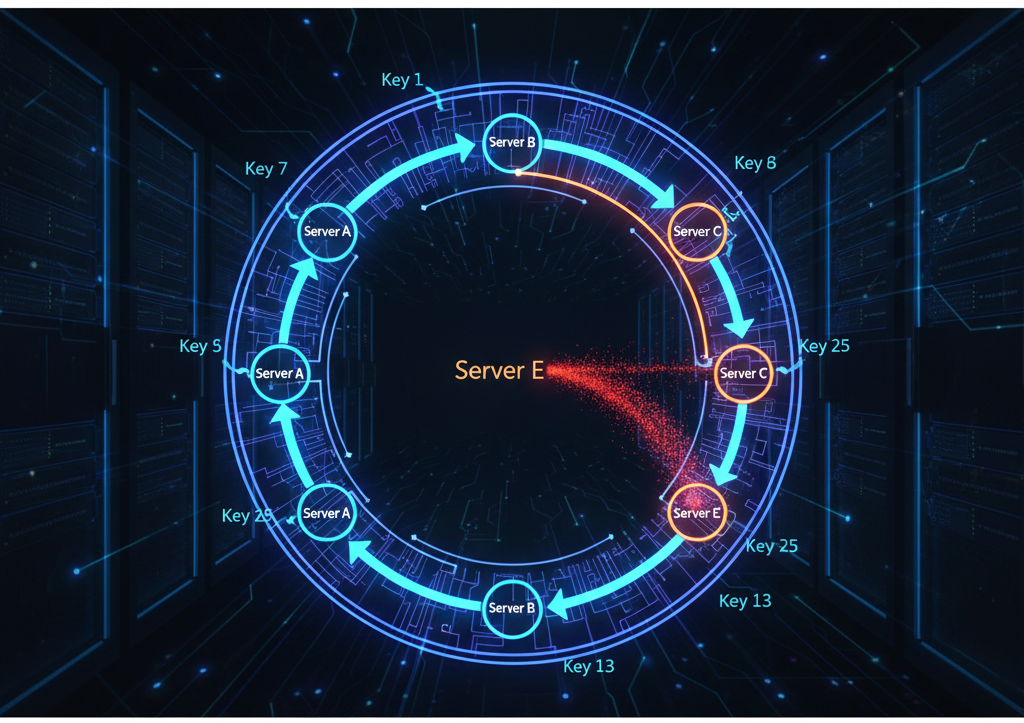
Instead, imagine a giant circle: keys and servers get hashed to points on it. To store a key, start at its position and go clockwise to the first server – that's your home. Need data? Reverse it. When you add a server, only a sliver of data shifts, minimizing chaos. It's like seating guests at a round table; newcomers squeeze in without upending the whole party.
This approach revolutionized key-value stores, powering apps like Netflix's recommendations. Pro tip: virtual nodes (multiple points per server) balance loads evenly. In 2026's cloud-native era, it's essential for seamless scaling.
Data Redundancy and Copies: Safeguarding Against Losses
No system is crash-proof, so key-value stores build in redundancy: each piece of data gets copies on multiple servers, say the next two clockwise on the hash ring. If one fails, others step up instantly.
Think of it as backing up your vacation photos in three spots – lose a drive, no sweat. This replication ensures availability without single points of failure. But it's not free: more copies mean more storage and sync overhead. Tune it right (e.g., replication factor of 3), and you strike a balance between safety and efficiency. For chat apps, this means your messages persist even if a server naps.
Consistency vs. Availability: The CAP Theorem Trade-Off
Here's a tough truth from distributed systems: you can't have it all. The CAP theorem nails it – pick two out of Consistency (everyone sees the same latest data), Availability (system always responds), and Partition Tolerance (handles network splits).
For banking, consistency rules: refuse requests if data's unclear, even if it means brief unavailability. But for web apps like shopping carts? Availability wins – serve what you have, even if slightly stale, to keep users happy. Chat messages lean eventual consistency here, prioritizing uptime over perfection. You might ask, why compromise? Because networks fail, and rigid consistency could tank your app. In practice, most key-value stores favor AP (availability + partition tolerance) for real-world resilience.
Eventual Consistency: Harmony Over Time
Eventual consistency is the pragmatic middle ground: updates propagate eventually, so copies might differ briefly, but given time (and no new conflicts), they sync up. It's like gossip in a small town – stories spread, and soon everyone's on the same page.
This model shines in high-throughput scenarios, like social feeds, where a second's delay is fine. Drawbacks? Rare inconsistencies need handling, but the speed gains are huge. Systems like Cassandra embody this, making them darlings for massive, write-heavy apps.

Handling Conflicts with Vector Clocks
Conflicts happen – two users edit the same cart item simultaneously. Vector clocks save the day: each update gets a "version tag" with timestamps from involved servers, like a family tree of changes.
Compare clocks to spot causality: if one descends from the other, it's the winner. Ties? Merge automatically (e.g., union sets), flag for user resolution, or timestamp-resolve. It's smarter than simple last-write-wins, reducing lost updates in chats or carts.
This elegance lets key-value stores handle concurrency without central bottlenecks, a boon for collaborative apps.
Server Failure Detection with Gossip Protocol
Servers die – hardware glitches, networks hiccup. Enter the gossip protocol: each server whispers its "known dead/alive" list to random neighbors periodically, like rumors rippling through a crowd.
Soon, everyone knows who's down, enabling quick handoffs. It's lightweight, scalable (no central coordinator), and fault-tolerant – even if some gossip fails, the info spreads. Amazon's Dynamo popularized this for key-value resilience.
You might wonder, does it miss failures? Rarely, thanks to tunable intervals. In 2026's edge computing, it's vital for always-on experiences.

Conclusion
Key-value stores aren't just databases; they're the resilient backbone for scaling shopping carts, chats, and beyond. From consistent hashing's efficient distribution to gossip's failure whispers, they've mastered massive data's chaos while juggling consistency and availability. As we push AI-integrated apps in 2026, these concepts will only grow in importance.