Introduction
Ever clicked a link and wondered if your data's zipping safely across the net, or if some eavesdropper's peeking in? As a developer who's hardened countless apps against threats, I can tell you: HTTPS is your best friend in that fight. It's HTTP on steroids, wrapping your traffic in encryption to keep prying eyes out. Without it, you're basically shouting your secrets in a crowded room. In this era of rampant cyber risks, understanding HTTPS isn't optional – it's essential for building trust and compliance.
Here's the thing: I've debugged enough man-in-the-middle scares to know TLS (Transport Layer Security) is the real hero here, turning plain text into gibberish for interceptors. We'll cover HTTP's weak spots, how HTTPS layers on TLS, the nitty-gritty of TLS 1.2 handshakes, why symmetric encryption rules the day, TLS 1.3's speed tweaks, and modern key exchanges. No fluff – just the mechanics with tips from the trenches. If you've ever puzzled over that green padlock or wrestled with certs, this'll clarify it. Let's encrypt this knowledge!
The Problem with Plain Old HTTP
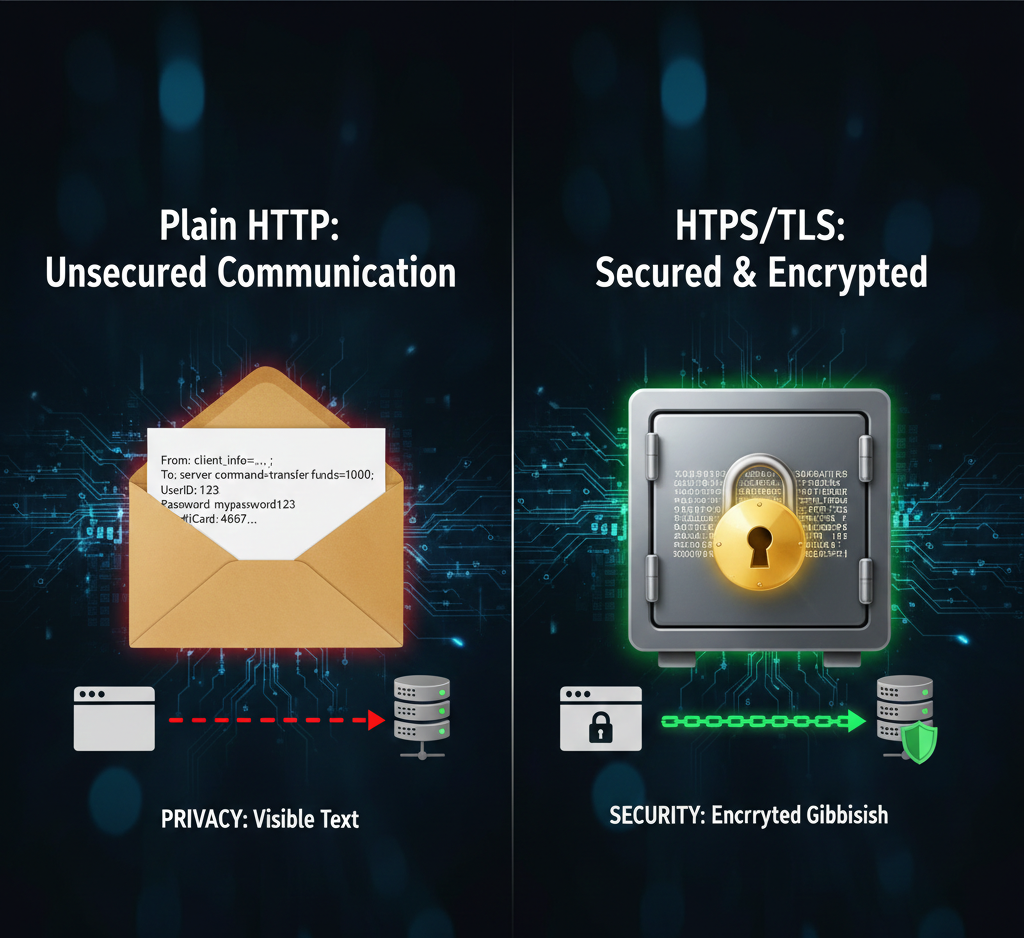
Let's start with the villain: vanilla HTTP. It ships data in plain text, like sending postcards instead of sealed envelopes. Anyone on the path – ISPs, hackers on public WiFi – can snag and read it. Credit cards, logins, personal deets? All fair game for interception.
In my early web dev days, I ignored this until a demo got MITM'd – embarrassing and educational. HTTPS fixes it by encrypting via TLS, turning readable streams into "jumbo data" gobbledygook. If snagged, it's useless without keys. Simple concept, massive impact – it's why every site worth its salt mandates it now.
HTTPS and TLS: The Secure Duo
HTTPS is essentially HTTP with a security blanket: TLS. It encrypts the conversation end-to-end, ensuring only the browser and server understand it. TLS evolved from SSL (remember those warnings?), but it's the standard today for confidentiality, integrity, and authentication.
From experience, implementing HTTPS means certs from authorities like Let's Encrypt – free and easy. Without TLS, your app's a sitting duck; with it, you're armored. It's not just protection; it's performance too, as search engines favor secure sites.
The TLS Handshake in TLS 1.2: Establishing Trust
The magic starts with the TLS handshake – a quick negotiation to set up encryption. It's like a secret handshake before chatting securely. In TLS 1.2, it's four steps:
First, TCP connection: Browser dials the server on port 443 for a reliable link.
Then, Hello phase: Client sends "client hello" with supported TLS versions and cipher suites (encryption recipes). Server replies "server hello," picking the best match and sharing its cert (with public key). This cert, signed by a CA, proves the server's legit – I've chased down expired cert issues more times than I'd like.
Key exchange: Client whips up a session key, encrypts it with the server's public key (RSA example), and sends it over. Server decrypts with its private key – now both have the shared secret.
Finally, secure channel: They switch to symmetric encryption with that key for the real data flow. Handshake done, traffic's locked down.
Pro tip: Monitor handshake times; bottlenecks here kill user experience.
Why Symmetric Encryption for the Heavy Lifting?
Asymmetric encryption (public/private keys) is great for the handshake – secure key swap without prior sharing. But it's a CPU hog, slow for big data.
Enter symmetric: both sides use the same key for encrypt/decrypt, lightning-fast for bulk transfers. I've optimized apps by ensuring symmetric ciphers like AES handle the payload – it's why HTTPS feels snappy despite overhead.
TLS 1.3 Improvements: Faster and Safer
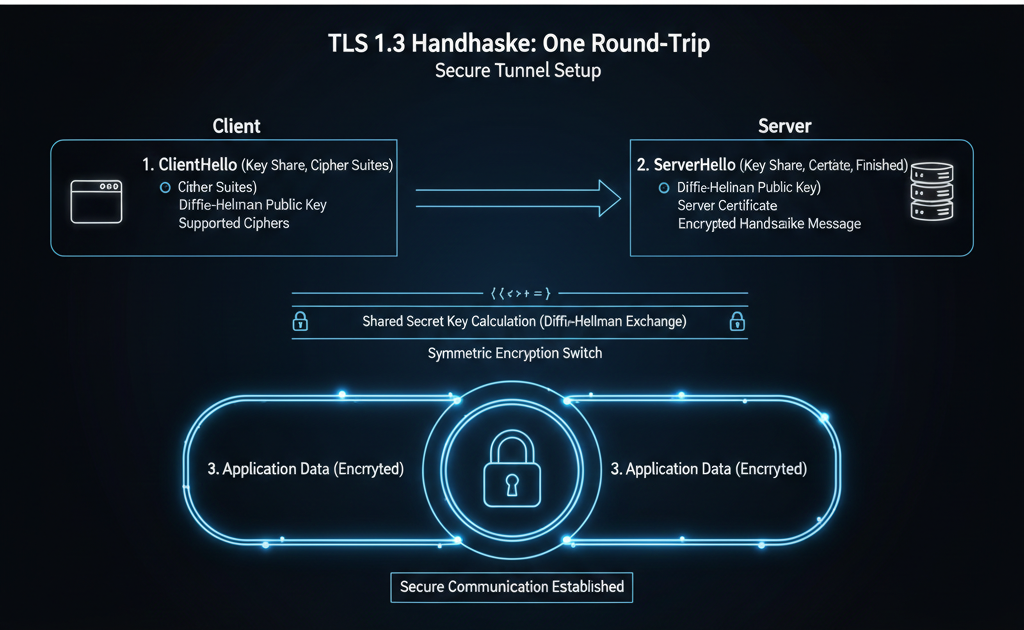
TLS 1.3 streamlines it all, slashing the handshake to one round-trip from two in 1.2. Fewer messages mean quicker connections – vital for mobile or IoT.
It ditches weak ciphers, mandates forward secrecy, and resists downgrade attacks. In upgrades I've led, 1.3 shaved milliseconds off latencies, boosting SEO and satisfaction.
Key Exchange Methods: Beyond RSA
While RSA illustrates nicely, modern TLS (especially 1.3) favors Diffie-Hellman for key exchange. It's ephemeral – keys generated per session, no public key transmission needed. Provides perfect forward secrecy: compromise one key, past sessions stay safe.
I've switched to DH in configs for that extra paranoia – worth it for sensitive data.
Conclusion
HTTPS via TLS turns the wild web into a fortified fortress, from vulnerable plain text to ironclad encryption. Handshakes build trust, symmetric handles the haul, and evolutions like 1.3 keep it zippy. As a dev who's enforced HTTPS everywhere, I say: implement it early, monitor certs, and sleep better. The web's safer for it.