
Introduction
Imagine running a global e-commerce platform where millions of users browse, buy, and review in real-time – how does it stay snappy without buckling under the data deluge? That's the magic of data management and scalability in distributed systems, the unsung heroes enabling everything from cloud databases to AI backends. These patterns slice, dice, and distribute massive data volumes, turning potential chaos into efficient operations.
Here's the thing: in 2026's data-saturated world, systems must juggle terabytes while delivering sub-second responses. Without smart strategies, you'd face bottlenecks, crashes, and sky-high costs. You might wonder, how do giants like AWS or Google pull it off? This post dives into the core concepts: partitioning for manageability, sharding for distribution, indexing for speed, replication for reliability, caching for low latency, CDNs for global reach, and scalability principles. We'll top it off with engineering wisdom to implement them wisely. Whether you're architecting the next big app or optimizing an existing one, these insights will level up your game. Let's partition the knowledge!
The Core Challenge: Handling Massive Data in Distributed Systems
Think of data as a sprawling city: too big for one mayor, it needs districts and infrastructure. The challenge? Massive volumes overwhelm single nodes, demanding patterns that boost performance and scalability. Pre-these techniques, systems lagged or failed during peaks, frustrating devs and users alike.
The breakthrough? Dividing and conquering data intelligently, ensuring even loads and quick access. This foundation powers high-scale systems, from social feeds to financial ledgers, proving that smart data management isn't optional – it's essential for survival in distributed environments.
Data Partitioning: Breaking Down Data for Better Management
Data partitioning kicks things off by carving large datasets into bite-sized pieces. It's like organizing a massive library: group books logically for faster finds. This optimizes queries and scales horizontally, reducing hotspots.
Vertical partitioning splits tables by columns – stash frequently hit "hot" data (like user names) separate from "cold" archives (like old logs). It slims queries, cutting I/O. Horizontal partitioning divides by rows via a partition key, say user ID or region, ideal for shardable attributes like price ranges. Pick wisely: mismatched keys lead to imbalances. In practice, it's the first line of defense for growing databases, ensuring your system breathes easy as data swells.

Database Sharding: Distributing Data Across Servers
Take partitioning up a notch with database sharding: spread those segments across independent servers or instances. It's horizontal partitioning on steroids, turning one bloated DB into a fleet of nimble ones. Why? To conquer scale where a single machine falters.
Strategies vary: Hash-based sharding scatters data evenly via key hashes, but range queries suffer – imagine searching prices without order. Range-based shines there, grouping by attributes like dates, yet risks hotspots (e.g., all new users in one shard). Directory-based uses a lookup service for flexibility, mapping keys to shards dynamically – more complex, but adaptable. Real-world wins? Netflix shards user data by ID, keeping queries zippy. Choose based on your access patterns to avoid the pitfalls of uneven loads.
Database Indexing: Accelerating Queries with Smart Structures
Queries grinding to a halt? Enter database indexing – auxiliary maps that point straight to data, like a book's index skipping the skim. They trade space and write time for read speed, crucial in distributed systems.
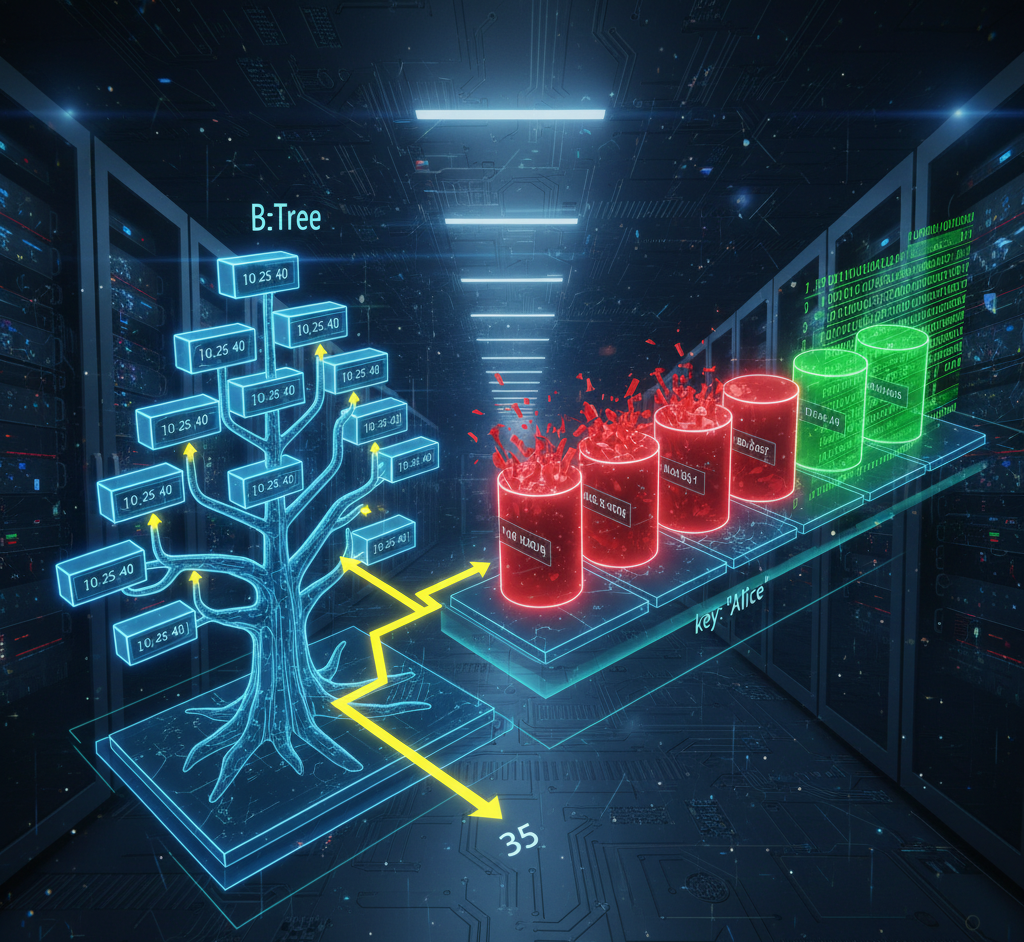
Types abound: B-tree indexes sort data for efficient range queries and point lookups, the go-to for most RDBMS. Hash indexes offer O(1) key access but skip ranges – great for exact matches. Bitmap indexes excel on low-cardinality fields (e.g., gender), compressing for quick scans. Inverted indexes power full-text search, flipping words to document pointers, like Google's backbone. Balance them: over-indexing bloats storage, under-indexing slows searches. In high-scale apps, they're the turbo boost keeping latency low.
Replication: Boosting Reliability and Read Scalability
What if a server crashes mid-transaction? Replication copies data across nodes, ensuring fault tolerance and read boosts. It's like having backups on speed dial, scaling reads without write bottlenecks.
Approaches: Single-leader funnels writes to one master, syncing to followers – simple, but single-point risk. Multi-leader allows writes anywhere, needing conflict resolvers for consistency. Leaderless spreads writes via quorums, using read repairs for eventual sync – think Cassandra's resilience. Tune replication factors (e.g., 3 copies) for your availability needs. In distributed systems, it's the safety net that keeps data alive and accessible, even in outages.
Caching: Low-Latency Access for Frequent Data
Caching is the express lane: stash hot data in fast storage (RAM or SSD) to dodge slow DB hits. It slashes latency and eases backend strain, vital for user-facing apps.
Strategies: Cache aside (lazy loading) checks cache first, loads from DB on miss, and populates – flexible but risks stale data. Write-through updates cache and DB sync, guaranteeing freshness at write cost. Write-behind caches writes async, boosting speed but risking loss on crashes. Tools like Redis shine here. Pro tip: Eviction policies (LRU) keep it fresh. In scalable systems, caching turns sluggish queries into instant wins.

Content Delivery Networks (CDNs): Global Speed Through Proximity
For worldwide users, CDNs are the geographic equalizer: cache content on edge servers near requesters, minimizing hops and latency. It's like local warehouses for online shopping – faster delivery, less central load.
They handle static assets (images, videos) and dynamic too, with smart routing. Benefits? Bandwidth savings, DDoS protection, and seamless scaling. In distributed systems, CDNs like Cloudflare ensure your app feels local everywhere, boosting user satisfaction.
Scalability: Measuring and Achieving Growth
Scalability gauges how your system grows with resources – linear is ideal (double servers, double throughput), but sublinear hits from contention (locks) or coherence (sync overhead). Factors: Amdahl's Law highlights bottlenecks.
Engineer smart: Start simple, instrument everything (metrics, logs), weigh ops overhead, and balance consistency/availability/latency. These principles guide from prototype to production, ensuring your distributed system scales gracefully.
Conclusion
Data management and scalability patterns are the bedrock of thriving distributed systems, taming massive data with partitioning, sharding, indexing, replication, caching, CDNs, and thoughtful scaling. From vertical splits to quorum writes, they deliver efficiency and resilience. As tech evolves in 2026, embracing these with solid engineering – simplicity, monitoring, trade-off awareness – will future-proof your builds.
Ready to shard? Experiment with tools like PostgreSQL partitioning. What's your scalability war story – share below!