
Introduction
I still remember the first time I watched an autonomous agent book a flight, update a Notion page, and notify the team without any human intervention. That moment made me realize: we are no longer writing step-by-step code; we are giving systems goals and guardrails.
As a principal engineer who has built production agent systems for fintech, healthcare, and developer tooling in 2025–2026, I can confidently say that AI agents are the most significant evolution in software architecture since the rise of microservices. This post gives you the deep, practical understanding you need to design, evaluate, and deploy them effectively.
Traditional Software vs AI Agents: A Fundamental Shift
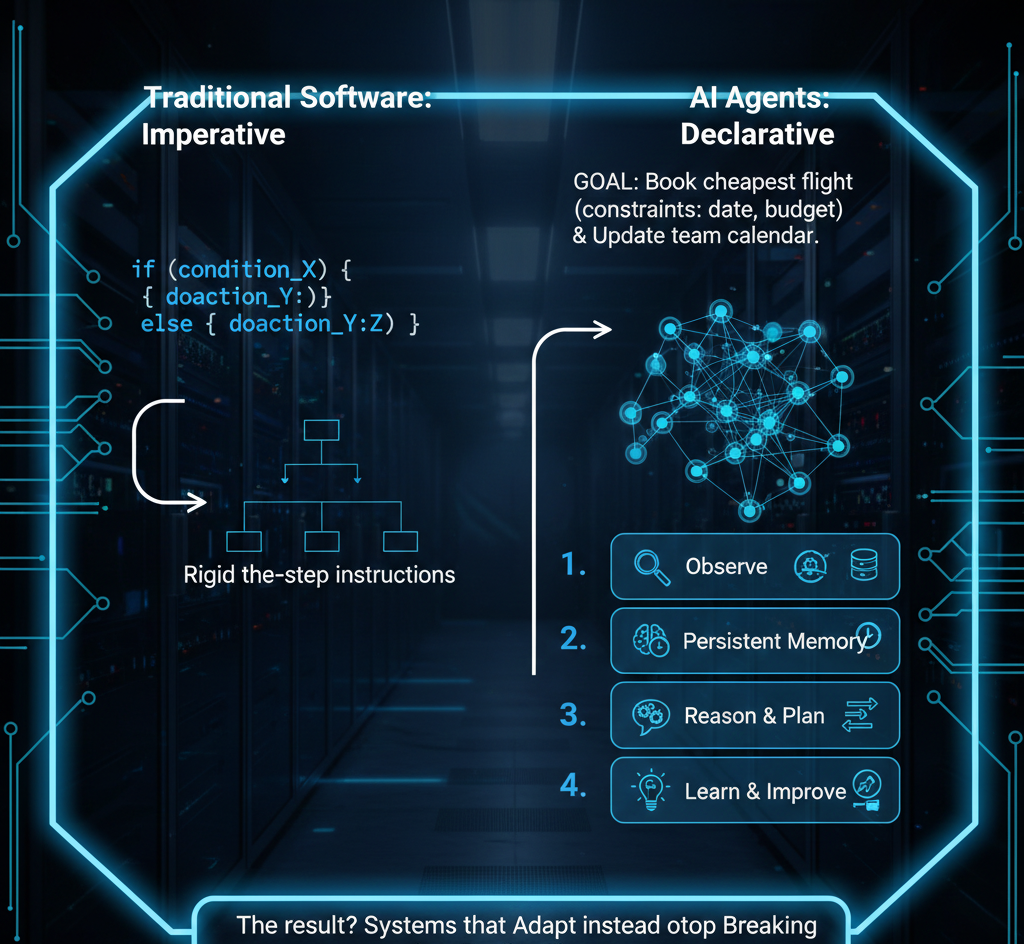
Traditional software is imperative — you define exact steps: “if X, then do Y.” AI agents are declarative — you define the goal: “Book the cheapest flight that meets these constraints and update the team calendar.”
This shift brings four game-changing differences:
- Agents continuously observe their environment (tools, APIs, databases, user input)
- They maintain persistent memory across sessions
- They reason and plan multi-step actions
- They learn and improve from feedback (human or automated)
The result? Systems that adapt instead of breaking when reality changes.
Foundational Capabilities of Modern AI Agents
1. Autonomy Spectrum
Agents exist on a continuum:
- Recommendation-only (suggest next action)
- Semi-autonomous (act after human approval)
- Fully autonomous (act within defined guardrails)
In 2026 production systems, most successful deployments sit in the “human-in-the-loop” or “human-on-the-loop” zone for safety and compliance reasons.
2. Persistent & Multi-Tier Memory
Modern agents use layered memory:
- Short-term (conversation history in context window)
- Long-term (vector stores like Pinecone, Weaviate, or PGVector)
- Procedural memory (learned skills stored as fine-tuned LoRAs or tool libraries)
- Episodic memory (past successful/failed trajectories)
The best agent frameworks (LangGraph, CrewAI, AutoGen) let you configure different memory backends per agent.
3. LLM as Reasoning Engine + Tool Use
The LLM is no longer just a text generator — it’s the brain that decides:
- What to do next
- Which tool to call
- How to format the output for the next step
Tool calling (function calling) has become the standard interface. Every major provider (OpenAI, Anthropic, Google, Grok) now supports structured tool definitions.
4. Integration Layer
Agents don’t live in isolation. They orchestrate:
- APIs & REST/gRPC endpoints
- Databases (SQL/NoSQL)
- File systems (via secure MCP servers)
- Other agents
- External services (email, calendars, CRMs)
This is where protocols like Anthropic’s Model Context Protocol (MCP) become critical — they standardize how agents discover and use external capabilities.
The Five Types of AI Agents (With 2026 Examples)
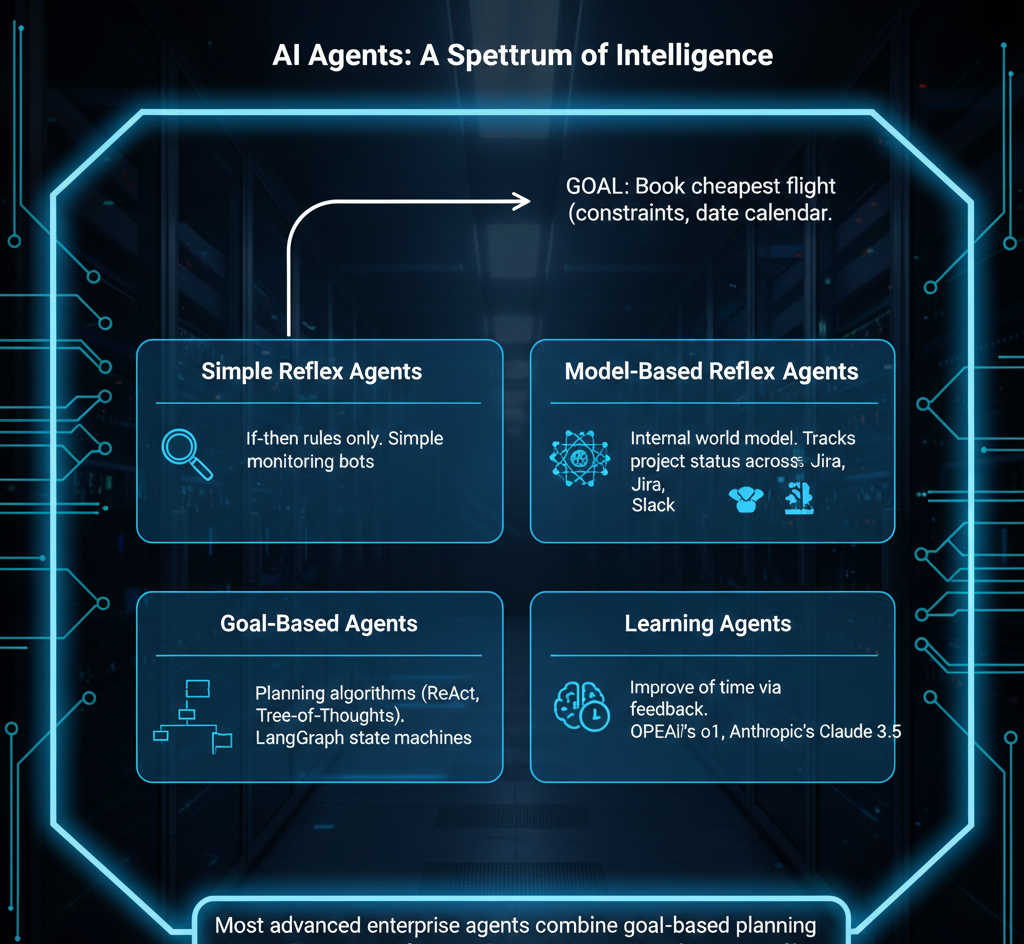
- Simple Reflex Agents If-then rules only. Still useful for simple monitoring bots.
- Model-Based Reflex Agents Maintain internal world model. Example: an agent that tracks project status across Jira, GitHub, and Slack.
- Goal-Based Agents Use planning algorithms (ReAct, Plan-and-Execute, Tree-of-Thoughts). LangGraph’s state machines are the gold standard here.
- Learning Agents Improve over time via reinforcement learning or human feedback. OpenAI’s o1 reasoning models and Anthropic’s Claude 3.5 “computer use” are early examples.
- Utility-Based Agents Calculate expected value of different action paths. Most advanced enterprise agents combine goal-based planning with utility scoring for cost/latency/quality trade-offs.
Architectural Patterns in Production (2026)
- Single-Agent Architecture — Personal assistant style (e.g., Cursor Composer, Claude Projects)
- Multi-Agent Systems — CrewAI, AutoGen, LangGraph multi-agent workflows, OpenAI Swarm. Specialized agents (researcher, writer, critic, executor) collaborate.
- Human-Machine Collaborative Architecture — The sweet spot for regulated industries. Agents propose, humans approve or steer. This is where most Fortune 500 deployments sit today.
Real-World Challenges & Best Practices
- Hallucinations & Reliability — Use ReAct + self-critique loops + tool validation
- Cost Control — Token budgeting, hierarchical agents, caching, shorter context when possible
- Security — Sandboxed execution, MCP-style scoped access, audit logs
- Observability — Trace every reasoning step (LangSmith, Phoenix, Helicone)
- Evaluation — Agent-specific metrics: success rate, cost per task, latency, human intervention rate
Conclusion
AI agents are not just the next feature — they are the new operating system layer for intelligent applications. The shift from imperative code to goal-directed, autonomous systems is as profound as moving from bare metal to cloud.
If you’re still building everything with traditional request-response APIs in 2026, you’re already behind.
The teams winning right now are those that treat agents as first-class citizens in their architecture.